LONDON: The iron ore market is on a roll again.
After a brutal price collapse that saw benchmark ore with 62 percent iron content collapse to a three-year low of $ 87 per ton in September last year, the market has since staged a turbo-charged recovery, hitting 15-month highs above $ 158 per ton last week.
Iron ore’s spectacular bounce is in stark contrast to other industrial metals such as copper, which perked up on the first day of trading in 2013 only to slide back into a well-trodden trading range.
The strength of this rally has been a direct consequence of the previous slump, China’s massed ranks of steel producers switching from de-stocking to restocking mode.
That says much about their renewed sense of optimism about Chinese steel demand this year.
But this rally also says a lot about iron ore supply, an ingredient in the bull mix that could yet come back and bite the market.
De-stocking was the single most important driver of last year’s price rout.
As Chinese steel demand flagged, unsold product stocks rose and steel prices fell, steel mills collectively exited the spot market and drew down both their own iron ore stocks and those at Chinese ports.
A less visible but no-less powerful accelerator of the process was the tightening of credit by many Chinese banks after a string of scandals related to collateral financing of steel stocks, some of which turned out to be non-existent.
The process has turned full circle over the course of the last couple of months with Chinese mills restocking just as fast as they de-stocked.
There is a certain seasonality at work here as steel producers beef up their stocks chain in expectation of an acceleration in demand after the Lunar New Year holiday period, which falls in February this year.
But normal seasonality is being given extra oomph by rising domestic steel prices, alleviating the margin compression that beset the sector over the middle of last year.
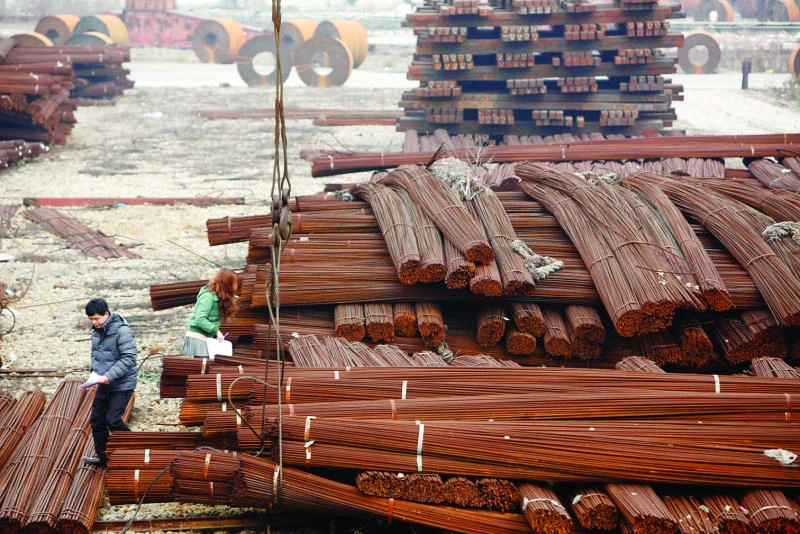
Shanghai rebar futures have gained nearly 15 percent since early December, itself a remarkable performance since rebar is used primarily in construction and activity in this sector is itself seasonal, dropping off over the winter months.
That speaks to the collective optimism in the Chinese steel market that government infrastructure spend is going to kick in after the New Year holidays.
All this has been happening just at a time when iron ore supply has dwindled, amplifying the rally.
China is experiencing its harshest winter in nearly three decades, decimating iron ore production in the country’s northern provinces.
Many smaller operators closed when the price slumped back in September but it is cold weather conditions that have kept them closed.
Don’t expect this drop in domestic production to show up in the official iron ore production figures. Many of China’s small, privately-owned operators fall beneath the official statistical radar.
But the likes of Henry Liu, head of commodities research at Mirae Asset Management, estimate that up to 15 percent of China’s iron ore mines are currently out of action.
It would certainly help explain why China’s imports of iron ore surged to an all-time monthly high of 71 million tons in December.
But international supply is itself about to enter its most challenging time of the year with production in both Brazil and Australia, China’s top two suppliers, liable to disruption from heavy rain and cyclones respectively.
Vale, Brazil’s top producer, has not been offering cargoes into the spot market over the last couple of weeks, according to analysts at Macquarie Bank, who note that “this is standard into Q1 which is a disruption period, and makes sure contract customers receive their needs.”
And, right on cue, the Australian port of Dampier, which handles close to a fifth of the world’s seaborne iron ore trade, has just experienced its first closure of the cyclone season, albeit only a limited two-day one.
All the time exports from India, which has historically been China’s third-largest supplier, continue to fall due to that country’s clampdown on illegal mining.
Chinese imports of Indian ore were just 155,000 tons in November. Even last year when the Indian authorities’ battle with its iron ore operators was already in full swing, imports averaged over six million tons per month.
It is possible that one of the accelerators in this iron ore rally has been speculative buying in anticipation of more seasonal disruption among the world’s largest producers.
So what happens next?
The broad consensus among analysts is that the iron ore price rally has been just a bit too turbo-charged and some sort of correction is overdue.
If nothing else, restocking is itself a finite process.
Macquarie, for example, cites figures from Chinese consultancy Mysteel, showing that iron ore stocks at 50 smaller Chinese steel mills have recovered from a threadbare 17 days’ worth of supply in September to over 33 days at the end of last week.
If symptomatic of a broader trend, it suggests that the restocking impetus may soon fade.
Macquarie itself is taking a benign view of any likely price pullback, sticking to its forecast that prices will average $ 140 per ton over the first quarter.
Underpinning that assessment is an assumption that Chinese steel mills will crank up production after the Lunar New Year holidays as both end-user demand and prices recover further.
That, the bank argues, will require domestic iron ore suppliers to be incentivized to turn back on the taps.
The wild card, however, is how quickly and forcefully they do so and how the “usual” seasonal disruption in Australia and Brazil pans out.
Indian supply is an even wilder card, particularly in light of the first shipment of iron ore from Goa since mining was banned in the state last October.
So which will it be? Gentle price moderation or another plunge on the iron ore roller-coaster?
Supply will be as important a part of the answer as Chinese steel demand.
— Andy Home is a Reuters columnist. The opinions expressed are his own.
Iron ore rally is about supply too