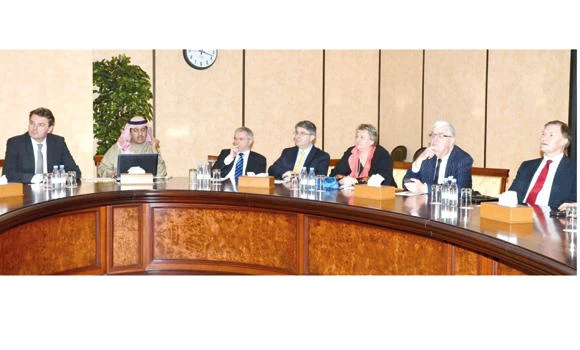
Members of the British Parliament discussed with the Saudi International Trade Commission (ITC) here last week the need to overcome the obstacles facing the increase of trade exchanges and investment flow between Saudi Arabia and Britain.
According to the Saudi side, the volume of trade exchange between the two countries neither reflects the strong will of the political leadership in both countries to strengthen economic cooperation nor does it meet the aspirations of the business segments in the two countries.
This has prompted the ITC of the Council of Saudi Chambers (CSC) to showcase Saudi Arabia’s potential and discuss the matters with the British parliamentary delegation headed by MP Daniel Robert Kawczynski of the Conservative Party who is also chairman of the Saudi British Friendship together with deputies from the British Conservative Party.
The high profile meeting held at CSC’s headquarters was also attended by representatives from the Saudi embassy in London and the Shoura Council.
They discussed aspects of cooperation in trade and investment, and how to bolster the relations between the two countries in these areas. In his welcome address, ITC Secretary General Omar Bahlaiwa stated that the volume of trade exchange between the two countries leaves a lot of room for further expansion.
While noting the strategic partnership between the two countries, especially in the fields of economy, he said the economic cooperation does not reflect the aspirations of the business segments in the two countries.
He stressed the need to overcome the obstacles facing the increase of trade exchanges and investment flow between the two countries. He also called on Britain to take advantage of investment opportunities arising in the wake of Saudi projects.
Bahlaiwa called for strengthening cooperation with Britain in the field of technical expertise related to small and medium enterprises (SMEs), citing the highly experienced UK in the SMEs sector. This would contribute to the competitiveness of this sector in the Saudi economy, he said.
According to him, there are 1.3 million SMEs in the Kingdom. He said the exchange of bilateral visits would be in their mutual interest. Bahlaiwa also lauded the institutional role played by the Saudi-British Business Council in building bridges of cooperation between the two countries.
He observed that their focus should be on value added projects leading to technology, rehabilitation techniques and manpower training.
The delegation watched a presentation on the strength of the Saudi economy in terms of GDP growth, the size of the budget, liquidity growth and the presence of a quarter of the world’s oil reserves. The Saudi economy is the largest in the Middle East and among the top 20 global economies.
The presentation also showed Saudi Arabia as an attractive investment option because of its market size, the political and economic stability and market openness in addition to the availability of energy and raw materials.
Besides, Saudi Arabia does not impose personal income taxes on individuals. It provides a strong infrastructure in addition to the presence of investment opportunities and foreign direct investments estimated at billions of dollars in many sectors such as housing energy, water, petrochemicals, technology, education, health and agriculture.
In response, the head of the British delegation expressed his country’s interest in strengthening the trade relations between the two countries and promised to bring the standpoint of the Saudi side to the British officials and urge them to increase interest in Saudi Arabia as a strategic partner.
He also acknowledged Saudi Arabia as an important player in the region and to work to enhance Britain’s role in the transfer of technology and knowledge to the Saudi market and increase access of British companies into promising investment opportunities in the Kingdom.
ITC talks with British MPs on trade