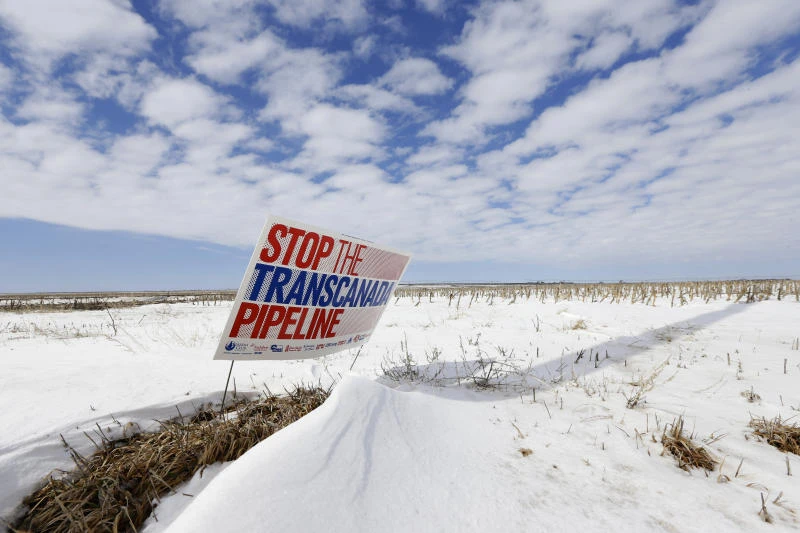
WASHINGTON: The Obama administration is extending indefinitely the amount of time federal agencies have to review the Keystone XL pipeline from Canada, the State Department said, likely shifting the decision over the controversial oil project until after the midterm congressional elections late this year.
The project, proposed by Canadian company TransCanada, has become a proxy for a larger battle between environmental activists and energy advocates over climate change and the future of American energy. It's also become an issue of concern in Canada, which has long pushed for approval of the pipeline.
A spokesman for Prime Minister Stephen Harper called the US decision a political one.
"We are disappointed that politics continue to delay a decision on Keystone XL," Jason MacDonald said in an email.
Foreign Affairs Minister John Baird spent several days in Washington recently pleading for a decision soon, arguing that it would be unfair to keep construction workers and the industry waiting as the building season approached.
The State Department has jurisdiction on the issue because the pipeline would cross an international border.
In a rare display of bipartisanship, prominent Democrats from energy-dependent states joined Republicans in blasting the Obama administration for delaying the decision once again. Senate Minority Leader Mitch McConnell, a Republican, accused Obama of kowtowing to "radical activists" from the environmental community. Democratic Sen. Mary Landrieu called the decision "irresponsible, unnecessary and unacceptable."
The State Department didn't say how much longer it will give agencies to weigh in but cited a recent decision by a Nebraska judge that overturned a state law that allowed the pipeline's path through the state, prompting uncertainty and an ongoing legal battle. Nebraska's Supreme Court isn't expected to rule for another several months, and there could be more legal maneuvering after that.
The delay potentially frees President Barack Obama to avoid making a final call on the pipeline until after the November election.
"The agency consultation process is not starting over. The process is ongoing, and the department and relevant agencies are actively continuing their work in assessing the permit application," the State Department said in a statement.
The 1,179-mile (1,890-kilometer) pipeline would travel through Montana and South Dakota to a hub in Nebraska, where it would connect with existing pipelines to carry more than 800,000 barrels of crude oil a day to refineries in Texas.
Keystone XL pipeline review is delayed