RIYADH: China’s One Belt, One Road initiative for Asia-Europe rail freight could deal a big blow to the existing Asia-Europe air cargo traffic.
SEZ Khorgos-East Gate is located near the Kazakh-Chinese border. The project includes the Khorgos international center for cross-border trade, a dry port and industrial zones.
The Kazakh-Chinese terminal at the port of Lianyungang will handle 250,000 TEUs (twenty foot equivalent units). The ongoing work on the creation of a logistics center will enable it to handle up to two million TEUs.
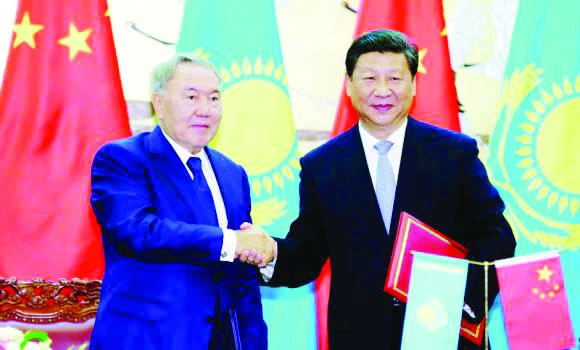
The groundwork for this landmark movement was laid on Aug. 31 in Beijing when Chinese President Xi Jinping and Kazakh President Nursultan Nazarbayev signed an agreement to build stronger ties between their countries.
Subsequently, on Sept. 3, Xi welcomed Nazarbayev to China for his state visit to participate in the country’s V-Day celebrations.
Xi called for improved bilateral cooperation in capacity building, investment, trade, energy, infrastructure and high technology. He also pitched in for making full use of financing mechanisms such as the Asian Infrastructure Investment Bank (AIIB) and the Silk Road Fund.
The AIIB has an initial capitalization of $50 billion, while the latter has a development fund of $40 billion.
John Lin, director of the Shanghai International Shipping Institute, said the initiative supported two key policy objectives of China.
“From my point of view, the central government is using this campaign to kill two birds with one stone. The first is to raise the political and commercial influence in neighboring countries in Asia, as well as Africa and Europe.
“The second is to sustain the steady growth of the Chinese economy by mobilizing, reallocating and transferring the surplus production power of Eastern China to Western China and to the neighboring poorer countries.”
To this end, China is planning to invest $600 million in joint logistics projects with Kazakhstan Railways (KTZ) over the next five years for the development of Khorgos-East Gate special economic zone (SEZ), reports Think Railways.
Khorgos Gateway, a new free-trade zone on the Kazakhstan-China border, represents a good example of China’s drive to connect its inland provinces with central Asia and Europe by land. The growth in rail freight will check the air cargo traffic as overland transit time and costs fall.
“I don’t see rail really competing with ocean but definitely with air. We think it will take one percent possibly of sea freight but maybe up to 10 percent of the air freight,” said Darryl Hadaway, chief financial officer of NVOCC startup Silk Route Rail.
He said that with the opening of Khorgos, shippers could operate a hub-and-spoke system for Asia-Europe rail cargo, since the DP World-run facility would be consolidating cargo from across China onto block-trains with single destinations. Silk Route Rail is planning to take advantage of this by taking ownership of containers to serve multiple customers with time-definite, two-way services.
Khorgos Gateway Deputy Chief Executive Hicham Belmaachim explained that the project, which combines a dry port with logistics and industrial zones, would benefit shippers looking for an alternative to established sea and air networks.
He said: “The main difference with Khorgos is that we have a container yard to store boxes coming from different Chinese provinces, which is something new for this region. By storing containers to prepare block-trains with single destinations, you will improve frequency and regularity and it will be much faster.”
Khorgos Gateway will also allow shippers and their freight service providers to load and unload containers in a demarcated area that includes an industrial zone for manufacturers seeking to benefit from duty-free exports to Russia.
“We’re providing land so factories can produce cargo with the stamp ‘Made in Kazakhstan,” said Belmaachi. “The main advantage of this is that when you produce here you are able to enter the whole customs union area, including Russia, duty-free.”
Although Khorgos Gateway is funded by the Kazakhstan government, it demonstrates how China’s One Belt, One Road initiative is helping coordinate the growth of previously underdeveloped trade routes.
The policy is an attempt by China to connect 65 countries via land, sea and rail through transport infrastructure investments totaling $50 billion, which could eventually add $2.5 trillion to China’s trade over the next decade. This is more than the value of China’s total exports in 2013 and represents a new gateway to growth and development.
Khorgos set to become China’s Silk Route to Asia-Europe