JEDDAH: Saudi Arabia's economic strength is very high, supported by a track record of strong growth, according to top economists and financial analysts.
"We have the opportunity, but what we need is good management in order to bring up our economy to the level it deserves," said Sami A. Al-Nwaisir, chairman of Al-Sami Holding Group.
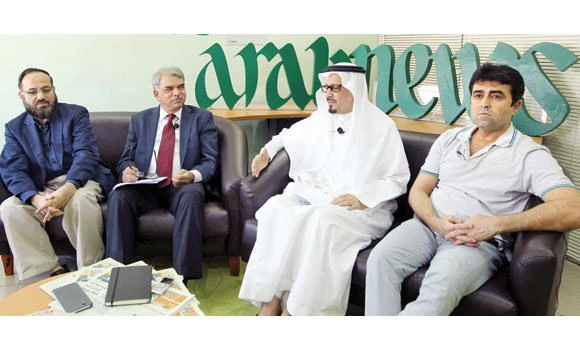
He made these remarks during an Arab News Business Dialogue that took place at Arab News headquarters themed "S&P Evaluation of KSA Economy: Is It Backed by Reality?"
Standard & Poor’s (S&P) recently lowered the rating of Saudi Arabia to "A+" from "AA-" with a negative outlook.
The latest rating assessment has focused more on the oil price decline and its implication on the fiscal account over the coming few years while less attention has been paid to other economic fundamentals.
This was the consensus of the dialogue participants.
The rating decision seems motivated more by the oil price, principally, and their bearish view of oil through 2018, than the reality on the ground. The economy is still on solid grounds even if oil revenues are on the decline, said a leading economist.
The assessment will not have any short-term material impact for Saudi Arabia. This will not affect domestic financing costs, said another.
The assessment is certainly not good news for Saudi capital markets. This was opined by another participant.
Saudi authorities have every reason to criticize S&P’s assessment as the downgrade is based on projections and assumptions based on the oil price decline. This was one other view expressed at the dialogue.
More people joined Al-Nwaisir from outside to discuss the latest S&P and Moody’s reports.
They included Said Al-Shaikh, group chief economist at the National Commercial Bank (NCB), Fahad Alturki, chief economist and head of research, Jadwa Investment; Fawaz Alfawaz, a Riyadh-based economic consultant; Basil Al-Ghalayini, CEO of BMG Financial Group; John Sfakianakis, Middle East director at Ashmore Group; Jordi Rof, economist at Kuwait-based Asiya Investments and Akber R. Naqvi, executive director at Dubai-based Al-Masah Capital.
The New York-based rating agency said the move reflects a "pronounced negative swing in Saudi Arabia's fiscal balance" in light of the collapse in crude oil prices that began last summer.
Two major rating agencies, Moody’s and Fitch, have given two different views of the Saudi economy.
In a statement released by SPA recently, the Ministry of Finance said the downgrade was unjustified.
"We consider S&P's credit assessment reactionary, driven by fluid market factors rather than changes in the fundamentals of the sovereign," the ministry added.
It said that the Saudi economy remained fundamentally strong and is growing faster than similar economies, noting that the state's net assets exceeded 100 percent of gross domestic product and the country had large foreign exchange reserves.
The ministry also pointed out that the world's other two major rating agencies view Saudi Arabia more positively.
The Finance Ministry's statement said: "A thorough fiscal consolidation plan has been announced to ensure that existing buffers remain sufficiently large."
Moody's global credit rating agency has, however, announced fixing the sovereign rating of the Kingdom at high credit grade of Aa3 with a stable future outlook.
The agency commended the strength of the banking system in the Kingdom.
The announcement comes to confirm the strength of the Saudi economy in spite of developments in the world oil markets.
On this occasion, Minister of Finance Ibrahim Al-Assaf said that the success of the Kingdom in maintaining its high credit rating despite the economic pressures that accompanied the decline in oil prices and anxiety associated with global markets reflects the solid foundations of the Kingdom's economy and its ability to face periodic fluctuations and the success of the economic policies adopted and implemented by the government of Custodian of the Two Holy Mosques King Salman.
Saudi Arabian Monetary Agency (SAMA) Gov. Fahd Al-Mubarak stressed that the
Kingdom is pushing ahead with its policy to diversify sources of income and which manifested itself in the large increases in the level of government spending on infrastructure and development projects while maintaining the levels of public debt, which is still low compared with international rates.
The governor added that Moody's fixing of the sovereign rating of the Kingdom at such a high grade confirms the success of the Kingdom's prudent policy, which emphasizes the strengthening of reserves to strengthen the solvency of the state.
Asked for his view on the latest assessment of S&P about Saudi Arabia, Al-Nwaisir said S&P is a New York-based rating company that usually evaluates countries.
Generally speaking, it is evaluating countries for the sake of issuing bonds, bond buyers and bond sellers. “They're interested in that. S&P evaluated Saudi Arabia on a limited scale.
They did not look to the whole picture; meaning, they just focused on the oil prices, they did not focus on other parameters, the economic parameters of Saudi Arabia, which make the report unjust and unfair.
S&P’s contract according to the Ministry of Finance was terminated. We all know S&P is a commercial entity, which is a profitable organization. What did entice them to do such a thing? Now if we look to study S&P’s history you’ll find that in 2007 and 2008 they gave excellent rating to the US subprime CD bonds as such.
And later, in a short period of time, the assets were termed bad assets. So this brings us into discussion that there is a concern about the methodology and the complex of interest that this rating company is following.
Secondly, S&P downgraded the US bonds and later on the US filed a lawsuit on them accusing them for losing more than $2 trillion. In February 2015, S&P settled the case with US government paying $1.5 billion, which can constitute 61 percent of the revenue.
Alturki agreed that the latest rating assessment of the Kingdom by S&P is focused more on the decline in oil prices and its implication on the fiscal account over the coming few years while less attention has been paid to other economic fundamentals. This was somewhat expected based on S&P methodology and previous assessments and their view on the Saudi fiscal account.
The Saudi government, however, has no foreign debt and local companies have minimal level, so the downgrade will not have any direct or material financial impact.
The Saudi authority’s aim is to highlight the strong performance of the economy and its solid fundamentals.
The Saudi economy has grown strongly in the last five years and is set for further healthy performance despite the grim global economic outlook and the decline in oil prices.
Business climate has been strengthened, education has been expanded, trade and foreign direct investment has been liberalized, and the depth and width of the financial sector have been improved. This has led to a fundamental shift in the composition of economic growth over the past decade, with the nonoil sector taking an important role alongside the oil sector as a source of growth.
Going forward, elevated fiscal spending, healthy FX reserves, strong domestic demand and sound financial systems will all improve the economy's resilience to exogenous shocks such as a decline in global stock markets and a fall in oil prices.
Commenting on S&P’s assessment, Said Al-Shaikh, group chief economist at the National Commercial Bank, said there could be shortcomings in the information they relied on that was in public domain. Also, the methodology used by S&P is not necessarily the same as used by Moody’s and Fitch Ratings.
The discussions centered on the fiscal accounts — what the government will do with budget deficit, what are the alternatives available to government for financing the deficit, etc. So, given that the deficit of this year is likely to reach 16 percent of the GDP to 20 percent of GDP compared to 1.5 percent or 1.6 percent to GDP last year, they thought this is a big jump from last year.
They also assumed that oil prices would remain at the same level or lower, which would mean that the deficit will continue next year and the government will continue to repatriate its reserves as well as issue debt, increasing its debt ratio to GDP to higher level and gradually deplete their reserves partially.
Accordingly, they maintained the negative outlook and they downgraded credit rating by one notch to A-plus from double-A-minus. and that is why the minister of finance thought this is not fair given the fundamentals of the Saudi economy had not changed and the government has enough resources to fund fiscal deficits this year or in the coming two to three years and on the expectation that oil prices will not remain low indefinitely.
That is why there was a rejection from the Ministry of Finance of the assessment of S&P.
Sfakianakis echoing the statements of the earlier speakers was emphatic that the rating decision seemed motivated more by the price of oil, principally, and their bearish view of oil through 2018, than the reality on the ground. The economy is still on solid grounds even if oil revenues are on the decline. If you take a look at many economies (both developed and emerging), growth is anemic combined by high debt, which is the opposite in the case of Saudi Arabia. The economy is still growing, expected reserves to GDP in 2015 should be above 95 percent and very low government. Not sure if a lot of developed economies can boast such a record.
Undoubtedly, rating agencies’ views impact markets and perceptions even if their track record especially prior to the 2008 financial crisis have been investigated and criticized by the US and EU regulatory authorities.
London-based James Reeve, deputy chief economist and assistant general manager at Samba Financial Group, was of the view that he did not see any short-term material impact for Saudi Arabia. This will not affect domestic financing costs (the interbank rate has been moving up, but this is not a response to S&P). The only impact I can envisage is if Saudi banks wish to either raise money abroad (unlikely in the near term) or sell some of their holdings of government debt abroad. The downgrade would mean that they would get a slightly worse price than previously. It might also have some marginal impact on potential foreign investors considering FDI into the Kingdom.
Al-Ghalayini went to the extent of questioning the credibility of these rating agencies, especially after their misleading performance in the subprime crisis. In spite of oil prices fluctuations and budget deficit, the Saudi economy’s fundamentals are still strong with the lowest sovereign debt among the G-20. Furthermore, as a positive outlook, the government will spend over $615 billion during the10th Five-Year plan by 2020. “S&P should have done their homework before coming up with these premature conclusions,” he remarked.
When asked to comment on the latest rating assessment of S&P, Akber R. Naqvi, executive director, Al-Masah Capital said Saudi authorities have every reason to criticize S&P’s move.
“They have every reason to criticize; the downgrade is based on projections and assumptions based on the oil price decline."
Saudi authorities would prefer to highlight all the recent actions they have taken to address the situation and be evaluated on the results of such actions down the line.
"With large reserves and a low debt ratio, the Kingdom has more weapons in its arsenal than most sovereigns around the world. Hence they are considering the downgrade as ‘jumping the gun’ and not being realistic according to the actual market dynamics," Naqvi said.
Rof of Asiya Investments felt that the latest assessment of Saudi Arabia’s debt is in line with the situation of public finance in the Kingdom. "The rating A- suggests that Saudi Arabia is in a strong position to fulfill its debt obligations, but its capacity to pay the debt back could worsen due to external factors," he said.
Al-Nwaisir dealt at great length on the issue of dropped oil price. “Let’s look to the whole picture of Saudi Arabia. The price of oil has dropped down by more than 65 percent. The oil revenue constitutes a major source for Saudi Arabia but nonetheless we have assets that back the Saudis. Their assets exceed SR2.5 trillion, which means it covers the GNP more than 100 percent. They have cash reserves of more than SR655 billion. They have access to go to the local market. They can get SR 480 billion. Why these and other parameters, including the expected economic growth, were not mentioned in the report and why one negative side is focused, he asked. “When you give the assessment, you must give the assessment for the whole picture.”
Replying to a question on what prompted S&P to lower the Kingdom’s rating when two other major agencies have given higher ratings for the Kingdom — Moody's is one notch higher with a stable outlook while Fitch is two notches higher with a negative outlook — Al-Nwaisir said: “I think they want to make sure two things — one, there is no conflict of interest within the organization and, two, they have to reveal their methodology.”
“But unfortunately there was no past resolution to cover these areas so nobody can speculate what their motives are but we know that there is damage…damage of reputation. We must say Saudi Arabia will not be affected financially by that damage because it does not borrow from international markets. If they need to borrow then they go to the local market. They have SR480 billion surplus cash that is ready. If government decides, they can issue bonds on that not to mention the money supply issue, which is about SR1.6 trillion. It stands on solid foundations,” he added.
Al-Nwaisir said it was true that the Ministry of Finance had said the downgrade was unjustified and terminated its rating agreement with S&P, forcing the agency to classify its assessment of the Kingdom as "unsolicited."
“Actually before the S&P issued this report they were not in contract with them. So the termination was prior to that. Secondly, I salute the ministry for taking this positive action and stand firm for their rights. So, for the ministry, this is a step forward and I hope they take more action on the international level to put more facts to the people,” he said.
Asked whether he agreed with Moody’s assessment, which says the economic strength of Saudi Arabia is very high supported by the track record of strong growth, Al-Nwaisir said: “I agree that they have looked at the whole picture; when you want to give assessment, you should give a fair assessment. Moody’s report puts the Saudi economy on par with the German economy, which is equivalent to the Japanese economy and the powerful Qatar economy. However, they evaluated the whole picture with a negative part because of the oil price drop. But the oil price situation can change any minute. If there is disruption in supply of oil from Iraq, Nigeria, Libya or Iran or any other country, for example, you will see the commodity’s price goes up and the whole equation will be totally different. So it is not right to make your forecast on one commodity and one issue.”
To the question whether S&P’s assessment will influence the decision-makers in the Kingdom, Al-
Nwaisir said these days the media circulation of any negative aspect spreads so fast that it looks like a reality.
There is a tendency on the part of the people to leave the main source. It might affect the business decision within Saudi Arabia. Saudi businessmen have businesses all over so this kind of negative spread could be a damaging factor. Secondly, there is a possibility that when the bank opens up LCs (letters of credit) or LGs (letters of guarantee) with international banks, shipping fees for insurance and banking transactions will be increased because of the risk factor. So, speculations follow.
"The bottom line is: What are your incentives, what are your motives, why you are doing all this. Is it because you want us keep our money with you there, is it you want to exert a political pressure on us, is it you want a put yourself as a dominant power over us, or what else? So I think it is about time that we stand up for our rights like other countries.”
Al-Nwaisir said: “But going back to our economy I am confident that the economy is solid, and will remain so even with oil prices fluctuating marginally because of the huge cash reserves and assets overall."
Al-Nwaisir said: "Thank God, this country enjoys high security; people live in peace, you feel secure in your home and while the whole region is in flames this is a mercy from God, but again we need to work more on the economic issues. We should fix them and will open up opportunities. We have the opportunity but what we need is good management in order to bring it up to the level that it deserves."
Compared to last year, oil prices have dropped more than 50 percent and with the government issuing its next budget in due course, Al-Nwaisir said his budget expectations were thus: Definitely there is a deficit in the budget; they will try to lower the price of oil to bring it to reality. Now, we see the price at around $ 55; there is a gap between the estimated price and this so definitely they need to work on that… the oil price could change any time.
In the 1980s, Al-Nwaisir recalled: "When we sacrificed the market price, we lost the market share and we lost the prices; so there is a big lesson in this. Now I see it is on the right track."