JEDDAH: In line with the trend of the previous year, Saudi Arabia forecasted a deficit of SR326.2 billion with projected revenue of SR513.8 billion and expenditure of SR840.0 billion.
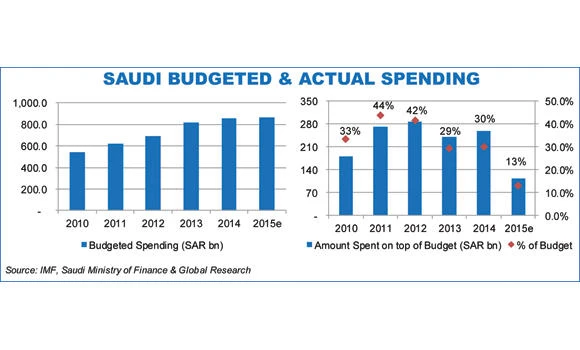
The 2016 budget, the first since Custodian of the Two Holy Mosques King Salman took over the country in January, contained significant changes in spending and revenue policy as Saudi Arabia adapted to oil prices that have fallen by more than 60 percent since mid-2014 to below $40 per barrel. The budgeted expenditure for 2016 stands at SR657 billion (excluding SR183 billion in a buffer provision; SR840 billion inclusive) as against the budgeted figure of SR860 billion in 2015 and an actual expenditure estimated at SR975 billion; underpinning a steep reduction. Interestingly, the budget allocation also highlights, for the first time, SR213 billion for military and security services, which constitutes 25 percent of the total expenditure for 2016. The government seems to be focusing more on necessary spending in 2016, evident from curtailment of expenditure. Several measures like issuance of bonds/public borrowing and implementation of new taxes and fees has been done and will be considered to cut down on the expected deficit. The government also mulls reducing the huge wages and bonus bill, which represents a major weight of the country’s expenditure.
Government bonds were issued to the local financial market during 2015, amounting to SR98 billion. By the end of the current fiscal year 2015, public debt is estimated at SR142 billion, equivalent to 5.8 percent of the expected GDP this year, as compared to the public debt registered at the end of 2014 at SR44 billion, which represented 2 percent of GDP for the year 2014.
As per Global Research, government has budgeted the revenue at a conservative oil price ranging from $30-$35/barrel; to breakeven, the Kingdom needs an average oil price of $59–$65/barrel and upon exclusion of the budgetary support provision of SR183 billion this range reduces to $43-$47/barrel.
Saudi Arabia’s government expected to run a record budget deficit of SR367 billion in 2015 because of low oil prices. The deficit exceeded the market expectations on the back of multi-year low crude oil prices. State spending in 2015 totaled SR975.0 billion, exceeding SR860.0 billion of the original planned outlay on the back of extra spending such as a salary bonus for public employees. Revenues totaled at SR608.0 billion in 2015, less than the original target of SAR715.0 billion as oil prices, on which the economy depends, fell more than expected. Noteworthy, amount spent over and above the budgeted amount was low at 13 percent which is nearly one-third of the average (overshot margin) for the past 5 years.
Spending on municipality, transport & water related sectors have been budgeted to drop by 24.4 percent in 2016 to SR123.3 billion from SR163.0 billion last year. Amongst the three sectors, municipality services spending is budgeted to fall by 46.9 percent while that on transport is down by 62.1 percent; however, spending on water/industrial economic resources was raised by 30.2 percent.
The government has allocated SR213.4 billion to military and security services this year as the last year the actual expenditure outlay was higher than the estimated due to higher spending on the salaries on the civil and military Saudi personnel.
Due to the recent excessive volatility of oil prices and to address potentially declining revenues, a budget support provision of SR183 billion has been established to offer increased flexibility to redirect capital expenditures and operating expenditures on both ongoing and new projects according to national developmental priorities and to meet any emerging expenditure needs.
The government has also cut down energy subsidies progressively and plans to privatize state entities over the next five years. The price of higher-grade unleaded gasoline has been raised by 50 percent to SR0.90 per liter from SR0.60 per liter. Lower-grade petrol price has been increased by 67 percent to SR0.75 per liter from SR 0.45 per liter. Petrochemical feedstock price increased ranging from 11 percent to 133 percent. The price of methane was raised to $1.25 per MMBTU and ethane to $1.75; previously, both were at $0.75. Furthermore, essential utilities like electricity prices for residential, governmental, commercial, agricultural and industrial use were also adjusted in accordance with consumption levels. Prices of fresh water and sewage utilities were adjusted across the board. The government also urged the citizens to pay their utility bills on time.
KSA plans to privatize some state entities over the next five years