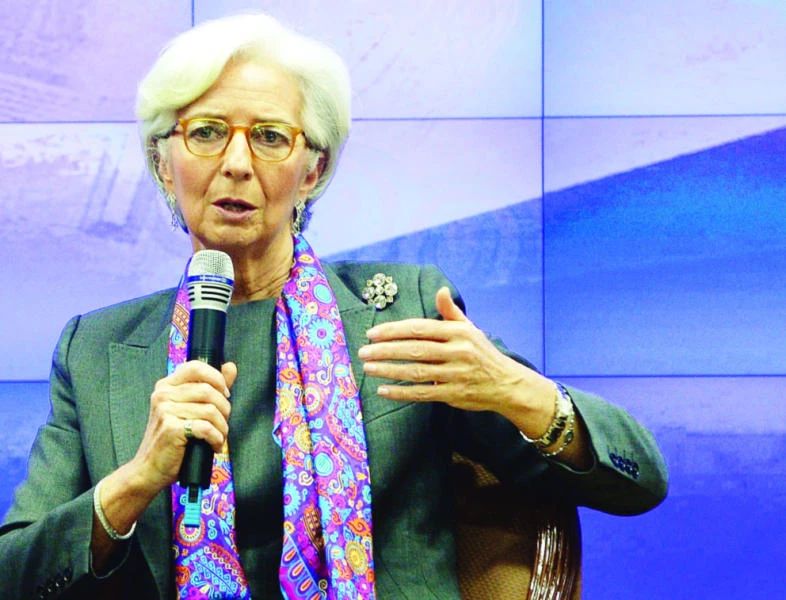
SHANGHAI: China's yuan at some point would be incorporated in the International Monetary Fund's Special Drawing Right (SDR) currency basket, said Christine Lagarde, Managing Director of the IMF, said in Shanghai on Friday.
"It's not a question of if, it's a question of when," she said during a question and answer session following a speech at Fudan University.
"There's a still a lot of work to be done and everyone knows that," she added.
He comments follow speculation that the IMF may decide to include the yuan in the SDR basket — currently made up of dollars, yen, pounds and euros — during a five-year review due to be conducted this year.
The US government is considered to be opposed to a move, that might diminish the dollar's standing internationally.
The first step in the review of the basket for the SDR, an international reserve asset, is an informal board meeting in May, followed by a formal review in the autumn. Any changes would come into effect in January 2016, but would require a 70 or 85 percent majority on the IMF council.
Though it keeps a tight rein on the yuan's movements and maintains strong capital controls, Beijing is pushing for the increased use of the yuan for trade and investment as part of a long-term strategic goal to reduce dependence on the dollar.
In her speech, Lagarde also said China's biggest current challenge is escaping the "middle-income trap" — a term which refers to the large number of developing economies that experienced heady periods of investment and export-driven growth based on cheap labor only to see their economies flatten out as their cost advantages shrink.
Only a few countries like Taiwan and South Korea are considered to have successfully made the transition in recent decades.
Lagarde called for slower, higher quality growth in China.
"By brewing its economic cup of tea more slowly, China will end up with a richer taste," she said.
China's economic growth slowed to just 7.4 percent last year, the slowest in 24 years, and the IMF estimates it will slow further to just 6.8 percent in 2015. That is below the Chinese government's official target of 7.0 percent.
Earlier in Mumbai, Lagarde said emerging markets must prepare for the impact of US interest rate rises, whose timing could surprise markets.
Speaking alongside India's central bank Gov. Raghuram Rajan, Lagarde said the so-called "taper tantrum" that hit emerging economies hard in 2013 could be repeated.
The US Federal Reserve caused panic in 2013 when it first signaled a reduction in its multi-billion dollar asset purchases to stimulate the economy.
India and other emerging economies were slammed as investors pulled out of their markets, in what came to be termed a "taper tantrum", amid speculation about the winding down of the stimulus program that had rallied emerging markets.
"The danger is that vulnerabilities that build up during a period of very accommodative monetary policy can unwind suddenly when such policy is reversed, creating substantial market volatility," Lagarde said in prepared remarks in Mumbai at the end of a two-day visit to India.
"We already got a taste of it during the taper tantrum episode in May and June of 2013, when most emerging market economies suffered indiscriminate capital outflows.
"I am afraid this may not be a one-off episode. This is so, because the timing of interest rate lift-off and the pace of subsequent rate increases can still surprise markets.
"Emerging markets need to prepare in advance to deal with this uncertainty."
Lagarde said developed economies could help avoid future volatility with "clear and effective communication of policy intentions".
"We are perhaps approaching the point where, for the first time since 2006, the United States will raise short-term interest rates later this year, as the first country to start the process of normalizing its monetary policy," she said.
"Even if this process is well managed, the likely volatility in financial markets could give rise to potential stability risks."
Emerging economies could prepare for future swings including through higher GDP growth, stronger external current account positions and lower inflation.
Central banks must also be ready to act, with aggressive and temporary liquidity support and targeted foreign exchange interventions, she advised.
Lagarde hopes China’s yuan will be in SDR basket soon