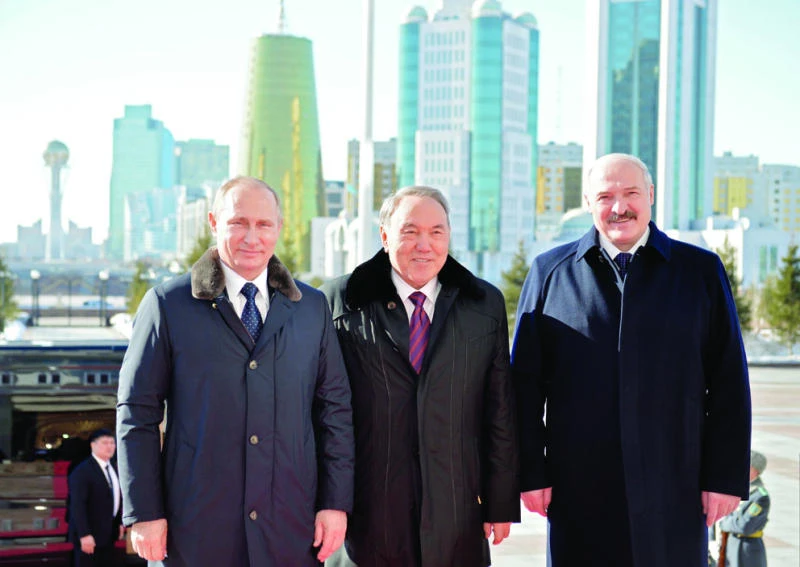
Astana, Kazakhstan: Russian President Vladimir Putin on Friday called for a single currency with the Kremlin's closest ex-Soviet allies despite fraying ties in the region which is struggling with the fallout from Moscow's economic crisis.
Putin urged closer integration for his flagship Eurasian Economic Union — which also includes Belarus, Kazakhstan and Armenia — as Moscow scrambles to limit the damage from Western sanctions over Ukraine and tumbling oil prices.
"We think the time has come to discuss opportunities to form a potential currency union," Putin said at a meeting with his Kazakh and Belarusian counterparts in Kazakhtan's capital Astana.
"Working shoulder to shoulder, it is easier to react to external financial and economic threats, and protect our common market."
Political and economic ties between Moscow and the bloc's two other founding members, Belarus and energy-rich Kazakhstan, have been strained by the recent economic woes and jitters over Russia's alleged military involvement in Ukraine.
"Major trials have befallen our union," said Kazakh President Nursultan Nazarbayev at the outset of the summit, while arguing for deeper cooperation.
The economic union — a pet project of Putin's — has been slammed by the West as an attempt by the Kremlin to revive its Soviet empire.
The debate over whether Ukraine would opt for closer ties with Europe rather than the Russian-led bloc is at the heart of the current crisis.
Nazarbayev said the trio were "interested in Ukraine becoming a strong, stable, independent state with territorial integrity," at the conclusion of the meeting.
The summit, which followed bilateral meetings between Nazarbayev and Belarusian leader Alexander Lukashenko and Putin was initially scheduled for March 12 but was canceled by Russia during a 10-day disappearance by Putin from public view that had sparked rumours over his health.
Ahead of their separate meetings with the Kazakh president, both Putin and Lukashenko backed Nazarbayev to extend his 23-year grip on power at snap presidential polls in April that he looks set to cruise through.
Meanwhile, Russian assets ended the week on a positive note, with a pick-up in the oil price on Friday afternoon pushing the ruble back below 60 rubles per dollar and boosting stock indexes.
At 1540 GMT, the ruble was up 1 percent against the dollar to 59.42 and 0.1 percent stronger versus the euro at 63.96 .
The ruble-based MICEX stock index was up 2.4 percent at 1,641 points and the dollar-based RTS index 2 percent higher at 868 points.
Oil benchmark Brent, a key driver for Russian markets, was up 1.2 percent to just over $55 per barrel, helped by a weaker dollar.
"There is a sell-off of the dollar taking place on global markets and the ruble, with some delay, is being included in this process," said Credit Suisse trader Dmitry Deev.
The ruble is also being supported by monthly tax payments requiring exporters to convert forex earnings into rubles to pay taxes that mainly fall due next week.
Although the volatile oil price continues to drive the ruble, analysts noted that the Russian currency has lately become less dependent on oil moves, and firmer overall.
On Friday it was trading close to a 2 1/2 month high of 59 against the dollar reached on Wednesday evening, although Brent remains several dollars below February's peak of $63 per barrel.
The ruble had opened flat on Friday morning, shrugging off a decision by European Union leaders to leave economic sanctions on Russia in place until a Ukraine peace deal is fully implemented. That will effectively extend them at least to the end of the year.
Analysts said the move had been expected and was therefore largely ignored by markets. But they said investors may be concerned that rhetoric related to the Ukraine conflict is again heating up, with Moscow and Kiev trading accusations over violations of last month's Minsk peace deal.
"The one thing that is causing serious concern is the situation in Ukraine, where at any moment the tension could strengthen," Forex Club analyst Irina Rogova said in a note.
Putin calls for a single currency with ex-Soviet allies