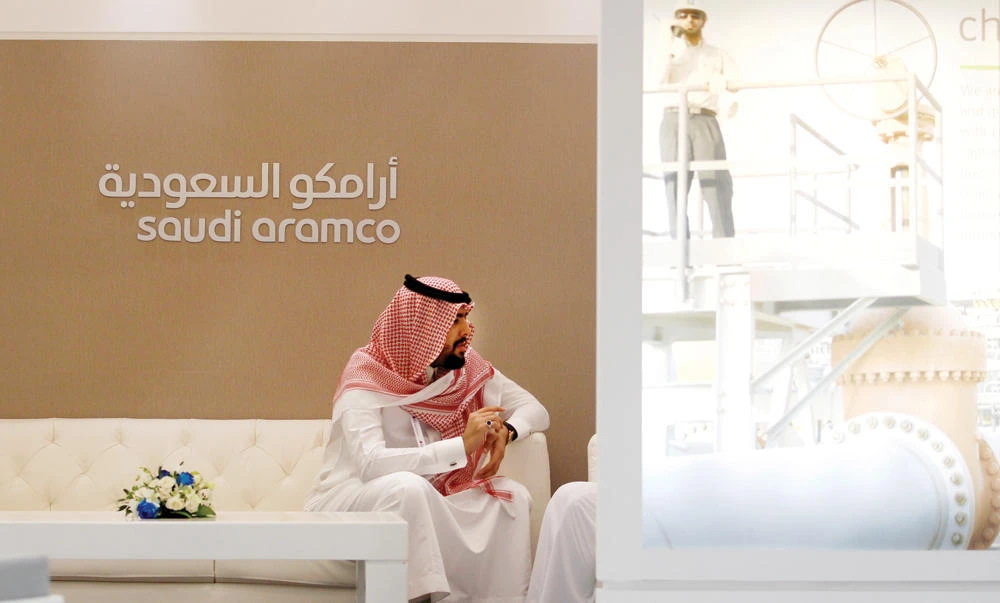
LONDON/JEDDAH Saudi Arabia and international oil companies have discussed gas venture opportunities inside the Kingdom and abroad as part of the top crude-exporting country’s drive to diversify investments before the listing of Saudi Aramco.
Saudi officials explored investment opportunities with firms including BP and Chevron to help develop its gas reserves, the world’s sixth largest, at a time of booming energy demand at home, said four industry sources.
Saudi Aramco has also looked into investing in gas ventures abroad, including with Italy’s Eni, the sources said.
Saudi Aramco is gearing up for a share listing next year, aiming to get a valuation of up to $2 trillion in what could be the world’s biggest initial public offering (IPO).
Chevron, BP, Aramco and Eni declined to comment on talks.
“We have a long-standing relationship with Saudi Arabia, so it is not uncommon for us to talk to them. We are always having discussions about business development. I do not have anything particular to say about Saudi Arabia,” Chevron CEO John Watson told Reuters last week.
British Petroleum (BP) Chief Executive Bob Dudley, who traveled to Saudi Arabia at the end of last year, said this year he wouldn’t rule out “creative partnerships” with Aramco but that an outright investment by BP in the IPO was unlikely.
The Kingdom has a long-term goal of increasing the use of gas for domestic power generation, thus reducing oil burning at home and freeing up more crude for export.
This could help increase Aramco’s valuation as it generates more revenue from exports than selling oil at lower domestic prices — Saudi Arabia is the world’s fifth-biggest oil consumer despite being only the 20th-biggest economy.
Energy Minister Khalid Al-Falih, who is also Saudi Aramco’s chairman, said last year that Aramco was interested in investing in international upstream ventures, particularly gas, and could invest in importing gas into the Kingdom.
Diversifying gas assets abroad would help Saudi Aramco achieve a better valuation and is attractive for investors, industry sources said. Riyadh also plans to raise domestic gas prices, a move seen as an incentive for foreign companies.
New gas strategy
Saudi Aramco is preparing to reveal in the next few months a new gas strategy aimed at developing resources to keep pace with rising domestic demand, sources familiar with the discussions said.
It comes as part of the Kingdom’s push to diversify its economy away from oil, a strategy known as “Vision 2030,” amid a global drive to phase out the most polluting fossil fuels.
Saudi Aramco wants nearly to double gas production to 23 billion standard cubic feet a day in the next decade.
“IOCs (international oil companies) are waiting for that (strategy) to make their decisions,” one industry source familiar with the matter said.
Another industry source said Energy Minister Al-Falih had said in private meetings with Western oil executives that he wanted Saudi Aramco to partner with other companies in upstream projects.
Two Saudi-based industry sources familiar with the discussions said BP’s Dudley had expressed an interest in investing in gas exploration in the Red Sea. However, the two sides have yet to hold any talks on the project.
Saudi Aramco controls gas reserves in excess of 8 trillion cubic meters, according to BP’s annual energy review. The Saudi company has said it wants to explore for gas in the shallow waters of the Red Sea as well as onshore shale gas.
Since gradually renationalizing the industry in the 1970s, Saudi Arabia has not allowed the majors to develop its oil.
The $25 billion gas initiative offered in 1997-98 had some of the world’s top oil companies such as Exxon and Shell expressing interest but struggling to agree terms.
Riyadh later invited investors in 2003-2004 to find and produce gas in Rub Al-Khail in the country’s southeast.
Companies including Russia’s Lukoil, Shell and China’s Sinopec formed ventures with Saudi Aramco but have failed to find commercially viable deposits. They also complained about low domestic gas prices and high extraction costs.
Russia’s Lukoil was the most recent foreign company to quit Saudi Arabia’s search for gas.
However, Saudi Arabia last month slashed income tax on energy companies operating in the kingdom to make energy investments more attractive.
“The terms will be better now,” an oil executive said.
Saudi officials explored investment opportunities with firms including BP and Chevron to help develop its gas reserves, the world’s sixth largest, at a time of booming energy demand at home, said four industry sources.
Saudi Aramco has also looked into investing in gas ventures abroad, including with Italy’s Eni, the sources said.
Saudi Aramco is gearing up for a share listing next year, aiming to get a valuation of up to $2 trillion in what could be the world’s biggest initial public offering (IPO).
Chevron, BP, Aramco and Eni declined to comment on talks.
“We have a long-standing relationship with Saudi Arabia, so it is not uncommon for us to talk to them. We are always having discussions about business development. I do not have anything particular to say about Saudi Arabia,” Chevron CEO John Watson told Reuters last week.
British Petroleum (BP) Chief Executive Bob Dudley, who traveled to Saudi Arabia at the end of last year, said this year he wouldn’t rule out “creative partnerships” with Aramco but that an outright investment by BP in the IPO was unlikely.
The Kingdom has a long-term goal of increasing the use of gas for domestic power generation, thus reducing oil burning at home and freeing up more crude for export.
This could help increase Aramco’s valuation as it generates more revenue from exports than selling oil at lower domestic prices — Saudi Arabia is the world’s fifth-biggest oil consumer despite being only the 20th-biggest economy.
Energy Minister Khalid Al-Falih, who is also Saudi Aramco’s chairman, said last year that Aramco was interested in investing in international upstream ventures, particularly gas, and could invest in importing gas into the Kingdom.
Diversifying gas assets abroad would help Saudi Aramco achieve a better valuation and is attractive for investors, industry sources said. Riyadh also plans to raise domestic gas prices, a move seen as an incentive for foreign companies.
New gas strategy
Saudi Aramco is preparing to reveal in the next few months a new gas strategy aimed at developing resources to keep pace with rising domestic demand, sources familiar with the discussions said.
It comes as part of the Kingdom’s push to diversify its economy away from oil, a strategy known as “Vision 2030,” amid a global drive to phase out the most polluting fossil fuels.
Saudi Aramco wants nearly to double gas production to 23 billion standard cubic feet a day in the next decade.
“IOCs (international oil companies) are waiting for that (strategy) to make their decisions,” one industry source familiar with the matter said.
Another industry source said Energy Minister Al-Falih had said in private meetings with Western oil executives that he wanted Saudi Aramco to partner with other companies in upstream projects.
Two Saudi-based industry sources familiar with the discussions said BP’s Dudley had expressed an interest in investing in gas exploration in the Red Sea. However, the two sides have yet to hold any talks on the project.
Saudi Aramco controls gas reserves in excess of 8 trillion cubic meters, according to BP’s annual energy review. The Saudi company has said it wants to explore for gas in the shallow waters of the Red Sea as well as onshore shale gas.
Since gradually renationalizing the industry in the 1970s, Saudi Arabia has not allowed the majors to develop its oil.
The $25 billion gas initiative offered in 1997-98 had some of the world’s top oil companies such as Exxon and Shell expressing interest but struggling to agree terms.
Riyadh later invited investors in 2003-2004 to find and produce gas in Rub Al-Khail in the country’s southeast.
Companies including Russia’s Lukoil, Shell and China’s Sinopec formed ventures with Saudi Aramco but have failed to find commercially viable deposits. They also complained about low domestic gas prices and high extraction costs.
Russia’s Lukoil was the most recent foreign company to quit Saudi Arabia’s search for gas.
However, Saudi Arabia last month slashed income tax on energy companies operating in the kingdom to make energy investments more attractive.
“The terms will be better now,” an oil executive said.