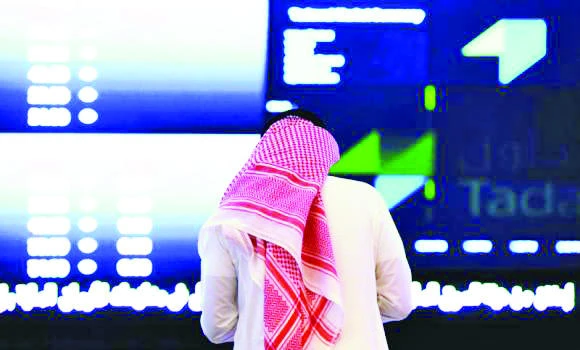
JEDDAH: Buying in some blue-chips lifted Saudi Arabia’s stock market on Tuesday but most Middle Eastern markets fell in thin trade because of a lack of positive corporate news and Turkey’s shooting down of a Russian warplane.
Tadawul All-Share Index ended 0.7 percent higher at 7,202 points.
Oil shipper Bahri climbed 2.8 percent and petrochemical producer Saudi Basic Industries gained 0.6 percent.
Real estate developer Dar Al-Arkan, which had dropped 2.3 percent on Monday after the cabinet announced plans for a tax on undeveloped land, closed flat on Tuesday.
However, the Saudi index ended well off its intra-day high of 7,242 points after news of the downing of the Russian plane caused buyers to become more cautious.
Other major Gulf bourses dropped. The Dubai stock index fell 1.4 percent as builder Arabtec, the most heavily traded stock, sank 4.3 percent.
Arabtec rose as much as 2.6 percent in opening trade after the company, confirming a Reuters story published late on Monday, said its board had accepted the resignation of acting CEO Mohamed Al-Fahim and replaced him with board member Saeed Al-Mehairbi. But the stock quickly pulled back.
Abu Dhabi’s index fell 0.8 percent as Aldar Properties lost 2.1 percent.
Qatar’s index slipped 0.6 percent as Doha Bank slid 3.8 percent.
Egypt’s index sank 2.0 percent as Orascom Telecom Media, which plunged 7.6 percent on Monday after EFG Hermes downgraded it and the company described difficulties at its North Korean unit, dropped a further 4.8 percent to 0.59 of an Egyptian pound.
EFG Hermes put the stock’s fair value at 0.53 of a pound.
Commercial International Bank dropped 1.2 percent.
EFG Hermes director for research in regional strategies, Simon Kitchen, said the stock was widely held by foreign investors who had become more concerned about the possibility of depreciation of the Egyptian pound since the Russian plane crash in Sinai last month, which was deterring tourist inflows and hurting hard currency earnings.
Mansoura Poultry jumped 4.1 percent after the government said it would stick to buying its poultry domestically, turning its back completely on international tenders, following pressure from local producers.
But Egypt Poultry dropped 1.6 percent, Cairo Poultry was flat and Ismalia Poultry fell 2.6 percent.
Saudi stocks rise 0.7%; Bahri jumps 2.8%