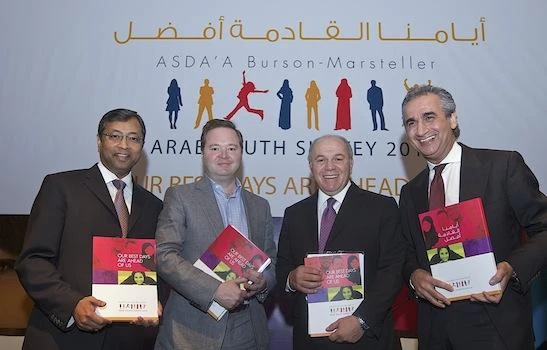
A majority of youth in the Gulf states and MENA feel their best days are ahead – and 74 percent of Arab youth in the 15 countries surveyed are hopeful for an improvement in their economic prospects.
Representing a loud vote of confidence in the MENA’s future outlook, three-quarters of Arab youth, the region’s largest demographic, say their best days are ahead of them in the fifth annual ASDA’A Burson-Marsteller Arab Youth Survey, released yesterday.
The survey states that Arab youth have more national pride since the Arab Spring. Nearly nine out of 10 young Arabs (87 percent) feel “more proud to be an Arab” following the uprisings, and 59 percent believe recent changes in their country will have a positive impact on them and their family. Two-thirds (67 percent) feel “better off” following the events of the Arab Spring and 45 percent believe their national government has become more transparent.
ASDA’A selected international polling firm Penn Schoen Berland (PSB) to complete 3,000 face-to-face interviews with Arab national men and women aged 18-24 in the UAE, Saudi Arabia, Qatar, Kuwait, Oman and Bahrain, Iraq, Egypt, Jordan, Lebanon, Libya, Tunisia, and in three new countries added this year: Morocco, Algeria and Yemen. The survey was conducted between December 2012 and January 2013. Participants were interviewed in-depth about subjects ranging from the political to the personal.
There were 200 respondents for each country represented in the survey, except for the UAE, Saudi and Egypt, with 250 respondents each, and Algeria, Oman and Yemen, with 150. The geographic location of respondents was also taken into account when developing the fieldwork methodology – with, for example, 40 percent of Saudi Arabian respondents in Riyadh, 40 percent in Jeddah and the remaining 20 percent in Dammam.
As in 2012, being paid a fair wage is of greatest importance to young Arabs across the MENA, while unemployment continues to be seen as one of the region’s gravest challenges.
The survey also said that owning one’s own property is considered more important than living in a democracy. However, anxiety about living costs is evenly split across GCC and non-GCC states, and noticeably up from two years ago. With 62 percent saying they are “very concerned” about the issue. According to the latest findings, the rising cost of living is a bigger worry than “the economy”, “the threat of terrorism”, “events of the Arab Spring” and “unemployment”.
Representing a significant shift in media consumption patterns, television is now the primary source of news for 72 percent of regional youth (up from 62 percent in 2012), while 59 percent of all Arab youth rely on online news sources, an 8 percent increase from 2012.
Newspaper readership among Arab youth plummeted from 62 percent in 2011 to 32 percent in 2012 and 24 percent this year.
The survey pointed out that civil unrest and lack of democracy are the biggest barriers facing the region. Among nations outside MENA, France viewed most favorably by Arab youth. When considering foreign relations, Arab youth view France most favorably, followed by Germany and China; favorability toward the US is highest in Oman while the UK is viewed most favorably in Egypt
While asked to name the country, anywhere in the world, where they would most like to live, Arab youth, as they did in 2012, cite the UAE as their preference. The UAE is the top choice of 31 percent of Arab youth across the 15 countries surveyed, followed by France (18 percent), the United States and Turkey (16 percent).
“Every year ASDA’A Burson-Marsteller conducts the Arab Youth Survey because we understand the importance of providing reliable data here in the Middle East, where research into public opinion is often limited,” said Sunil John, chief executive officer of ASDA’A Burson-Marsteller.
Survey: Majority of Arab youth optimistic about future