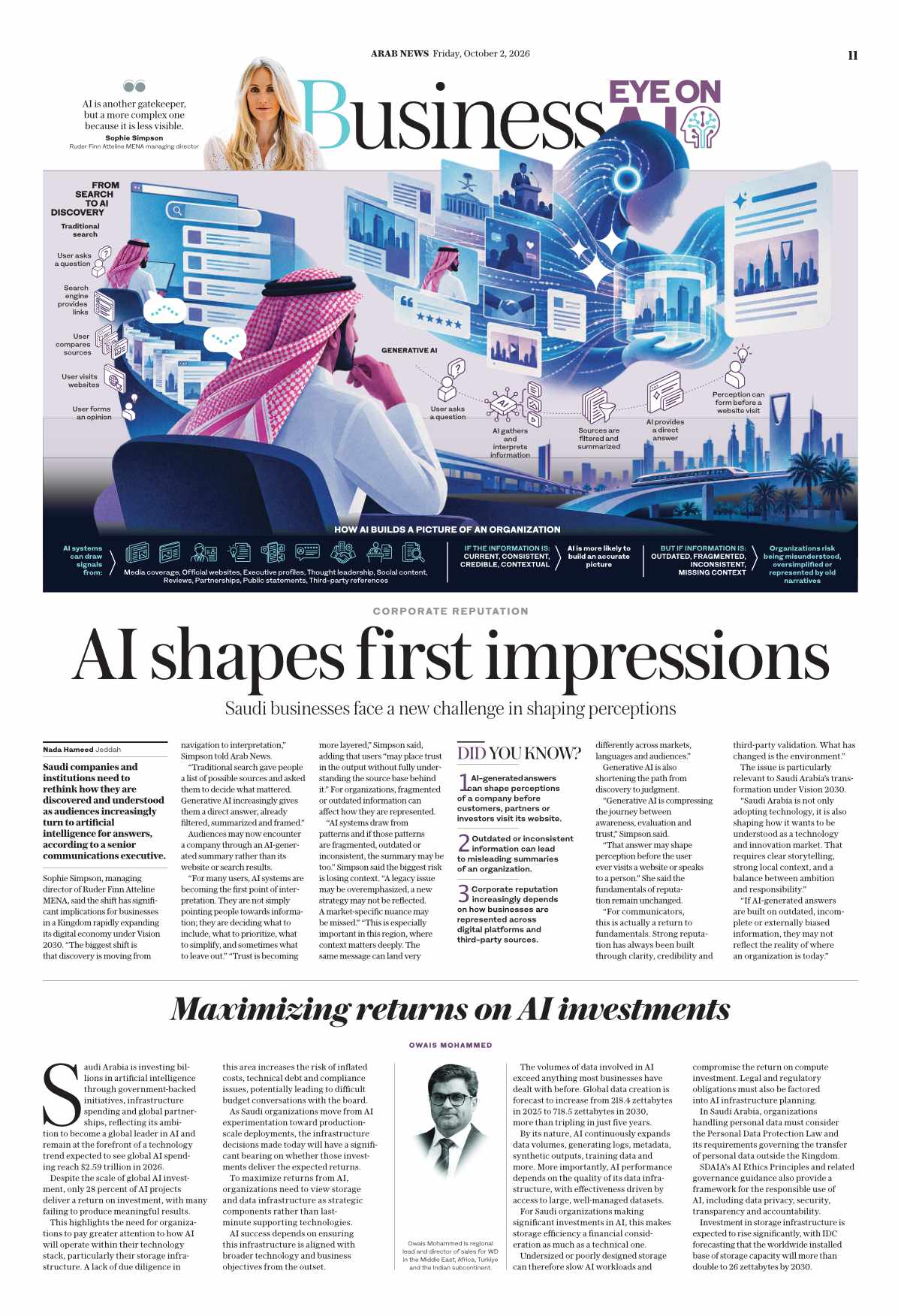
- Executive warns outdated information and lost context can distort corporate reputations
JEDDAH: Saudi companies and institutions need to rethink how they are discovered and understood as audiences increasingly turn to artificial intelligence for answers, according to a senior communications executive.
Sophie Simpson, managing director of Ruder Finn Atteline MENA, said the shift has significant implications for businesses operating in a Kingdom expanding its digital economy under Vision 2030. Potential customers, partners and investors may now encounter an organization through an AI-generated answer rather than its website or conventional search results.
“The biggest shift is that discovery is moving from navigation to interpretation,” Simpson told Arab News.
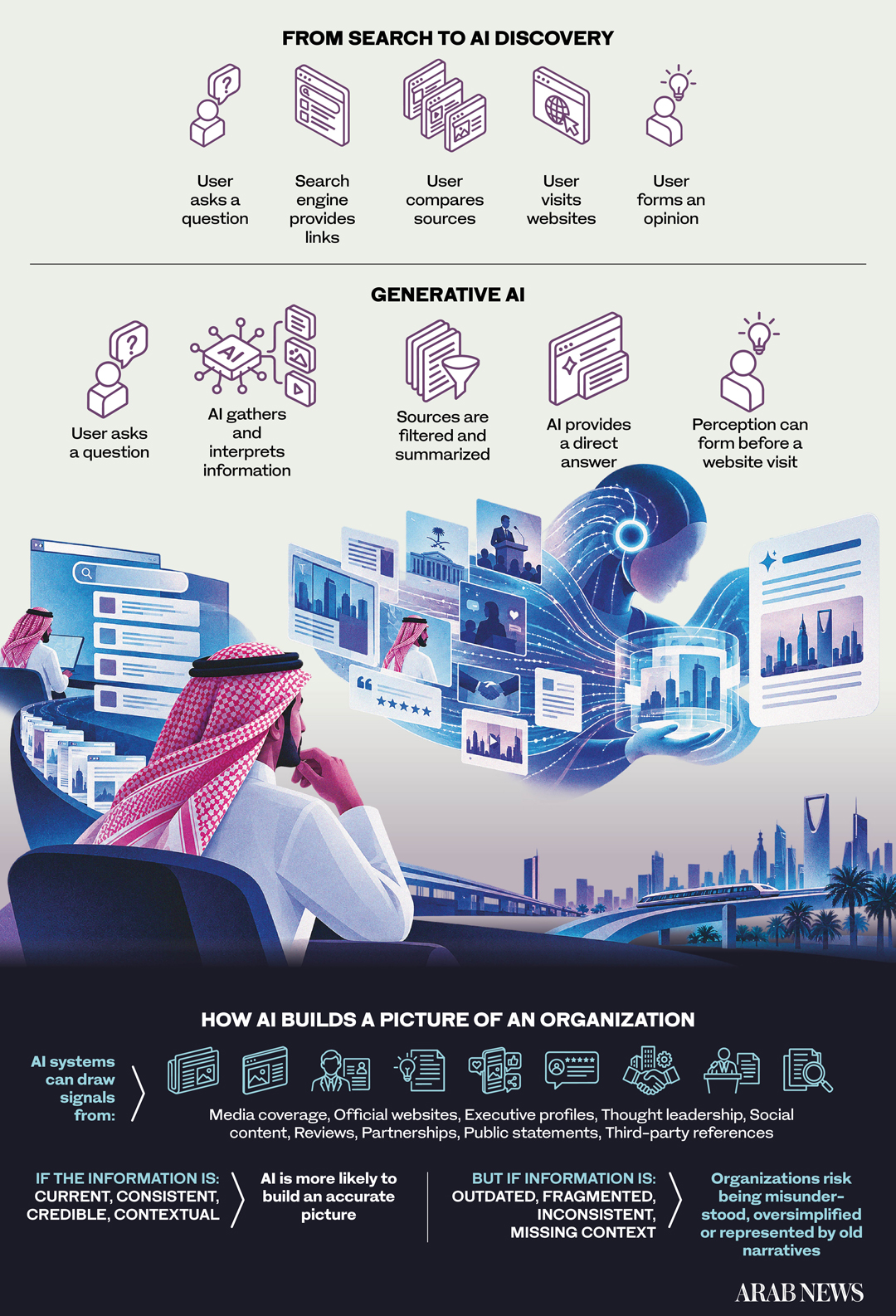
“Traditional search gave people a list of possible sources and asked them to decide what mattered. Generative AI increasingly gives them a direct answer, already filtered, summarized and framed.”
This changes the objectives of corporate communications. Audiences may encounter a brand, institution or news story through an AI-generated summary rather than a homepage, campaign, press release or search result.
“Visibility is no longer only about being findable; it is about being understood correctly, consistently, and credibly by both people and machines,” Simpson said.
“The question is becoming less, ‘Do we rank?’ and more, ‘How are we represented when an answer is produced?’”
Simpson said this does not mean search engines are disappearing. Instead, AI is changing the layer between people and information.
“For many users, AI systems are becoming the first point of interpretation. They are not simply pointing people towards information; they are deciding what to include, what to prioritize, what to simplify, and sometimes what to leave out.”
While communications has long involved gatekeepers, including editors, journalists, influencers, platforms and algorithms, AI introduces a less visible intermediary.
“AI is another gatekeeper, but a more complex one because it is less visible,” she said. “It does not always show clearly why one source is included, and another is not.”
This is also reshaping how audiences establish trust. Rather than evaluating a recognizable publication, journalist or official website, users may rely on an AI-generated response without seeing its underlying sources.
“Trust is becoming more layered,” Simpson said, adding that users “may place trust in the output without fully understanding the source base behind it.”
For organizations, maintaining credibility therefore requires consistency across earned media, owned channels, executive profiles, thought leadership, social content and third-party references.
“AI systems draw from patterns and if those patterns are fragmented, outdated or inconsistent, the summary may be too.”
The greatest risk, Simpson said, is not necessarily factual inaccuracy but the loss of context. Communications often needs to explain why something happened, what changed, who is affected and what evidence supports a particular position.
“The main risk is loss of nuance.”
“A legacy issue may be overemphasized, a new strategy may not be reflected. A market-specific nuance may be missed.”

She said this is particularly relevant in the Middle East, where cultural and market differences can significantly influence how messages are interpreted.
“This is especially important in this region, where context matters deeply. The same message can land very differently across markets, languages and audiences.”
“If AI systems do not understand that nuance, or if the available information does not make it clear, there is a real risk of misrepresentation through omission rather than direct inaccuracy.”
AI is also shortening the time between discovering an organization and forming an opinion about it. Users seeking recommendations for agencies, institutions, products or experts may receive a concise answer that shapes their perceptions before they visit a website or speak to a representative.
“Generative AI is compressing the journey between awareness, evaluation and trust,” Simpson said.
“That answer may shape perception before the user ever visits a website or speaks to a person.”

In this environment, reputation depends increasingly on an organization's accumulated public record, including media coverage, leadership visibility, reviews, social content, partnerships and public statements, as well as consistency over time.
Simpson sees this as an evolution of established communications principles rather than a departure from them.
“For communicators, this is actually a return to fundamentals. Strong reputation has always been built through clarity, credibility and third-party validation. What has changed is the environment.”
The shift also requires organizations to broaden how they measure communications performance. Reach, search rankings and media coverage remain relevant, but they do not capture how AI systems represent an organization.
“Are we visible in AI-generated answers? Are we cited accurately? Are competitors being recommended ahead of us? Are our spokespeople associated with the right topics? Are our proof points clear enough to be understood by both humans and machines?”
“That is the next evolution of communications strategy. It is not replacing traditional communications; it is expanding the discipline.”

Simpson said the development aligns with Saudi Arabia’s economic transformation under Vision 2030, which places emphasis on innovation, technology and building a knowledge-based economy.
“Generative AI aligns very naturally with the direction of Vision 2030 because the Kingdom’s transformation has always been about more than infrastructure. It is about building a knowledge-based, innovation-led economy with the confidence to compete globally.”
AI, she noted, “is not being treated as a side conversation,” but is increasingly relevant to government services, education, healthcare, logistics, culture and media.
“Saudi Arabia is not only adopting technology, it is also shaping how it wants to be understood as a technology and innovation market. That requires clear storytelling, strong local context, and a balance between ambition and responsibility.”
For businesses and institutions, this makes AI visibility a strategic communications concern, particularly in a rapidly changing market where outdated information can misrepresent an organization’s current operations, leadership or ambitions.
“If AI-generated answers are built on outdated, incomplete or externally biased information, they may not reflect the reality of where an organization is today.”
Simpson said organizations should therefore consider how AI-driven tools interpret their leadership, credibility, services, achievements and market position, rather than treating visibility as a purely technical issue.
“In a country where national transformation is moving with such intent, organizations cannot afford to be invisible, misunderstood or defined by old narratives.”
“Those who invest early in clear, credible and culturally relevant information will be better placed to shape how they are discovered and trusted in the next phase of the internet.”