Philippine cuisine is still largely unknown despite the presence of a large diaspora of Filipino working abroad, especially in the Arab world.
Who would ever think that the best way to eat a Spanish paella in Riyadh is at a Filipino restaurant? Philippine food is basically indigenous food from the land, sea, field and forest of a rich archipelago with 7,000 islands as well as dishes from China, Malaysia, Spain, Mexico, and the United States.
When the Spanish settlers arrived in the Philippines, they brought food influences from both Spain and Mexico because the Philippines were ruled through the vice-royalty of Mexico. This meant a food for which ingredients were not locally available such as oil, paprika, saffron, chili peppers, corn, potatoes and tomato sauces.
Beside the method of stuffing and sautéing with garlic and onions, Spanish dishes were so to speak localized to suit the local taste buds and ingredients.
This is the case with “paella,” the dish, traditionally prepared in the fields by Spanish workers, which became a festive dish with many versions differing from every region. For instance, paella from the Visayas region is made with chicken, shrimp, peas, tomatoes and rice and is given a local flair by the use of ginger and achiote annatto. One can truly say that “paella” has become a Philippine specialty.
According to Doreen Fernandez, probably the most famous Filipino food writer who died a few years ago: “What makes certain dishes Philippine? The history and society that introduced and adapted them; the people who turned them to their tastes and accepted them into their homes and restaurants, and especially the harmonizing culture that combined them into contemporary Filipino fare.”
Pinoy, a Filipino restaurant in Batha, situated in downtown Riyadh, does not serve individual portions of paella, which is understandable because the dish is usually enjoyed with friends and family. At Pinoy, you can order paella for a minimum of four people for the price of SR45.
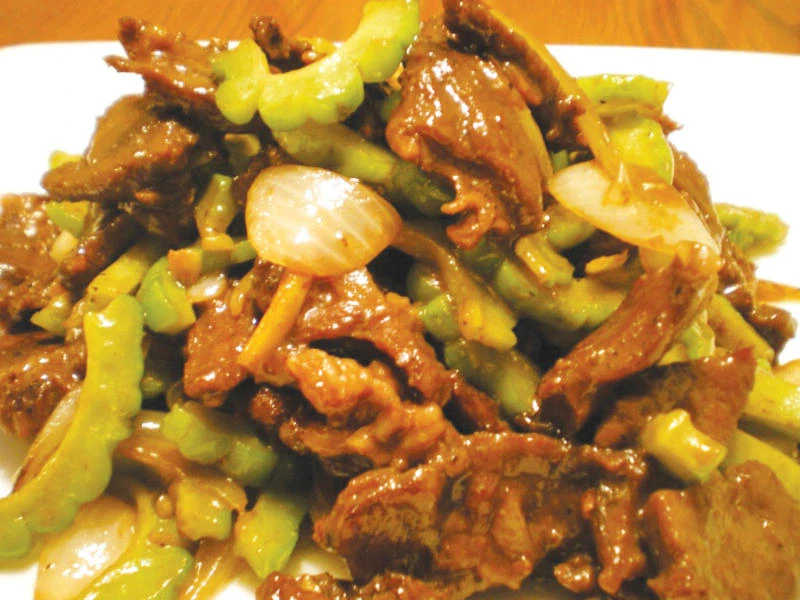
Pinoy also serves another typical Filipino specialty beef con ampalaya. However, this dish can be found on old Chinese menus and is sometimes available in new Chinese restaurants. The dish has a characteristic sour taste due to the presence of the ampalaya, bitter melon, also called bitter gourd or even bitter cucumber. This vegetable is also found in China, Japan, Indonesia, India and Vietnam.
Ampalaya, a greenish, oblong-shaped fruit grows on vines and has long been used as a traditional medicine in Asia to combat diabetes. However, no scientific study has yet proved that it can cure the disease. Like most bitter food, ampalaya is known to stimulate digestion and relieve constipation. In China, ampalaya is stir-fried whereas in India it is curried and the Japanese from Okinawa eat a lot of it and that might explain their longer life span. A typical beef con ampalaya is made with beef and bitter gourd (ampalaya) flavored with oyster sauce, soy sauce. The bitter gourd should not be overcooked, and it should be crunchy when you eat it.
Pinoy’s menu also features papaitan, a famous Ilocano (ethnic group in the northern Philippines) soup prepared with cow or goat innards. The name of this dish was derived from the Filipino word “pait”, which means “bitter.” The bitter taste of this soup comes from the bile. This is a bitter liquid extracted by the liver and stored in the gallbladder to aid digestion.
Although this soup is popular, one needs to acquire a likening for its distinct taste to enjoy it without minding its components. It is said that papaitan tastes better with ‘calamansi”, limejuice and it should definitely be served piping hot. The dish most representative of Filipino taste is sinigang not to be confused with sinangag (rice fried with garlic and served at breakfast with a fried egg and cured meat). It is lightly boiled, slightly soured (with the use of lime, tamarind or raw mango) and includes fish, shrimps or even meat and broth. It is adaptable to all tastes, all classes and all budgets.
Sour broths are also cooling in hot weather and are delicious with rice. Pinoys enjoy sinigang so much because it reflects their nature: an adaptable, fun-loving, and ingenuous people.
What I find most characteristic about Filipino cuisine is the bold combination of sweet with sour or salty flavors. The pairing of something sweet with something salty results in a surprisingly pleasant taste.
This is the case of bibingka, a cake made with salty cheese, champorado (a sweet cocoa rice porridge) eaten with tuyo (salted, sun-dried fish) as for unripe fruit like mangoes which are sour and slightly sweet, they are dipped in salt. This reminds me of the genarek, unripe green plums, which Lebanese enjoy, dipped in salt!
• [email protected]
Pinoy restaurant; typical Filipino food