- New conservation guide promotes safer feeding sites for resident and migratory birds
JEDDAH: Saudi Arabia plans to establish three vulture feeding stations this year as its first national guide for the facilities — known as “vulture restaurants” — gains international exposure through a UN conservation platform.
Developed by the National Center for Wildlife with international specialists, the guide provides technical standards for supplementary feeding aimed at protecting vultures from poisoned or contaminated carcasses while supporting resident and migratory populations.
“The National Center for Wildlife, in cooperation with local partners, intends to establish three stations during this year,” the center told Arab News, adding that other national entities may establish their own stations during the same period.
Dr. Hany Tatwany, a conservationist with more than 36 years of experience in biodiversity conservation, said the initiative has implications beyond protecting the birds themselves.

“Vultures may not be the most glamorous birds, but they are hugely important for human and ecosystem health,” he said.
The guide, titled “Vulture Restaurants: Best Practices for Establishment and Management of Supplementary Feeding for Vultures in Aridlands,” was published in Arabic and English in August through the Convention on the Conservation of Migratory Species of Wild Animals’ memorandum of understanding on birds of prey in Africa and Eurasia.
It was produced with the IUCN Vulture Specialist Group, SAVE, the RSPB, CMS and the Raptors MOU.
The NCW said its publication on the CMS platform “represents international recognition, places the Saudi experience among global best practices in vulture protection, and makes it an international reference for every country seeking to activate feeding stations as a tool for protecting vultures.”
Vulture restaurants are designated sites where safe carcasses are provided for wild birds, reducing their exposure to poisoned food and harmful veterinary drug residues.
“Poisoning is one of the causes of vulture deaths worldwide,” the center said. “Poisoned baits that are sometimes placed to target predators may reach vultures when they feed on them, and several vultures may feed on a single carcass, so the circle of harm widens.”
The NCW said poisoning cases had been recorded in several regions of the Kingdom. Veterinary drug residues in livestock carcasses are another potential threat, including diclofenac, an anti-inflammatory drug associated with devastating vulture declines in South Asia.
But determining the cause of an individual bird’s death requires specialist investigation.
“The cause of death of any bird cannot be established with certainty, nor the substance responsible identified, without specialist examination and analysis,” it said.
“For this reason we focus on prevention and on verifying the source of the food and its safety before activating vulture feeding stations.”
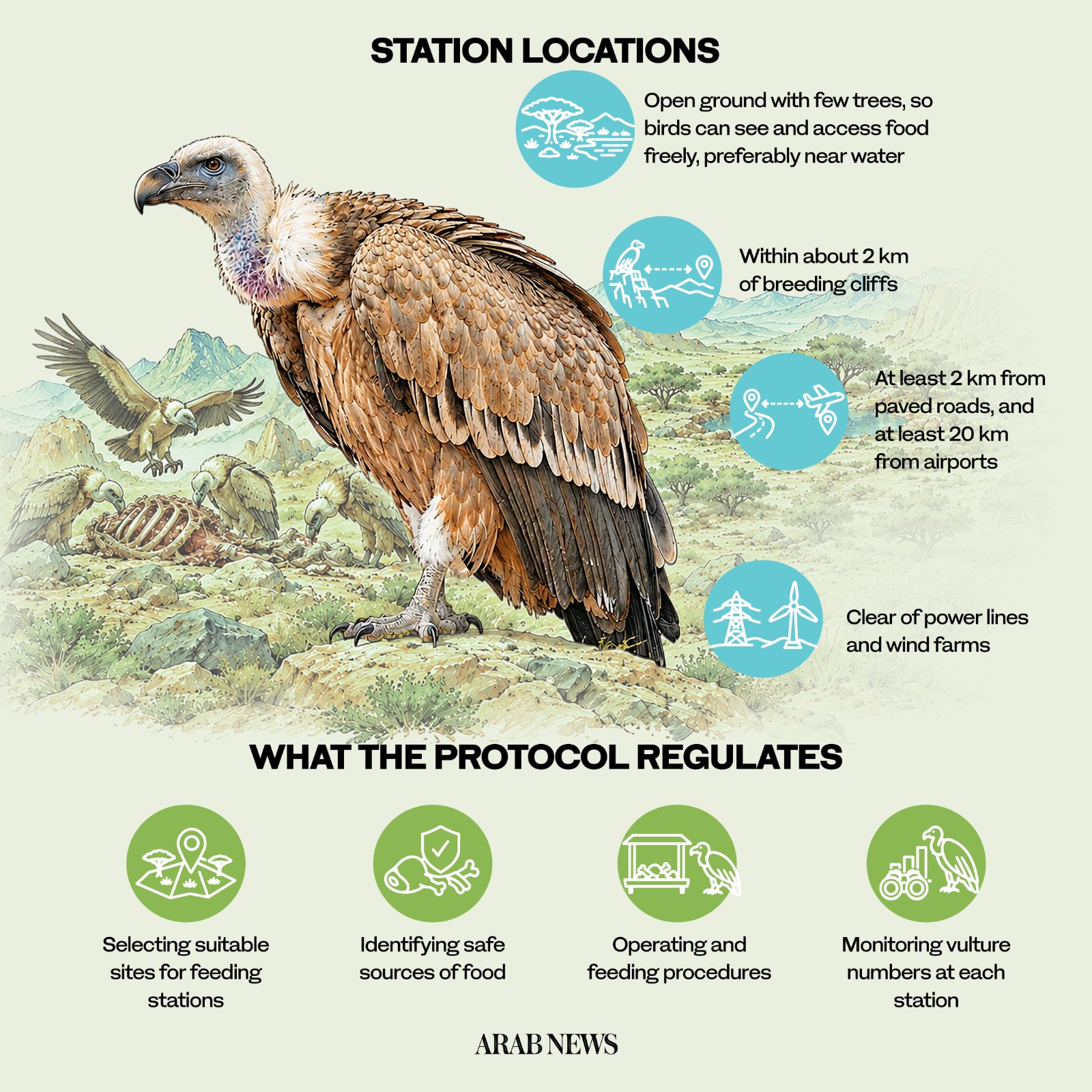
The precautionary approach is reflected in the guide’s feeding requirements. Before a carcass is accepted, its origin and the animal’s cause of death must be established in consultation with veterinary specialists, with testing carried out where necessary.
Carcasses of unknown origin are excluded, as are animals suspected of poisoning or infectious disease. Roadkill is also excluded because of the potential for poisoning.
“External appearance alone is not relied upon to judge the safety of a carcass,” the center said.
Location is equally important. Feeding stations should be established in open areas with few trees, allowing vultures to spot food and land and take off easily, preferably near water.
The technical guidance recommends sites within about 2 km of breeding cliffs, at least 2 km from paved roads and at least 20 km from airports. Power lines and wind farms should also be avoided.
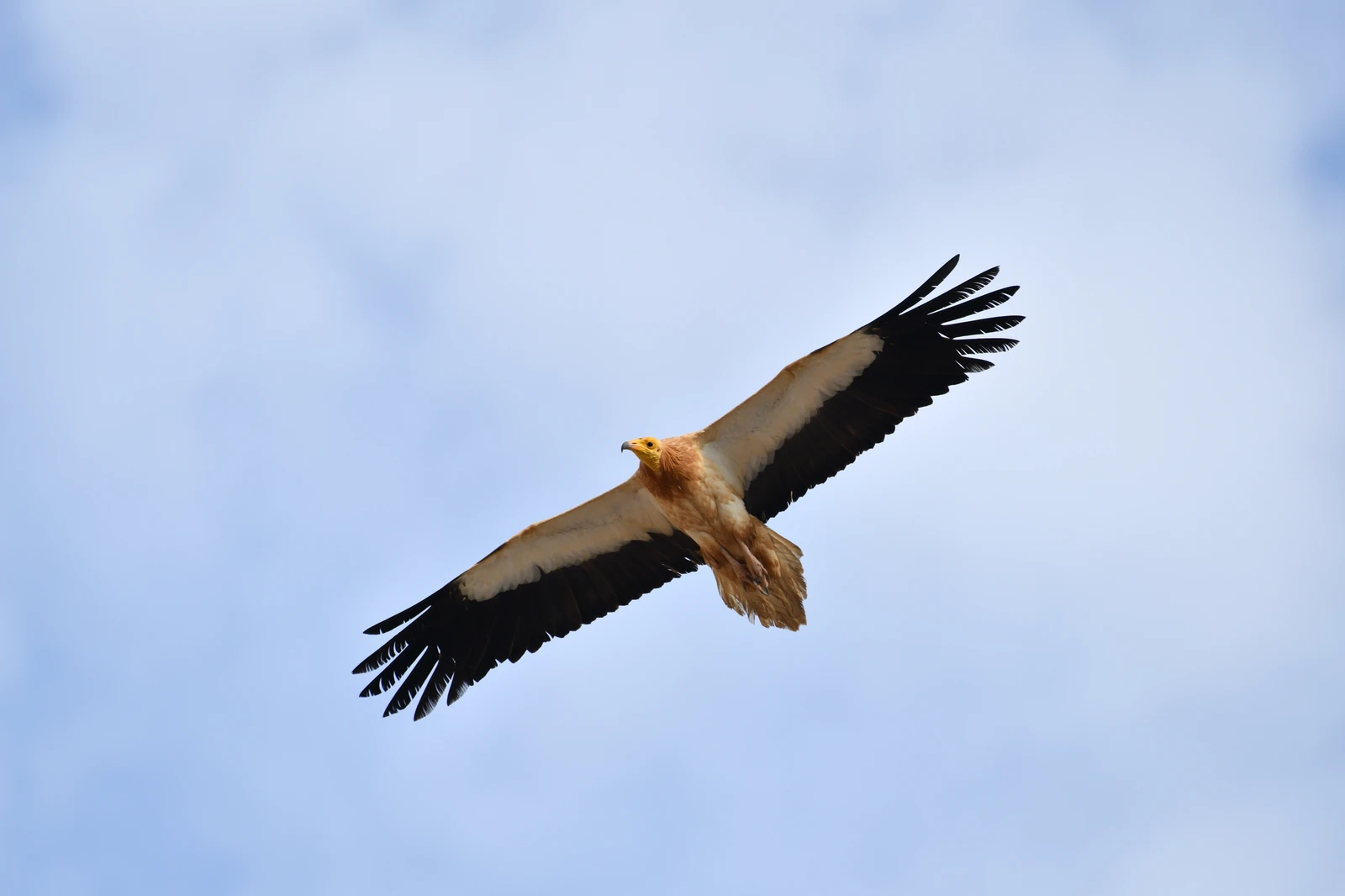
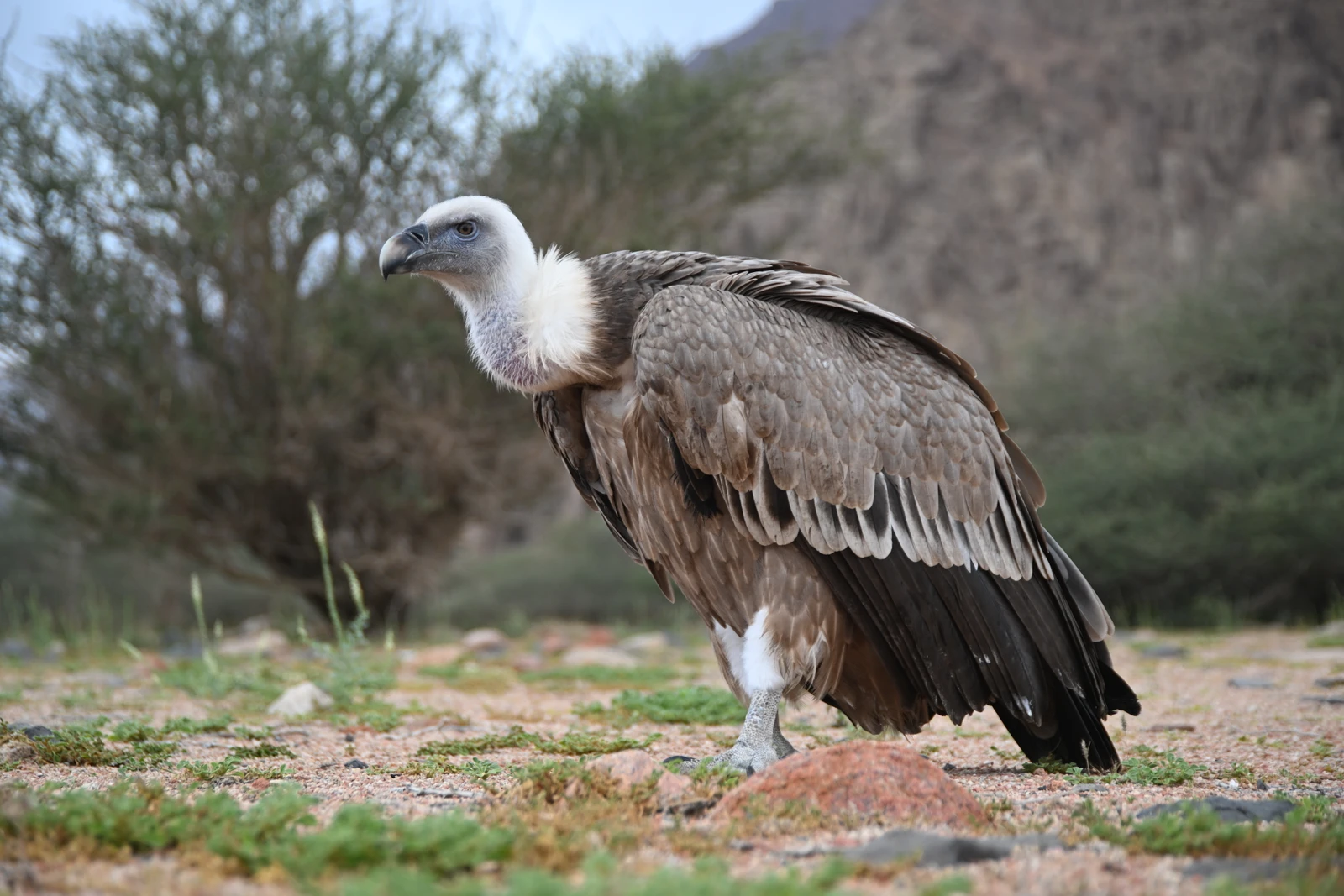
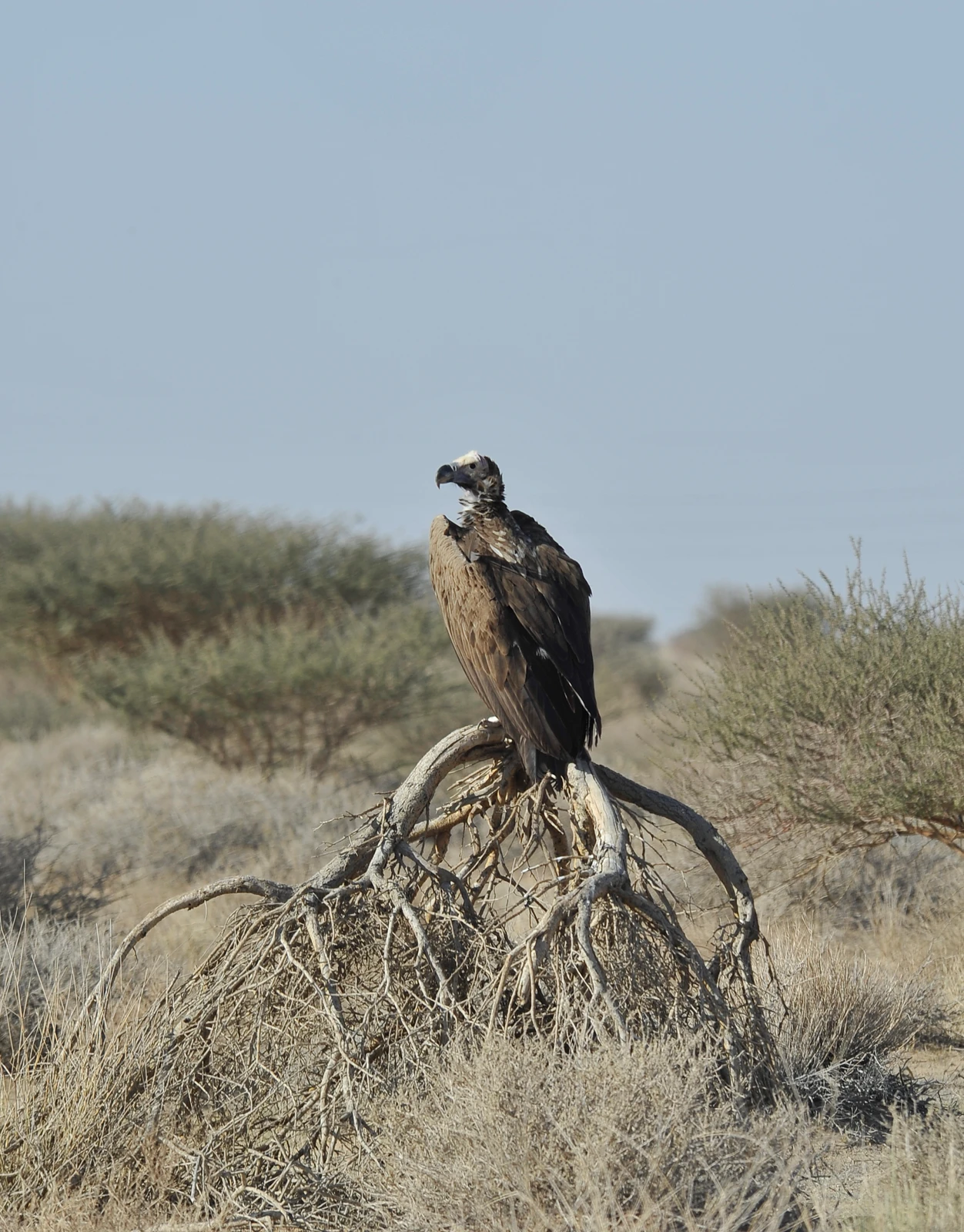
The stations are intended to support several resident and migratory species found in Saudi Arabia, including lappet-faced, Egyptian, griffon, cinereous and bearded vultures.
Griffon and lappet-faced vultures breed in the Kingdom, as do Egyptian vultures, whose local populations are supplemented by wintering and migratory birds. Cinereous vultures are winter visitors.
The bearded vulture is now so scarce that no recent breeding has been confirmed, while both lappet-faced and Egyptian vultures are threatened with extinction.
Saudi Arabia’s position along major migration routes gives the Kingdom an important role in their conservation. Vultures travel through the country from Europe and Asia toward Africa and southern Arabia, while some remain during winter.
“These journeys pass through vast desert areas where opportunities to find food may be scarce,” the NCW said.
Feeding stations, it added, “can give vultures the chance to feed at safer sites and reduce their exposure to contaminated carcasses.”
Monitoring will be central to managing the stations. Camera traps and livestreaming cameras will be used where possible to observe birds without disturbing them, supplemented by field observations from a distance.
Teams will record the date, weather conditions, type and quantity of food and the time it is provided. They will also document visiting species, bird numbers, age groups, behavior and identification markings.
“Success is not measured by the number of visiting birds alone,” the center said. “We also look at the frequency of visits, changes in numbers and breeding outcomes.”
The stations are designed to supplement natural feeding, not replace it or create dependence.
Food is provided in the early morning, allowing vultures to feed during daylight before nocturnal predators become active. Fencing is generally avoided so predators attracted to the site can be observed and recorded.
“Feeding must remain supplementary and directed toward a conservation purpose,” the NCW said, “and must not become a permanent source on which the birds depend instead of their natural food.”
The wider conservation benefits stem from vultures’ role as scavengers. By rapidly consuming carcasses, they help recycle nutrients and reduce opportunities for disease to spread among people, livestock and other wildlife.
Their digestive systems can neutralize many pathogens, while rapid removal of carrion reduces food available to flies, rodents and stray dogs.
“Despite their value to human and planetary health, vultures are among the world’s most endangered birds,” Tatwany said.
Because vultures cross national borders, protecting them also requires cooperation between countries along their migration routes.
“The borders of a single country do not bind vultures,” the NCW said, “and protecting them requires cooperation along the length of their migration routes.”
The center said formally leading a regional network would depend on agreements between countries. It nevertheless expects the guide’s international reach to encourage wider cooperation — “locally, regionally and perhaps internationally.”