- KAUST’s entrepreneurship ecosystem helps startups secure funding and industry partnerships
RIYADH: Saudi Arabia is investing heavily in water and food research, as startups increasingly turn scientific discoveries into commercial ventures, developing solutions to resource challenges and attracting investor interest.
Startups supported by King Abdullah University of Science and Technology have raised approximately $1.4 billion in cumulative funding, reflecting growing investor interest in ventures emerging from the university’s entrepreneurship ecosystem.
“Ultimately, a technology must demonstrate not only scientific merit, but also a clear market need and a credible path to commercial adoption. This is particularly important when attracting private sector investment,” Haitham Al-Humsi, director of Innovation Ecosystem Development at KAUST, told Arab News.
Commercial potential depends on three key considerations: Understanding customers and the problems they face, identifying a market large enough to justify investment, and meeting the regulatory requirements for bringing a product to market.
Namya, a venture established through collaboration between KAUST and Riyadh-based venture builder SEQUENCIVE, is seeking to translate plant science research into agricultural applications. Its first product, Plantiva, is designed to improve crop yields and help plants use water and nutrients more efficiently.
However, launching a product is only the first step. Research findings must translate into reliable results under real-world conditions, with measurable benefits that justify the cost to customers.
KAUST’s entrepreneurship ecosystem illustrates the growing effort to bridge this gap.
“Our latest entrepreneurship ecosystem report shows that KAUST-supported startups have raised approximately $1.4 billion in accumulative funding, with 66 companies securing $338 million between July 2025 and June 2026, an increase of more than 30 percent year on year. Across the portfolio, 282 active startups have generated $1.1 billion in cumulative revenue,” Al-Humsi said.
His work involves helping researchers turn scientific discoveries into marketable technologies and businesses by connecting them with industry partners, investors and opportunities to scale.
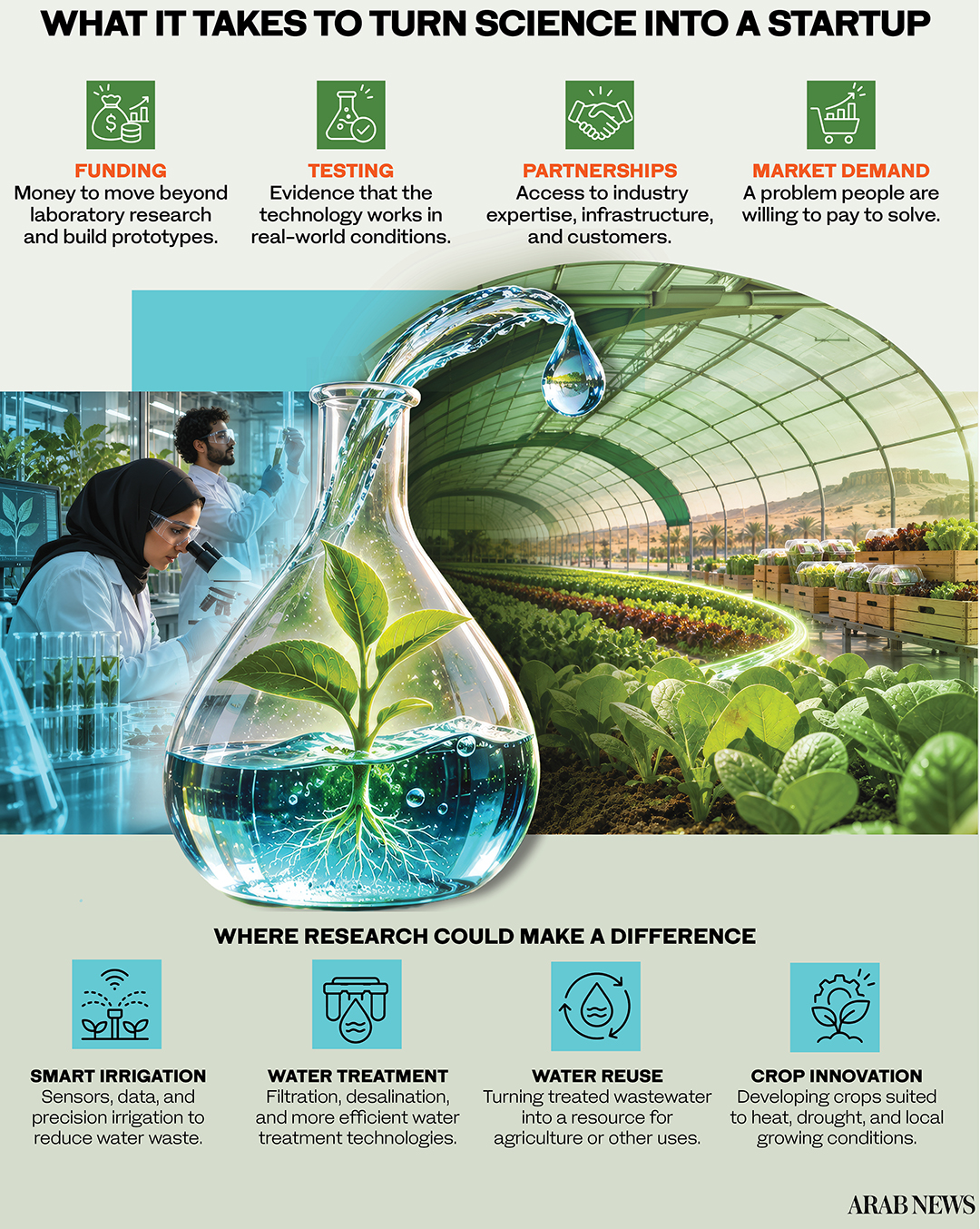
In the water sector, Nurain is working with the National Water Co. on technology demonstrations at Petro Rabigh, with plans for future expansion. Flow Guard, a Hult Prize-recognized startup, focuses on monitoring and managing water waste, while Furat develops technologies to detect and manage biofouling in water systems.
Food and agriculture ventures are also addressing resource efficiency and sustainability.
“In food and agriculture, Edama converts organic waste into valuable soil improvers for agriculture and has secured investment from the Saudi Investment Recycling Co., alongside partnerships with Catrion and Nespresso,” Al-Humsi said. “Terraxy has attracted investment from Wa'ed Ventures and is pursuing scale-up activities in Zulfi, while AKSense is working with the National Center for Palms and Dates. TerraSense is another emerging company within the portfolio.”
PoultrySync’s management platform has been deployed across Arabian Farms facilities in Saudi Arabia and the UAE, supporting operations involving millions of birds and eggs annually. It also works with Golden Chicken and is part of the Saudi Alliance for Agri-Food Technologies.
Barakah addresses food waste through its surplus-food platform and has engaged with the General Food Security Authority on initiatives to reduce waste and promote innovation.
“Together, these companies demonstrate how KAUST’s entrepreneurship ecosystem supports technologies at different stages of development, helping innovators connect with industry, attract investment and develop solutions to real-world challenges,” Al-Humsi said.
To support this transition, KAUST has launched its Venture Studio program, offering technology-based founders structured development, expert mentorship and $125,000 in seed capital to advance their technologies and reach early commercial milestones.
KAUST has contributed approximately $77 million in funding, while 90 percent of its portfolio’s funding comes from external sources, including $33 million from the National Technology Development Program.
“The success of so many of our portfolio companies is a testament to the fact that Saudi Arabia is a great place to grow and scale as a business,” said Dr. Ian Campbell, senior vice president, National Transformation Institute at KAUST.
“KAUST is a vital part of this thriving ecosystem, supporting startups to find commercialization opportunities that help bring their innovations from the lab to the market,” he said.
The university also works with the Ministry of Environment, Water and Agriculture through its Sedra, Sunbolah and Sahabah incubation and acceleration programs, as well as its Partnership Collaboration Office.
One example is SeaCras, an intelligence data company using AI and high-resolution satellite imagery to help organizations and governments monitor and protect marine environments. Founded in Croatia in 2020, the company has established a regional partnership with MEWA through its Sedra program.
“There was a need to act fast to develop solutions for the large-scale, low-cost monitoring of seas, coastal waters, and inland water systems, such as lakes and rivers,” CEO and founder Mario Spadina told Arab News. “Scientific research and academia played — and still play — an enormous part in our product development, not only for quality control, but also for disseminating the generated knowledge and technology. It is the most natural way to expand globally: Teaming up with local scientific and academic partners to solve the real challenges that people, industry, and governments face in specific areas.”
SeaCras provides monitoring data to support the management of marine and water resources, while helping clients assess costs, sustainability impacts and environmental and social changes.
Its solutions are deployed across four continents, serving ports, aquaculture companies, fisheries, marine protected areas, hotels, wildlife reserves, environmental agencies and government ministries.
“Given that SeaCras provides environmental monitoring of seas, coastal waters, and water systems using satellites and deep-tech analysis, the Sedrah program helped us understand the legal, financial, and market aspects of deploying technology and creating value within the Kingdom of Saudi Arabia,” Spadina said.
Adapting research to local conditions, however, remains a challenge. Much of the world’s water and agricultural data comes from climates significantly different from the region, making technologies developed elsewhere difficult to apply without local validation.
“Getting from a lab result to a product in the market is the slowest and most expensive step in science everywhere in the world. Saudi Arabia is already showing it can be done in water and food. AI can make it faster and cheaper,” academic and AI expert Prof. Mohammed Al-Qarni told Arab News.
Artificial intelligence is increasingly helping startups assess the viability of technologies before committing to expensive pilots and field trials.
“Take a new desalination membrane, a water reuse process or a crop treatment built for saline soil. Before anyone builds a pilot plant or plants a test field, AI can model how it performs across different water qualities, temperatures, energy prices and production volumes. You can run a thousand trials on a computer before you run one in the desert. The strongest ideas reach investors sooner, with evidence instead of promises,” Al-Qarni explained.
Beyond technology development, researchers must secure funding, establish viable business plans and demonstrate their products under conditions that convince potential customers.
“Solutions proven in controlled greenhouses or benchtop cells often behave differently under Saudi Arabia’s extreme heat, soil salinity, and water scarcity,” Alia Omar Bahanshal, founder and CEO of Aurora AI Consultancy Firm, told Arab News.
“As ventures like Namya and Terraxy, backed by KAUST and the Ministry of Environment, Water and Agriculture move innovations into the market, artificial intelligence acts as a vital connective tissue across the entire commercialization pipeline.”
AI can help researchers identify commercially viable technologies suited to local climate conditions, accelerate development through digital twins and simulations, and assess market demand by forecasting water stress and calculating ownership costs for farms and utilities.
Bahanshal explained: “At the industrial stage, AI optimizes local feedstock supply chains, maintains manufacturing consistency during scale-up, and powers advisory tools that help end users adopt new inputs with confidence.
“Ultimately, while AI does not replace wet-lab science, agronomy, or engineering, it compresses the cycle between discovery, validation, and commercial scale — a decisive advantage when building resilient food and water businesses in harsh climates.”