- Investors back KAUST-linked ventures tackling water scarcity and food security
- Research startups secure $338m as commercialization accelerates
Saudi Arabia is investing heavily in water and food research, as startups increasingly turn scientific discoveries into commercial ventures, developing solutions to resource challenges and attracting investor interest.
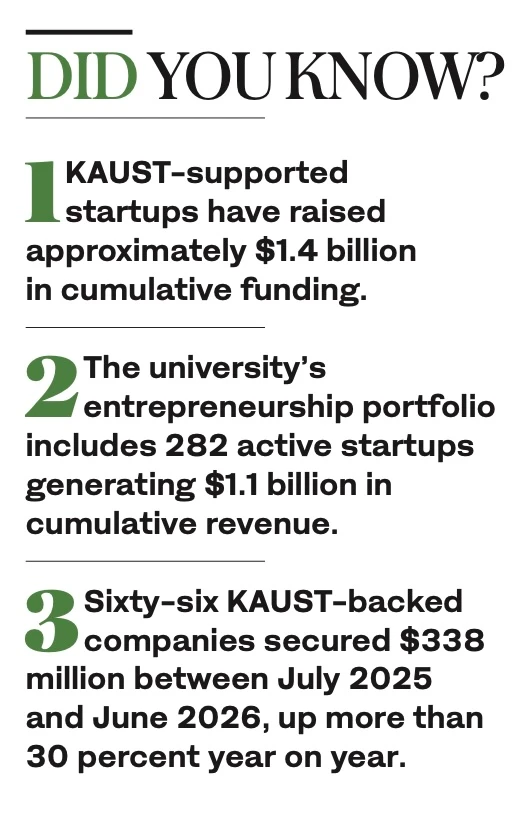
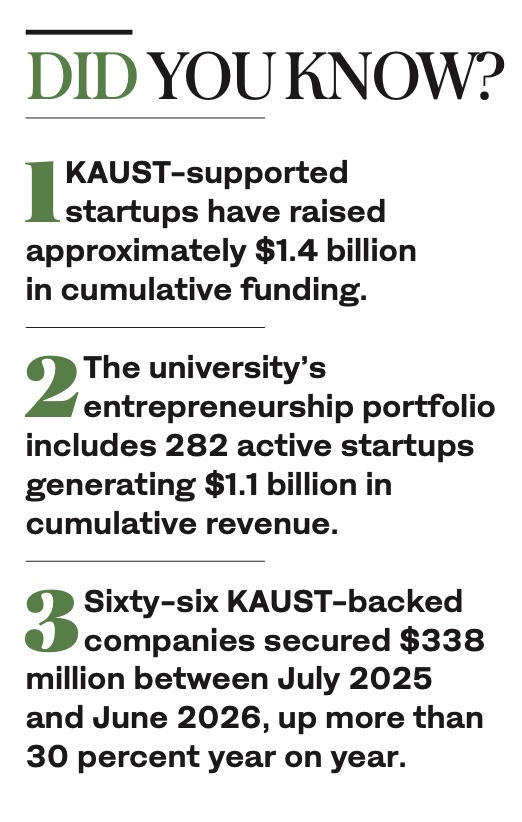
Startups supported by King Abdullah University of Science and Technology have raised approximately $1.4 billion in cumulative funding, with 66 companies securing $338 million between July 2025 and June 2026, an increase of more than 30 percent year on year. The university’s 282 active startups have generated $1.1 billion in cumulative revenue.
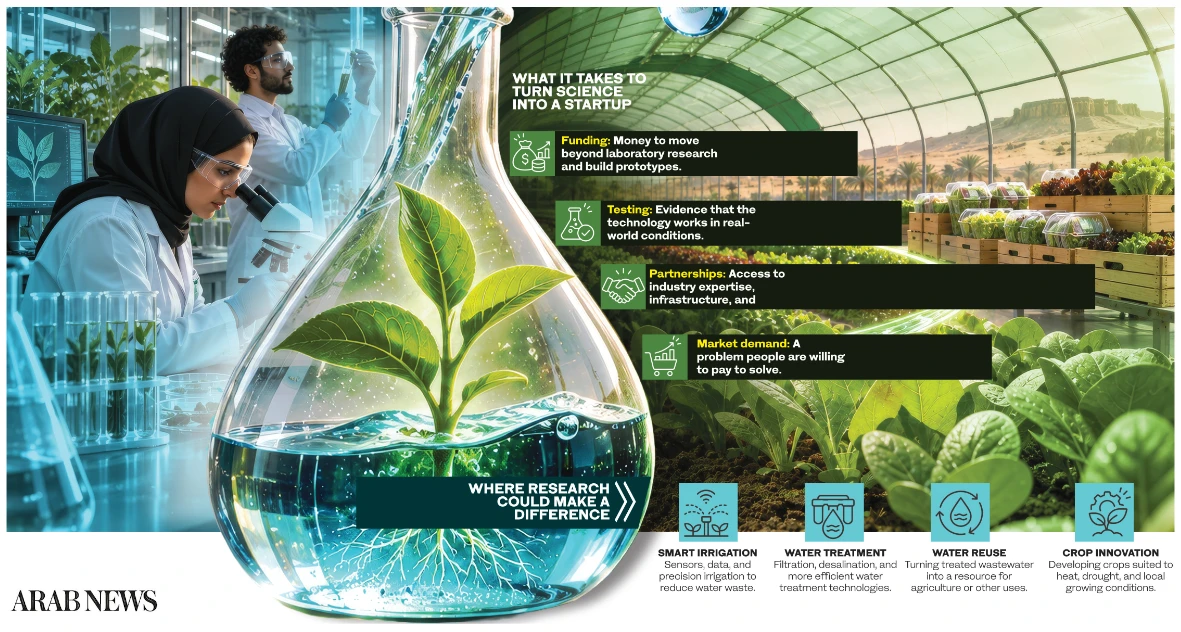
“Ultimately, a technology must demonstrate not only scientific merit, but also a clear market need and a credible path to commercial adoption. This is particularly important when attracting private sector investment,” Haitham Al-Humsi, director of Innovation Ecosystem Development at KAUST, told Arab News.
One example is Namya, a venture established by KAUST and Riyadh-based venture builder SEQUENCIVE.
Its first product, Plantiva, aims to improve crop yields and help plants use water and nutrients more efficiently.
Other ventures are addressing challenges across the water and agriculture sectors.
KAUST’s Venture Studio program further supports technology-based founders through expert mentorship and $125,000 in seed capital.
The university also works with the Ministry of Environment, Water and Agriculture through incubation and acceleration programs. One beneficiary is SeaCras, a Croatian-founded company using artificial intelligence and satellite imagery to monitor seas, coastal waters and inland water systems.
“Scientific research and academia played — and still play — an enormous part in our product development, not only for quality control, but also for disseminating the generated knowledge and technology,” SeaCras CEO and founder Mario Spadina told Arab News.
Adapting technologies to local conditions remains crucial, as solutions developed in other climates may not perform similarly under Saudi Arabia’s heat, soil salinity and water scarcity.
“Getting from a lab result to a product in the market is the slowest and most expensive step in science everywhere in the world. Saudi Arabia is already showing it can be done in water and food. AI can make it faster and cheaper,” academic and AI expert Prof. Mohammed Al-Qarni told Arab News.
“Solutions proven in controlled greenhouses or benchtop cells often behave differently under Saudi Arabia’s extreme heat, soil salinity, and water scarcity,” said Alia Omar Bahanshal, founder and CEO of Aurora AI Consultancy Firm.
“Ultimately, while AI does not replace wet-lab science, agronomy, or engineering, it compresses the cycle between discovery, validation, and commercial scale — a decisive advantage when building resilient food and water businesses in harsh climates,” she said.