BEIRUT/ANKARA/BAGHDAD: Syrian President Bashar Assad issued a decree forming a new government yesterday as massacre continues in the country.
The new government will be headed by a key loyalist and the foreign, defense and interior ministers kept their jobs.
The move comes as fears mounted that the conflict was aggravating regional tensions. Turkish President Abdullah Gul said yesterday his country would take retaliatory steps against Syria after Syrian forces shot down a Turkish military plane.
It was not clear if Gul was suggesting military retaliation, increased sanctions against Syria or other possible steps, including demands for an apology, and his aide would not comment on his words.
Syria's new government is headed by Riad Farid Hijab, a former agriculture minister and a loyalist member of the ruling Baath Party.
A deadly uprising has convulsed Syria for more than a year, and Assad has promised to enact political reforms. He vowed after the May 7 parliamentary elections to make the government more inclusive to politicians from other parties.
But the appointment of Hijab and the decision to keep the key posts unchanged raised questions about the commitment to that pledge.
The opposition boycotted the parliamentary elections, saying they were designed to strengthen Assad's grip on power.
In a sign of how the conflict is bleeding outside its borders, Syria said Friday it shot down a Turkish military plane that entered Syrian air space. It was the clearest and most dramatic escalation in tensions between the two countries, which used to be allies before the Syrian revolt began. Turkey has become one of the strongest critics of the Syrian regime's response to the uprising.
Gul said his country would take action against Syria but suggested that the aircraft may have unintentionally violated the Syrian airspace.
The plane, an unarmed F-4, went down in the Mediterranean Sea about 13 km away from the Syrian town of Latakia, Turkey said.
During a news conference yesterday in Baghdad, Iraqi Foreign Minister Hoshyar Zebari said the incident showed how explosive the Syrian conflict could be for the region. "This is a serious escalation," he said. "It is a security matter for Europe. It is a concern for the region and that is why we called for a calculated, well-drawn, democratic political transition. We do not want to see chaos in the region."
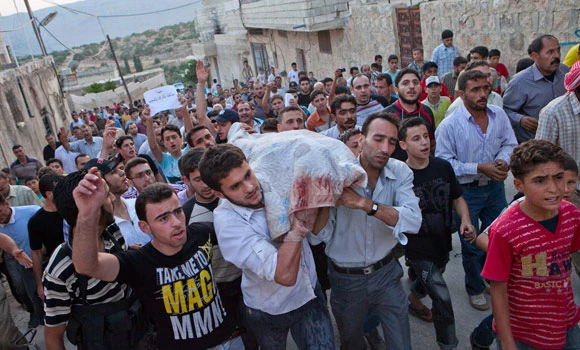
Zebari warned of the danger that the Syrian crisis might spill over into neighboring states, and insisted that Iraq have a role in the future of Syria. Syria's army battled rebels and shelled neighborhoods in Deir Al-Zor yesterday, killing at least 28 people in the eastern city, opposition activists said.
The victims, who included three women and several children, were mostly civilians killed when shells hit their houses in the city's Old Airport and Al-Hamidya districts, a source at a city hospital told said.
"The death toll is likely higher. There are more bodies at the morgue, but they have not been identified yet," the source said.
In the central province of Homs, five civilians were killed by gunfire and shelling by regime troops, including two in the rebel stronghold of Qusayr and a third elsewhere in the province.
The others were killed in the Khaldiyeh and Baba Amr districts of Homs city, where the Britain-based watchdog said troops have bombarded several neighborhoods in an attempt to regain control. Also in central Syria, two civilians were killed in the city of Hama in a dawn ambush by regime forces, and a third was killed when clashes broke out between troops and rebels elsewhere in Hama province.
In the town of Mahaja in the southern province of Daraa, the cradle of the revolt against the regime of President Bashar al-Assad, shooting broke out as troops used tanks to storm the area.
Elsewhere in Daraa, one civilian was killed in gunfire in a raid by regime troops, while in northern Aleppo province, two people, including a rebel fighter, were killed.
Assad retains old guard as 40 slain amid Turkey jet tensions