VIENNA: Iran has met a key commitment under a preliminary nuclear deal setting up the current talks on a final agreement, leaving it with several tons less of the material it could use to make weapons, according to a UN report issued Wednesday.
Obtained by The Associated Press, the confidential International Atomic Energy Agency report said more than four tons of the enriched uranium had been fed into a pipeline that ends with conversion of it into oxide, which is much less likely to be used to make nuclear arms.
The report indicated that only several hundred pounds of the oxide that is the end product had been made. But a US official told the AP the rest of the enriched uranium in the pipeline has been transformed into another form of the oxide that would be even more difficult to reconvert into enriched uranium, which can be turned into the fissile core of nuclear arms.
The official said that technical problems by Iran had slowed the process but the United States was satisfied that Iran had met its commitments to reduce the amount of enriched uranium it has stored. He demanded anonymity because he was not authorized to discuss the confidential review process.
The report did not say where the rest of the material was. But it appeared to confirm the US official’s description of the material being somewhere in the conversion line. That’s because the figures provided by the IAEA indicated that it was not added to Iran’s stockpile of low-enriched uranium.
Low-enriched uranium can be enriched further for weapons purposes. The interim accord capped Iran’s low-enriched uranium stockpile at 7.6 tons. If it went over that limit, it would have to convert the remainder into oxide.
The IAEA report said that stockpile was just under that level as of Tuesday.
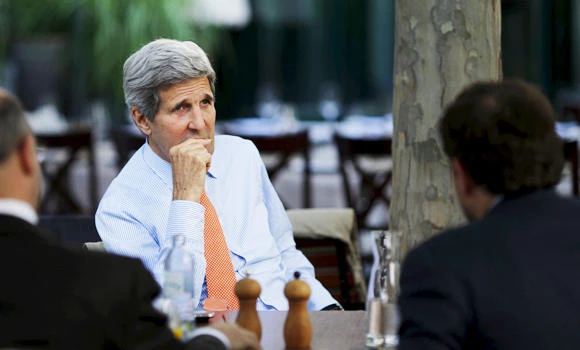
The report was circulated among the 35-nation IAEA board and the UN Security Council as the IAEA chief left for Tehran to meet with Iranian President Hassan Rouhani and US Secretary of State John Kerry met again in Vienna with Iran’s foreign minister.
In his talks in Tehran on Thursday, IAEA chief Yukiya Amano hopes to “accelerate the resolution of all outstanding issues related to Iran’s nuclear program, including clarification of possible military dimensions,” the Vienna-based agency said in a statement. Iran’s Mehr news agency said Amano will “receive Iran’s alternative proposal” to the proposed questioning of its nuclear scientists.
Confidential UN report ‘positive’ on Iran nuclear commitments