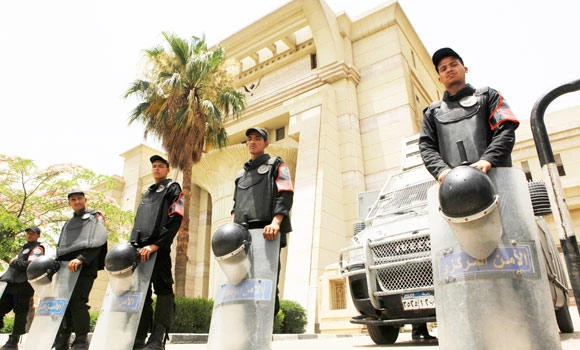
CAIRO: Egypt’s highest court ruled yesterday that the nation’s legislature and constitutional panel were illegally elected, dealing a serious blow to the legal basis of Muslim Brotherhood's hold on power.
The ruling by the Supreme Constitutional Court says that the legislature’s upper house, the only one currently sitting, would not be dissolved until the Parliament’s lower chamber is elected later this year or early in 2014. The constitutional panel has already dissolved after completing the charter.
But the ruling nonetheless deepens the political instability that has gripped the country since the overthrow of authoritarian leader Hosni Mubarak two years ago.
The same court ruled to dissolve Parliament’s lower chamber in June, a move that led to the promotion of the toothless upper chamber, the Shoura Council, to becoming a law-making house. The Shoura Council, long derided as nothing more than a talk shop, was elected by about seven percent of the electorate last year.
It was not clear whether the ruling on the 100-member constitutional panel would impact in any way on the charter it drafted. The constitution was adopted in a nationwide vote in December with a relatively low turnout of about 35 percent.
But even if it does not, the ruling will question the legal foundations of the disputed charter pushed through by allies of President Muhammad Mursi in an all-night session late last year. Critics say the charter restricts freedoms and gives clerics a say in legislation. The new parliamentarians who drafted it hail the document as the best one Egypt ever had.
Regardless of their consequences on the ground, the ruling is likely to prolong the polarizing political transition that followed Mubarak’s overthrow. Rival political groups disagree not just on policies and the future course of the nation but on the legitimacy of the basic institutions of government.
It will give heart to the mostly secular and liberal opposition, while providing fresh ammunition to the argument often repeated by the president’s supporters that the judiciary is filled with Mubarak loyalists determined to derail the nation’s political process.
In both rulings on Parliament’s two chambers, the court contended that political parties that fielded candidates for the third of seats set aside for independent candidates, as allowed by the election law, amounted to a breach of the principle of fairness.
The Shoura Council’s critics say it is ill-equipped to be the nation’s sole law-making body, and complain that it’s considering legislation that will have a far reach into the future rather than simply pass what is absolutely necessary during the transition period. The court also ruled unconstitutional clauses in a 1958 law giving the president far-reaching powers under a state of emergency.
Court: Egyptian Shoura Council and constitution panel ‘invalid’