WASHINGTON: US experts Wednesday urged Washington to drop its cautious stance and boost backing for Syrian rebels, including possible arms and air support, to avoid further bloodshed and atrocities.
They also told US lawmakers that as the Syrian regime begins to move its stockpiles of chemical weapons, the US administration must spell out red lines to President Bashar Assad on what would spark military intervention.
“It would be comforting to think that Assad knows that using such weapons of mass destruction would be crossing a red line — but unfortunately that would be too optimistic,” Andrew Tabler, senior fellow at the Washington Institute for Near East Policy, told the Senate Foreign Relations committee.
Their warning came as UN spokesman Martin Nesirky said in New York that the UN mission in Syria had confirmed that opposition forces in the city of Aleppo have “tanks” and “heavy weapons.”
Unarmed observers from the UN Supervision Mission in Syria went to the northern city on Tuesday.
UNSMIS has also reported seeing a fighter jet attacking Aleppo.
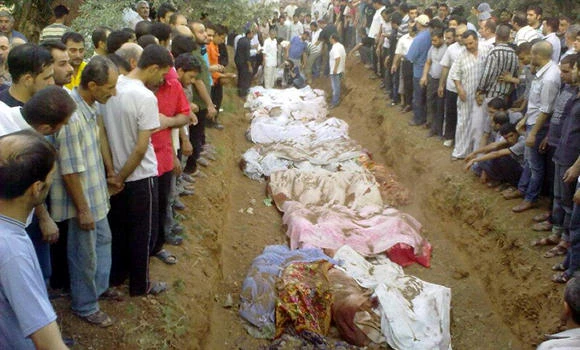
US experts also warned that the lack of stronger US action could also leave the way open for militants to move in and exploit the confusion, perhaps triggering a drawn-out sectarian conflict, and presaging an even more difficult situation once President Bashar Assad falls.
The United States on Wednesday denounced Syrian President Bashar Assad as “cowardly” and “despicable” for calling on his forces to continue the fight against opposition rebels.
“We think it’s cowardly quite frankly to have a man who’s hiding out of sight be exhorting his armed forces to continue to slaughter the civilians of his own country,” said a US State Department spokesman, Patrick Ventrell.
“We think it’s despicable to be exhorting his armed forces to continue this slaughter, and this bloodshed,” Ventrell said, reacting to a speech by Assad published by Syria’s official news agency SANA.
Earlier Wednesday Assad said that the Syrian army was engaged in a “crucial and heroic battle... on which the destiny of the nation and its people rests” in a speech marking the 67th anniversary of the army.
“The enemy is among us today, using agents to destabilize the country, the security of its citizens... and continues to exhaust our economic and scientific resources,” Assad said.
Damascus does not recognize the popular revolt that erupted in March 2011, describing opposition activists and rebels of the Free Syrian Army (FSA) alike as “armed terrorist groups” financed by foreign powers and sent to sow chaos.
Little appetite for action
So far, Washington has refused any talk of US military engagement in Syria and limited its backing for the Syrian opposition to non-lethal support such as communications equipment, with some $25 million set aside for such aid.
It has also provided a further $64 million for humanitarian assistance, such as helping set up camps for the tens of thousands of refugees streaming across the borders of Syria into neighboring Jordan and Turkey.
Just three months before US presidential elections and as the nation withdraws troops in Afghanistan, there is little appetite for any US military action in Syria.
Instead, the administration of President Barack Obama has focused on working to bring together the fractured Syrian opposition in a bid to tip the scales in the 17-month conflict that has claimed an estimated 20,000 lives.
Committee chairman, Democratic Senator John Kerry, said it was “imperative to work to expedite President Assad’s exit,” adding it was perhaps time to shift emphasis and work more closely with organizations such as NATO.
“What is clear is that we cannot appear to be feckless, or impotent, or ineffective, in the face of this kind of use of force by anybody against their own people with the implications that it has for the region itself,” Kerry said.
But he cautioned that the United States needed to remain “clear-eyed,” saying the United States could not just “willy-nilly commit some forces to a conflict without... a clear objective, and certainly without sober evaluation of the implications.”
“With respect to a red line, I can’t go into the details here, but I tell you there’s a red line, and people know what it is. The people who need to know, know what it is,” Kerry said.
But US senators were warned that the longer the conflict in Syria drags on, the greater the danger of mass atrocities and that the lack of stronger US action could also pave the way for a drawn-out sectarian conflict.
“The consequences are very bad, and they are coming down the road... that’s why I think it’s important for us to step up active engagement, but to do it in a wise way,” Martin Indyk, ex-US ambassador to Israel, said.
Indyk, now director of the foreign policy program at the Brookings Institution, warned however that “we need to know who we are arming,” saying he was not sure the United States had a clear handle yet on all the different groups that make up the Syrian opposition and their objectives.
Director for international security at the RAND Corporation James Dobbins said one further step could be imposing a “no-fly” zone over some or all of Syria, which would require some kind of US participation.
“Doing so would present a tougher challenge than faced during the air campaigns over Bosnia, Kosovo, Afghanistan or Iraq, in none of which the United States lost a single pilot, but the task is hardly beyond the capacity of the United States,” he told senators.
He also argued that if Syrian forces began systematically using fixed-wing aircraft against the opposition, that could be designated as another “red line” for greater US engagement.
But Dobbins, a former US ambassador to the European Union, cautioned there should be pre-conditions including that the Syrian opposition asked for help, and that the Arab League endorsed any such call.
Most NATO allies should also support the plan, but while a UN Security Council mandate would be “highly desirable, as demonstrated in Kosovo, (it is) not absolutely necessary,” he said.