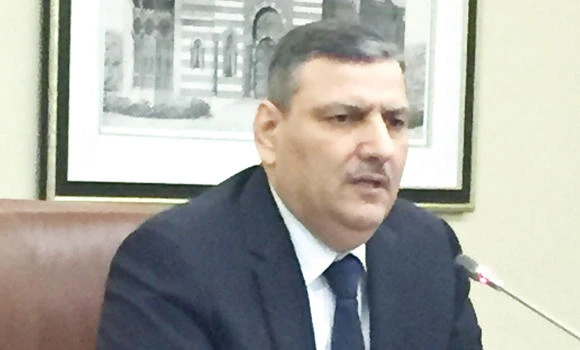
RIYADH: Syria’s former Prime Minister Riad Hijab, who is the general coordinator of the Supreme Organization of the Syrian Revolution and Opposition, announced on Wednesday, names of three persons who would hold talks with the Syrian regime to end the crisis.
The three are Mohammed Alloush, a political figure in the Jaish Al-Islam (Army of Islam), George Sabra, an opposition politician and Asaad Al-Zoubi, another opposition figure, who will head the negotiating team.
Hijab stressed he would not allow any third party to get involved in such talks, brushing aside Russia’s interest to take part in the discussions.
Hijab said his organization does not want Russian interference in Syrian affairs. “Syria now suffers from injustice, especially the massacre of Syrian citizens by Russians,” he said. The talks are set to begin on Jan. 25.
Hijab, who heads the council formed in Riyadh last month, accused Russia of impeding negotiations, and also told a news conference in Riyadh that the opposition could not negotiate while Syrians were dying from blockades and bombardment.
The peace talks aim at ending the country’s five-year conflict, in which more than 250,000 people have died, and also at setting up a transitional government and eventual elections.
Recalling a meeting with United Nations special envoy for Syria Staffan de Mistura last week, Hijab said that the group sent a proposal for the agenda of the negotiations based on Geneva 1 and UN Security Council resolution.
In the agenda, he said: “We have focused on the political transition of power to stop the bloodshed of innocent Syrian people. We do not want Bashar Assad and his government to be a part of this process. We also stress the Importance of maintaining the unity of Syria.”
Hijab wants the talks to be based on the Geneva 1 agreements and United Nations Security Council Resolution 2118 which means the formation of a transitional government with full executive powers. “We are going into negotiations on this principle, we are not entering talks (based on) anything else. There will be no concession,” he said.
— Dina Fouad contributed to this report
Hijab names negotiators for Syria talks, raps Russia