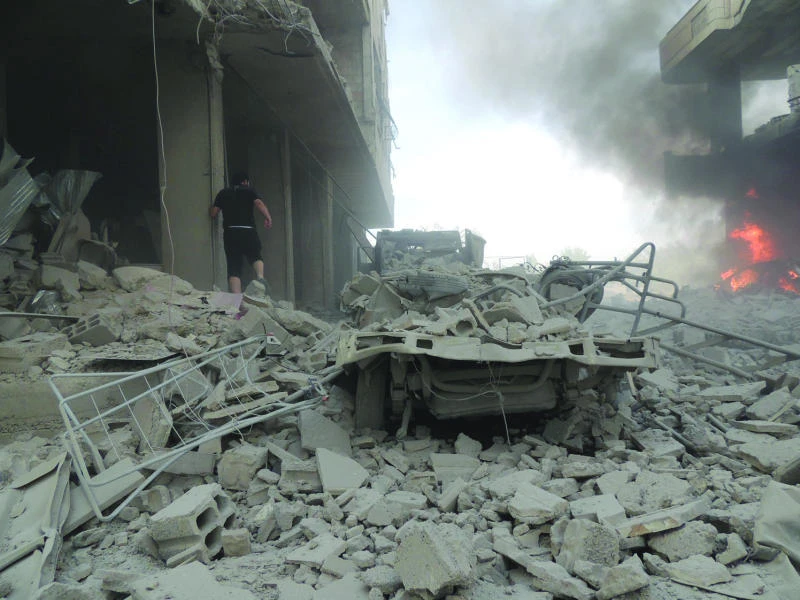
BEIRUT: Heavy fighting raged around the strategic Syrian border town of Qusayr and the capital Damascus yesterday and further reports surfaced of chemical weapons attacks by President Bashar Assad’s forces on rebel areas.
The Syrian military pounded eastern suburbs of Damascus with air strikes and artillery and loud explosions echoed around Al-Nabak, 80 km north of the capital, where fighting has cut the highway running north to the central city of Homs, the pro-opposition Syrian Observatory for Human Rights group said.
UN Secretary-General Ban Ki-moon voiced “deep concern” overnight at Hezbollah’s admitted combat role and the risk that the Syrian conflict will spill into Lebanon and other neighboring states.
Ban urged all concerned “immediately to cease supporting the violence inside Syria and instead to use their influence to promote a political solution to Syria’s tragedy.”
In Harasta, an eastern Damascus suburb largely under rebel control, dozens of people were suffering the effects of an apparent overnight chemical attack, according to opposition sources. Video showed victims lying on the floor of a large room, breathing from oxygen masks.
The sides in the conflict, now in its third year, have accused each other of using chemical weapons. France’s Le Monde newspaper published first-hand accounts yesterday of apparent chemical attacks by Assad’s forces in April.
The newspaper said one of its photographers had suffered blurred vision and respiratory difficulties for four days after an attack on April 13 on the Jobar front, in central Damascus.
Another video from Harasta overnight showed at least two fighters being put into a van, their eyes watering and struggling to breathe while medics put tubes into their throats.
A doctor interviewed in another video said the alleged chemical attack in Harasta was revenge for a rebel raid on nearby military checkpoints. He complained of a severe shortage in staff and medical supplies to treat “dozens of wounded.”
As Washington and Moscow seek to bring the warring parties to the negotiating table, European Union foreign ministers gathered in Brussels to discuss calls from Britain and France to ease an EU embargo on arming Syrian rebels.
All EU sanctions on Syria could collapse unless the 27-nation bloc agrees on the fate of the arms embargo before it expires on June 1, but several EU members oppose any change.
British Foreign Secretary William Hague signaled that Britain was prepared to see EU sanctions fall apart rather than retreat from his demand to give more support to rebels. If the EU could not agree, then “each country will have to ensure it has its own sanctions,” Hague declared.
The opposition crisis deepened yesterday when liberals were offered only token representation, undermining international efforts to lend the conservative-dominated alliance greater support.
To the dismay of envoys of Western and Arab nations monitoring four days of opposition talks in Istanbul, the 60-member Syrian National Coalition thwarted a deal to admit a liberal bloc headed by opposition campaigner Michel Kilo.
Syria chemical attacks reported