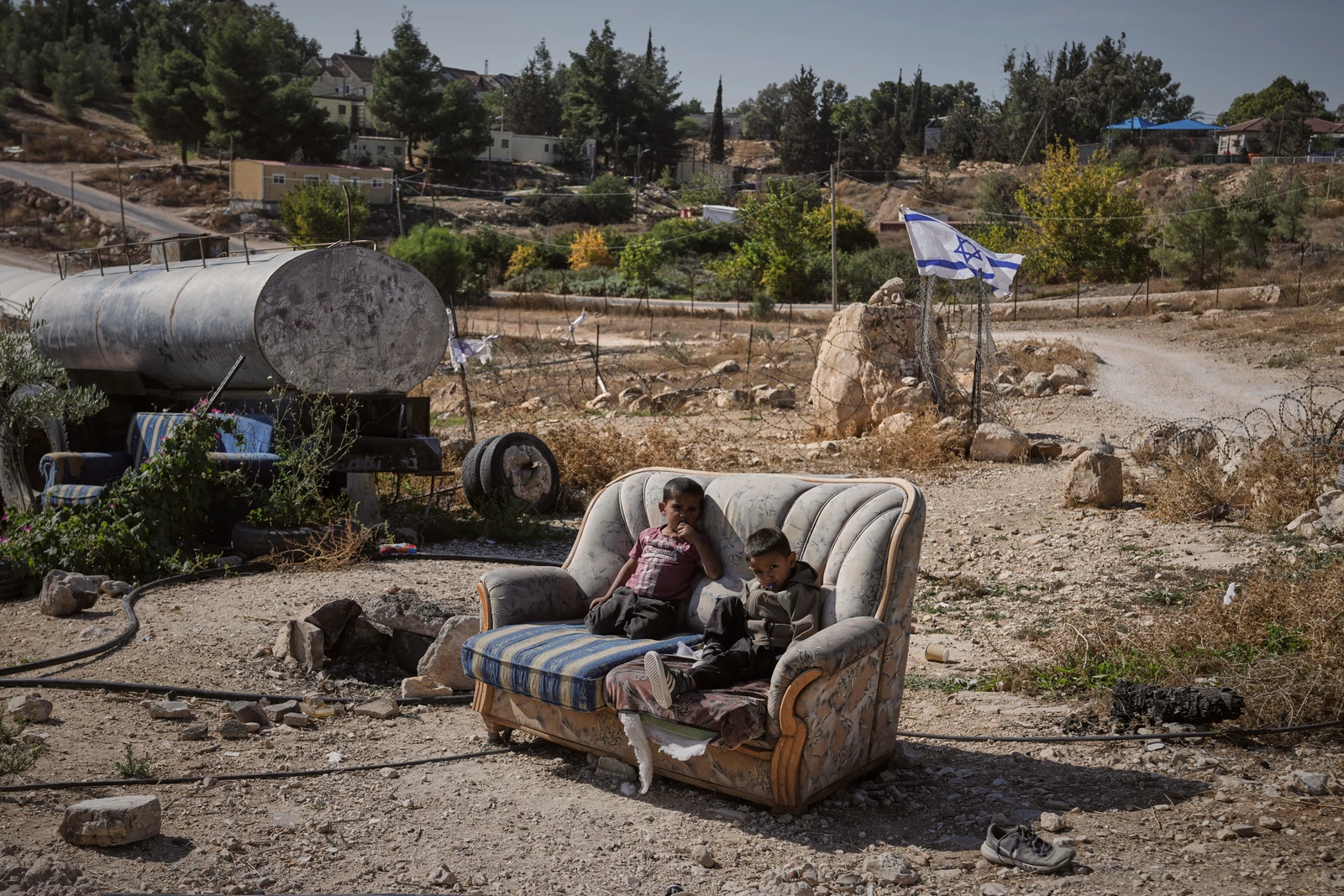
- First new sanctions since British government’s shift to a harder line on firms that build and sell settlement homes come shortly before bids close on E1 development near Jerusalem
- ‘My message on E1 is clear: do not bid, do not build and do not profit from the destruction of the two-state solution,’ says Foreign Secretary Ed Miliband
NEW YORK CITY: UK authorities on Tuesday sanctioned eight Israeli companies involved in the planning, building and selling of homes within settlements in the occupied West Bank, as well as Tzav 9, a right-wing activist movement that has repeatedly blockaded aid convoys bound for Gaza.
The measures were announced shortly before the final deadlines for tenders on Israel’s E1 development, a settlement project near Jerusalem that London says threatens the prospects for establishing a viable Palestinian state.
All nine of the newly sanctioned organizations face asset freezes, and director disqualifications that bar individuals connected with them from managing, forming or running companies in the UK.
It is the first package of sanctions since the British government reset its approach to Israel’s actions in the West Bank in September, shifting from verbal criticism to punitive and regulatory measures. The aim is to cut off the firms’ financing and their ability to support further construction projects.
“Protecting the two-state solution is the North Star of this Government's approach,” the British foreign secretary, Ed Miliband, said.
“That is why my message on E1 is clear: do not bid, do not build, and do not profit from the destruction of the two-state solution.”
He also warned that Britain “will not stand by while those blocking desperately needed aid deepen the intolerable suffering of civilians in Gaza.”
UK authorities accused the Israeli government of facilitating and encouraging the expansion of settlements rather than trying to prevent it. They said Israel had approved more settlements during the four-year term of the most recent government than in the previous 20 years. Britain still welcomes trade with Israel originating inside of the Green Line that separates it from Gaza and the West Bank, but draws a firm line between such trade and settlement activity, they added.
The sanctioned firms are collectively involved at every stage of the settlement supply chain, from the drawing board to sales offices.
For example, Har Hevron Development Company carries out construction and infrastructure work for settlements and outposts in the southern West Bank and supplies them with housing units. Hemdat Shomron builds and markets housing in settlements including Einav, Kfar Tapuach, Peduel, Ma’ale Efrayim, Mitzpe Yericho and Dolev. SAG Construction and Development builds homes and public buildings in Efrat, Shilo and Eli.
Lev HaHar Yazamut develops housing in Itamar, Elon Moreh, Bruchin, Rechelim and Neria. Ariel Residential Judea and Samaria operates in Ariel, Alei Zahav, Pedu'el, Metzad and Efrat.
Britain warned that the E1 settlement would “cut across the heart of Palestine” and could separate the West Bank from East Jerusalem. It renewed its call, shared with the wider international community, for Israel to halt the project immediately and withdraw the tender invitation.
The stated mission of Tzav 9, meanwhile, is to prevent humanitarian aid from entering Gaza. British authorities say the group has organized blockades of border crossings, ports and roads used by aid convoys as recently as October.
The humanitarian situation in Gaza is getting worse as winter sets in. About 1.4 million people are living in tents or makeshift shelters, and floods have left nearly 4,000 households without shelter.
UN figures reveal that more than 150,000 tents and 300,000 tarpaulins, bought and paid for by donors and aid organizations, continue to be held outside of Gaza by Israeli authorities. Because they continue to block shipments of timber, no emergency shelter kits are available inside the territory.
On Nov. 12, Britain brought together more than 50 countries at the UN to call on Israeli authorities to lift their restrictions and allow significantly more aid to enter Gaza. This followed a UK-led “Call to Action” agreed at the General Assembly in September.
The sanctions unveiled on Tuesday followed a statement to Parliament on Sept. 8 in which Miliband said the British government now viewed the occupation of the West Bank as a whole to be unlawful.
This marked a step up from its previous position that only the settlements themselves were illegal. The move brought the UK closer to the position of the majority of UN members, many of them in the Global South, who on Sept. 18, 2024, backed a resolution that endorsed an International Court of Justice advisory opinion that Israel’s occupation of Palestinian territory was unlawful. Britain had abstained from the vote on the resolution.
France and Canada joined the UK on Sept. 8 this year in announcing measures restricting trade in goods and services originating from Israeli settlements in the occupied West Bank. Israel announced its own countermeasures, including the downgrading of the British Consulate General that serves the Palestinian people in Jerusalem to the status of “UK Mission.”
In July 2025, Saudi Arabia and France co-chaired a UN conference on the two-state solution, which resulted in the New York Declaration, a road map for peace and the establishment of a Palestinian state that was later backed by the General Assembly.
As opposition leader Gadi Eisenkot continues his efforts to assemble a governing coalition following Israel’s general election last month, Miliband said the UK was committed to working “productively with a new Israeli government and the Palestinian Authority.”
Meanwhile, the Foreign Office was drafting legislation that would ban the import into Britain of goods produced in settlements, and prevent properties in settlements being advertised in the UK. If the law is approved, developers and real estate firms that target foreign buyers could lose access to a significant overseas market, as well as their finances.