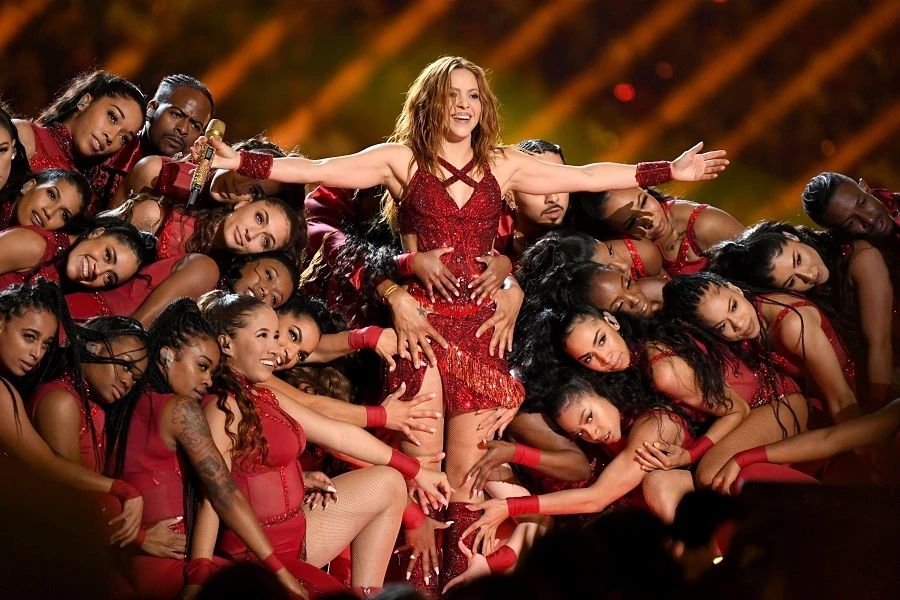
DUBAI: Latina-Arab singer Shakira’s Lebanese side was on full display during her Super Bowl LIV halftime performance in Miami on Sunday.
The 43-year-old hitmaker took to the stage to perform some of her biggest hits, including “Hips Don’t Lie,” however, it was her zaghroota that would ultimately go on to take social media by storm and spark a series of memes in the process.
The Internet exploded with hilarious memes and tweets about the zaghroota - scroll down to see our top picks.
During her opening set for the Latin-inspired halftime show performance, the singer made sure to also honor her Arab roots by looking straight at the camera and letting out the ubiquitous cry often associated with Arab weddings and celebrations, resulting in an outpouring of jokes and memes on the Internet.
“Did Shakira just do a zaghroota?” one user wrote on Twitter.
“It’s indeed zaghroota, which we have across the Arab world. Shakira, bless her heart, tried her best but if you want a real zaghroota, you need to find yourself a Syrian grandmother (sic),” another teased.
Because the star seemed to be doing it wrong, an account jokingly tweeted: “When they hand you the mic at a wedding and this is how your zaghroota comes out…”
With many users quick to point out Shakira’s supposedly shaky technique, we have to ask: How do you pull off a zaghroota? The loud, trilling sound is often achieved by making a high-pitched tone in the back of the throat while simultaneously wiggling the tip of the tongue back and forth.
Some tweets were more educational than others. “Everyone is making fun of this but it’s a traditional Arabic celebration chant, referred to as ‘zaghroota,’” a tweet said.
“Zaghroota has been chanted for thousands of years in Arab geography and clearly she was chanting a zaghroota right there too. Y’all really giving all y’all energy to erase her Arab heritage,” another tweet explained.
Indeed, while many users on the Internet took the opportunity to post jokes about the chant, it should be noted that the ululation actually has deeper meaning, with its origins dating back to centuries ago.
That high-pitched warble is a traditional Arab expression of happy emotions. The origin of the ululation dates back to the pre-Islamic era and was reportedly practiced in as far-flung areas as Ancient Egypt and Ancient Greece, according to one academic study.
Shakira, whose father was born in New York to Lebanese parents and later immigrated to Colombia where Shakira was born, also paid homage to her Middle Eastern roots by way of a belly dance performance set to a soundtrack of Arab music.
The Internet exploded with hilarious memes and tweets about the zaghroota - scroll down to see out top picks.