UAE’s Amal spacecraft rockets toward Mars in Arab world first

UAE’s Amal spacecraft rockets toward Mars in Arab world first
1 / 5
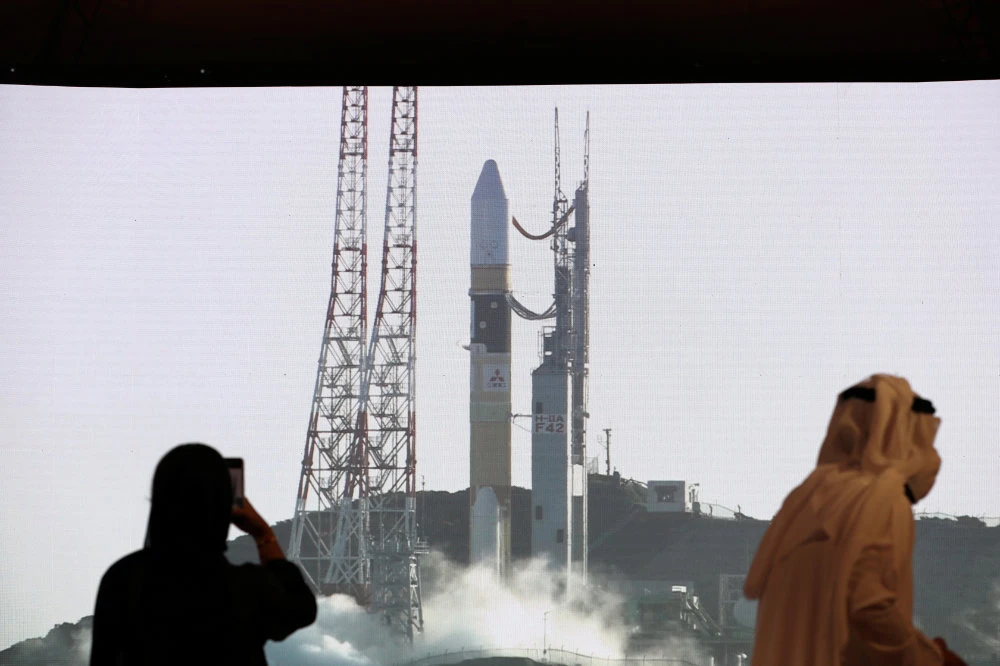
People view a big screen displaying the booster rocket of the Hope Probe ahead of its launch from Tanegashima Island in Japan, at the Mohammed bin Rashid Space Centre in Dubai, UAE, on July 20, 2020. (REUTERS/Ahmed Jadallah)
UAE’s Amal spacecraft rockets toward Mars in Arab world first
2 / 5
A representation of Mars and the Hope Probe is seen at the Mohammed bin Rashid Space Centre ahead of its launch from Tanegashima Island in Japan. (Reuters)
UAE’s Amal spacecraft rockets toward Mars in Arab world first
3 / 5
The Mohammed Bin Rashid Space Centre in Dubai ahead of the expected launch of the "Hope" Mars probe from Japan. (AFP)
UAE’s Amal spacecraft rockets toward Mars in Arab world first
4 / 5
People watch a big screen displaying the launch of the Hope Probe from Tanegashima Island in Japan, at the Mohammed bin Rashid Space Centre in Dubai, UAE, on July 20, 2020. (REUTERS/Ahmed Jadallah)
UAE’s Amal spacecraft rockets toward Mars in Arab world first
5 / 5
Short Url
Updated 20 July 2020

UAE’s Amal spacecraft rockets toward Mars in Arab world first

UAE’s Amal spacecraft rockets toward Mars in Arab world first
  • Liftoff in Japan marked start of a rush that includes attempts by China and the US
  • A newcomer in space development, the UAE has so far successfully launched three observation satellites

TOKYO: A United Arab Emirates spacecraft rocketed away Monday on a seven-month journey to Mars, kicking off the Arab world’s first interplanetary mission.
The liftoff of the Mars orbiter named Amal, or Hope, from Japan marked the start of a rush to fly to Earth’s neighbor that includes attempts by China and the United States.
The UAE said its Amal was functioning after launch as it heads toward Mars.
Omran Sharaf, the project director of Emirates Mars Mission, told journalists in Dubai about an hour and a half after the liftoff that the probe was sending signals. Sharaf said his team now would examine the data, but everything appeared good for now.
People cheered and clapped, with one woman offering a celebratory cry common for weddings.
 

Hope is set to reach Mars in February 2021, the year the UAE celebrates 50 years since the country’s formation.
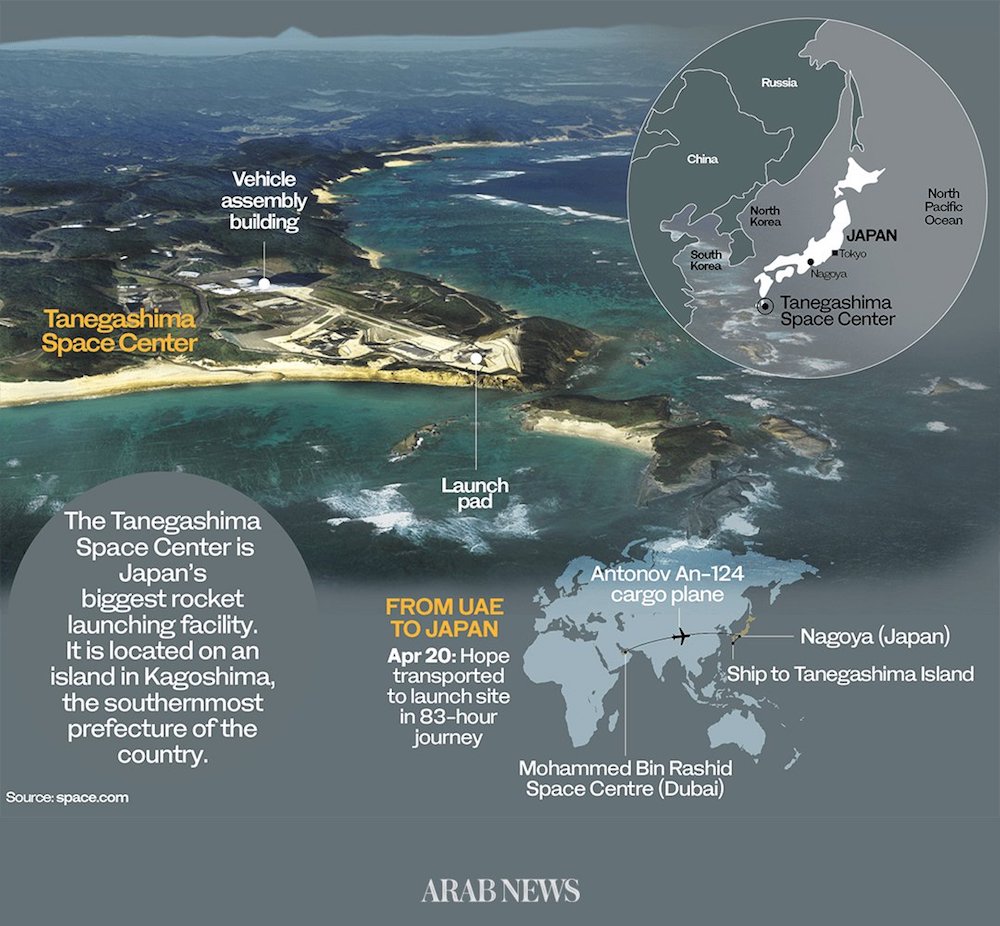
It blasted off from the Tanegashima Space Center on a small southern Japanese island aboard a Mitsubishi Heavy Industries’ H-IIA rocket, on time at 6:58 a.m. (2158 GMT Sunday) into the blue sky. Mitsubishi said the probe has been successfully separated from the rocket and is now on its solo journey. The launch had been delayed for five days because of stormy weather.
At Mohammed bin Rashid Space Center in Dubai, Emirati men in their traditional white kandora robes and women in their black abayas watched transfixed as the rocket lifted off. As its stages separated, a cheer went out from a group of Emirati men seated on the floor. They began clapping, one using his face mask due to the coronavirus pandemic to wipe away a tear.
“It was great to see everything going according to schedule today. It looks like things are all on track. It’s a huge step in terms of space exploration to have a nation like the UAE taking that giant leap to send a spacecraft to Mars,” Astronomer Fred Watson said.
“Being on route to a planet like Mars is an exceptional achievement.”
A newcomer in space development, the UAE has successfully put three Earth observation satellites into orbit. Two were developed by South Korea and launched by Russia, and a third — its own — was launched by Japan.
 

A successful Hope mission to Mars would be a major step for the oil-dependent economy seeking a future in space, coming less than a year after the launch of the first UAE astronaut, Hazzaa Ali Almansoori. He spent over a week at the International Space Station last fall.
The UAE has set a goal to build a human colony on Mars by 2117.
“It sends a very strong message to the Arab youth that if the UAE is able to reach Mars in less than 50 years, they could do much more,” Omran Sharaf, the project director of Emirates Mars Mission, told The Associated Press on Sunday as his colleagues prepared for the launch.
The Emiratis involved in the program also acknowledged it represented a step forward for the Arab world, the home of mathematicians and scientists for centuries before the wars and chaos that have gripped wide swathes of it in recent times.
“So the region has been going through tough times in the past decades, if not centuries,” Sharaf said. “Now we have the case of the UAE, a country that’s moving forward with its plans, looking at the future and the future of region also.”
For its first Mars mission, the UAE chose partners instead of doing it all on its own.
“Developing a spacecraft is not easy even if there is ample funding,” said Junya Terazono, an astronomer at Aizu University.
Emirati scientists worked with researchers at the University of Colorado Boulder, University of California, Berkeley and Arizona State University. The spacecraft was assembled at Boulder and transported to Japan as the two countries looked to expand their ties with the rich and politically stable Middle Eastern nation.

The Hope Probe is ready to launch into space in a few hours..
Watch the launch LIVE: https://t.co/A0mQfe2Awh
20th July
01:58:14 AM (UAE Time)
19th July 2020
09:58:14 PM GMT#HopeMarsMission pic.twitter.com/ZU7T1FtT55

The Amal spacecraft, along with its launch, cost $200 million, according to Omran Sharaf, the UAE project manager. Operation costs at Mars have yet to be divulged.
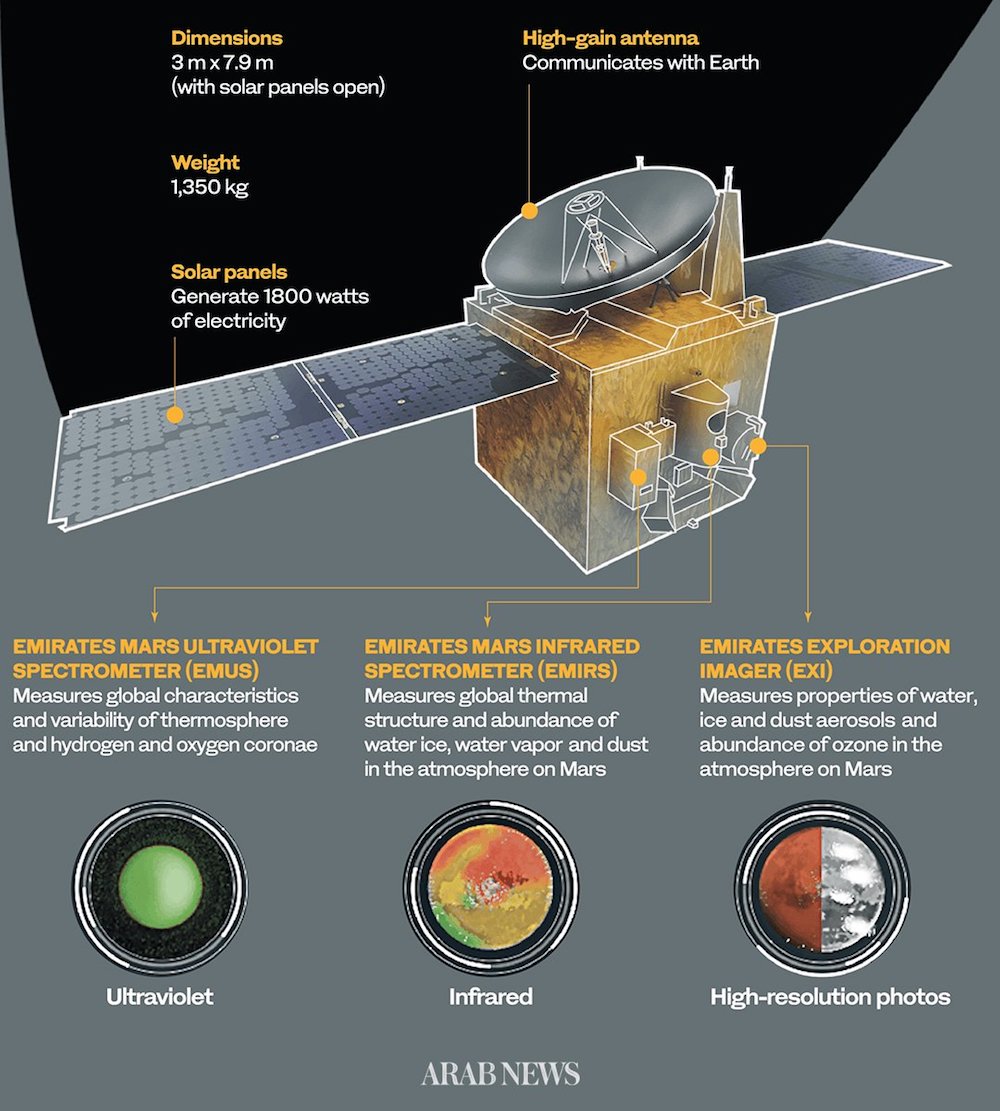
Amal, about the size of a small car, carries three instruments to study the upper atmosphere and monitor climate change while circling the red planet for at least two years. It is set to follow up on NASA’s Maven orbiter sent to Mars in 2014 to study how it went from a warm, wet world that may have harbored microbial life during its first billion years, to the cold, barren place of today.
Hope also plans to send back images of weather changes.
Japan, a US ally, has already long collaborated in defense and space technology.


When a Saudi went to space
Prince Sultan bin Salman speaks exclusively to Arab News about his 1985 NASA mission and how he became the first Arab, Muslim and royal in space

Enter


keywords


Resource-poor Japan has traditionally kept friendly ties with Middle Eastern countries. In recent years, Japan has increasingly stepped up trade and defense ties with the UAE, and now seeks to expand its space business.
Two other Mars missions are planned in the coming days by the US and China. The US plans to send a rover named Perseverance to search for signs of ancient life and collect rock and soil samples for return to Earth. Liftoff is targeted for July 30. China aims to explore Mars with an orbiter and rover to study the planet’s surface, and search for water and ice. This launch is set for around July 23.
Japan has its own Mars mission planned in 2024.
Japan Aerospace Exploration Agency, or JAXA, plans to send a spacecraft to the Martian moon Phobos to collect samples to bring back to Earth in 2029.


Yemeni PM says Saudi initiative will reveal Houthis' intentions towards peace

Yemeni PM says Saudi initiative will reveal Houthis' intentions towards peace
Updated 42 min 10 sec ago

Yemeni PM says Saudi initiative will reveal Houthis' intentions towards peace

Yemeni PM says Saudi initiative will reveal Houthis' intentions towards peace

DUBAI: Yemeni Prime Minister Maeen Abdulmalik said that a recent peace proposal offered by Saudi Arabia to the Houthi militia would reveal to Yemenis which party refuses to end the war.   

Abdulmalik, who heads the UN-recognized government in Aden, said the proposal puts the Iran-backed Houthi militia in a real confrontation with the people of Yemen. 

“[They] face a real confrontation with the Yemeni people and the international community, to expose those who reject all peace efforts and insist on the continuation of war,” he told Asharq Al-Awsat newspaper. 

He added that his government will not be an obstacle to any real and serious efforts for peace that the Yemeni people have been seeking. 

Abdulmalik also praised Saudi efforts to bring peace and end the war according to the three references of the locally agreed and internationally supported political solution represented by the Gulf Initiative and the UN resolution  2216.


Quarter of civilian casualties in Yemen are minors: Save the Children

Quarter of civilian casualties in Yemen are minors: Save the Children
Updated 23 March 2021

Quarter of civilian casualties in Yemen are minors: Save the Children

Quarter of civilian casualties in Yemen are minors: Save the Children
  • In press conference attended by Arab News, aid group warns of ‘enormous, deep-rooted famine’
  • Saudi Arabia on Monday announced measures to ease Yemen’s humanitarian crisis

LONDON: Roughly one in four civilian casualties of the war in Yemen are children, and the situation is getting worse, Save the Children said during a press conference attended by Arab News on Monday to mark six years since the start of the conflict.


“Between 2018 and 2020, there were 2,341 confirmed child casualties,” but “the actual number is likely to be much higher,” the aid group said.


“In addition, the conflict is getting deadlier for children. In 2018, one in five civilian casualties were children, but in 2019 and 2020, that jumped to one in four.”


Yemen, the poorest country in the Middle East, was plunged into violence when the Iran-backed Houthi militia staged a violent coup against the UN-recognized government in the capital Sanaa. Since then, the humanitarian situation has progressively worsened.


“All wars that are waged in the world are wars against children, and Yemen is, sadly, a classic example of that,” said Jeremy Stoner, Save the Children’s regional director for the Middle East.


“Six years of conflict isn’t just about sporadic acts of violence that involve children, but what happens is that over six years the crises become compounded,” he added.


“We’re in a situation this year where Yemen is about to experience an enormous and deep-rooted famine that’s going to affect thousands or hundreds of thousands of children, and others, in that country. Children are going to be suffering these consequences right now, but (also) for years to come.”


Save the Children warned that a serious drop in funding for humanitarian aid, as well as problems in delivering it to those most in need, are likely to deepen Yemen’s already-serious crisis.


Due in part to the coronavirus pandemic, countries such as the UK have slashed their aid budgets and donations to Yemen have dropped massively, said Gabriella Waaijman, humanitarian director at Save the Children.


“It’s absolutely shocking to me that the UK proposed a 60 percent cut in its budget for Yemen … when six months ago the UK launched a global call to action to prevent famine,” she added.


“I don’t want to pick on the UK only. In 2018, we had about $5 billion available to Yemen — in 2020 we had $2 billion, so it’s not just the UK.”


Financial aid remains essential to ease the suffering of the Yemeni people, but the ultimate goal is peace, said Waaijman and Stoner.


Saudi Arabia, which is leading the nine-country military coalition in support of the UN-recognized government against the Houthis, on Monday said it had agreed major steps with the UN toward peace in Yemen.


Saudi Foreign Minister Prince Faisal bin Farhan on Monday announced a comprehensive ceasefire across Yemen, to be supervised by the UN.


In steps aimed at easing the humanitarian situation in the country, flights will be allowed to and from Houthi-controlled Sanaa to a number of regional and international destinations.


Restrictions on the port of Hodeidah will be eased, allowing ships and cargo — including vital humanitarian aid — to travel in and out of Yemen.


US Secretary of State Antony Blinken told Prince Faisal in a phone call that he supports efforts to “end the conflict in Yemen, starting with the need for all parties to commit to a ceasefire and facilitate the delivery of humanitarian aid.”


Prince Faisal said: “It is up to the Houthis now. The Houthis must decide whether to put their interests first or Iran’s interests first.”


Egyptian president warns of coronavirus third wave

Egyptian president warns of coronavirus third wave
Updated 22 March 2021

Egyptian president warns of coronavirus third wave

Egyptian president warns of coronavirus third wave
  • Extreme caution urged during Ramadan

CAIRO: Egyptian President Abdel Fattah El-Sisi has warned of an imminent coronavirus third wave and stressed that people should adhere to precautionary measures.

Egypt had “survived” the first and second waves and was “on the cusp” of a third, he said during a Mother’s Day speech, adding: “We hope that it will pass (without significant harm).”

Adhering to precautionary measures and exercising extreme caution was important, he said, especially during the holy month of Ramadan when people would want to gather. “We want the situation to end safely.”

A few days ago the Ministry of Health warned of an increase in COVID-19 cases during the coming weeks, coinciding with the month of fasting.

Egypt’s Minister of Health and Population Dr. Hala Zayed said that, through the lessons learned from the first wave and the hike in last April’s cases, there was the expectation that this April may also witness an increase in cases, as the peak occurred in the seventh week of each wave.

Presidential adviser for health affairs, Mohamed Awad Tageldin, also anticipated the coming period to see more COVID-19 infections.

Egypt was in a state of COVID-19 case fluctuations, he said, and the numbers were rising and decreasing by 10 percent daily. The third wave had started in other countries, he added. “But we hope that we will not reach this stage. A third wave may occur in Egypt if we do not adhere to the precautionary measures.”

Islam Anan, a professor of health economics and epidemiology, expected Egypt to witness a third wave by next month. The country was still at the end of its second wave and there was an increase in the number of casualties, he said.

Anan added that countries were divided into parts where COVID-19 spread along the emergence of new waves, as they appeared first in Europe, then Asia, the US, and finally the Middle East and Egypt, pointing out that the third wave had begun in Europe.

But Dr. Hossam Hosni, head of the scientific committee to combat coronavirus, said Egypt was currently in a stage of epidemic stability, having controlled the second wave.

“The occurrence of a third wave of the virus is related to factors including low societal awareness, climate changes, and the lack of necessary caution, which is the basis for surviving the rise of infections again. We are currently in the stage of epidemiological stability.”

An official at Egypt’s Health Ministry said an update was being made to the treatment protocol in order to contribute to high recovery rates among the sick, following the previous update in November.


UN experts demand ‘credible’ probe into murder of Hezbollah critic

Luqman Slim, 58, was shot six times, three times in the head, in his car on Feb. 4. He was found in an area of southern Lebanon said to be under Hezbollah’s control. (AP/File Photo)
Updated 22 March 2021

UN experts demand ‘credible’ probe into murder of Hezbollah critic

Luqman Slim, 58, was shot six times, three times in the head, in his car on Feb. 4. He was found in an area of southern Lebanon said to be under Hezbollah’s control. (AP/File Photo)
  • Concerns raised over effectiveness of Lebanese government’s investigation into Luqman Slim’s death
  • ‘A lack of accountability may have a profound chilling effect on freedom of expression in Lebanon’

LONDON: UN human rights experts have called on Lebanon’s government to “ensure a credible and effective investigation” into the assassination prominent intellectual and Hezbollah critic Luqman Slim.

“More than a month after Mr. Slim’s murder, the investigatory steps taken at national level have led to no meaningful result, raising concerns as to the effectiveness of the current investigation,” said the three special rapporteurs from the UN’s Human Rights Council.

“The government should urgently implement measures to guarantee the independence and the impartiality of the investigation, and ensure that those responsible are identified and held accountable.”

Slim was an outspoken critic of Iran-backed Hezbollah, and many have speculated that the group was behind his murder.

Slim, 58, was shot six times, three times in the head, in his car on Feb. 4. He was found in an area of southern Lebanon said to be under Hezbollah’s control.

Prior to his death, he said should he be killed, “everybody would know who would be behind it.”

The experts, who specialize in extrajudicial killings, judicial independence and free expression, said: “The killing of Mr. Slim appears to be linked to his civic engagement and to be emblematic of the regression of Lebanon civic space, in the context of a reported surge of arrests, intimidations, threats and violence against human rights defenders, journalists and activists.”

They added: “We are deeply concerned that the murder of Mr. Slim in the event of a lack of accountability may have a profound chilling effect on freedom of expression in Lebanon.”

The UN said Slim was reportedly probing how and why the huge supply of ammonium nitrate that exploded in Beirut’s port last year, killing over 200 people and injuring thousands, was in the country.

“Any alleged relation between the explosion and Mr. Slim’s assassination should be fully investigated,” the experts said.

At the time, US Ambassador to Lebanon Dorothy Shea condemned the killing, saying: “We are saddened to have lost a great person through such an unacceptable barbaric act that we will never forget.”

She emphasized “the need to know who committed this heinous crime,” and vowed to “continue supporting the institutions Slim had established.”


Lebanon stalemate continues after 18th Aoun-Hariri meeting collapses

The 18th meeting between Hariri (L) and Aoun (R), held at the Presidential Palace, was met before and after with pessimism by much of the Lebanese public. (AFP/File Photos)
Updated 23 March 2021

Lebanon stalemate continues after 18th Aoun-Hariri meeting collapses

The 18th meeting between Hariri (L) and Aoun (R), held at the Presidential Palace, was met before and after with pessimism by much of the Lebanese public. (AFP/File Photos)
  • Saad Hariri: President ‘had last chance to end collapse’
  • Protesters swarm Beirut streets as currency exchange rate spikes on black market

BEIRUT: A critical meeting on Monday between Lebanese President Michel Aoun and Prime Minister-designate Saad Hariri on the country’s uncertain future failed to reach an agreement.

The 18th meeting between the two men, held at the Presidential Palace, was met before and after with pessimism by much of the Lebanese public.

Hariri insists on forming a government of 18 independent specialists acting as ministers, without the capacity for a blocking third by any party, while Aoun and his Free Patriotic Movement (FPM) propose a government of 20 ministers, with the right to name 6 ministers in addition to an Armenian minister.

After Monday’s meeting, which lasted just 35 minutes, Hariri said that Aoun sent him on Sunday “a complete ministerial structure in which the portfolios were distributed among the sects and parties, along with a letter telling me that it is advisable to fill it out.

“The list includes a blocking third of his political team, whether the government consists of 18, 20 or 22 ministers.

“He asked me to suggest names for the portfolios according to the sectarian and party distribution that he had prepared.”

Hariri said that he told Aoun during the meeting that “this is unacceptable because it is not the prime minister—designate’s job to fill out lists prepared by anyone, and it is not the job of the president to form a government.

“Our constitution clearly says that the prime minister-designate forms the government and puts the names, and discusses his formation with the president of the republic.

As a result of this, Hariri said: “Accordingly, I respectfully informed him that I consider his letter as if it had not been sent. I returned it to him and informed him that I would keep a copy of it for history.”

Hariri said he previously suggested a government formation to Aoun more than 100 days ago, and told him: “I am ready for any proposals and amendments to names and portfolios. Even with his insistence on the Interior Ministry, I suggested a solution for him. Unfortunately, his answer was clear: The blocking third.”

Hariri added: “I have one goal, which is to put an end to the collapse and the suffering of the Lebanese. I asked the president to listen to the pain of the Lebanese and give the country its only and last chance for a government of specialists to implement reforms and stop the collapse without disruption or narrow partisan considerations.”

Hariri denied that he had previously provided Aoun with broad lines for his government. He distributed to the media the list of “specialized ministers” that he presented to Aoun on Dec. 9, requesting that “public opinion be the judge.”

The prime minister-designate did not respond to questions by the press, and no date has been set for a new meeting between the ​two parties.

Hariri’s suggested list included well-known academics and experts, including three women.

The Future Movement media coordinator, Abd Al-Salam Moussa, told Arab News: “Hariri thwarted the administration’s coup against the republic.”

After Hariri finished a speech at the Presidential Palace after the meeting, large swathes of protesters took to the streets of Beirut to express their anger, while electronic platforms that control the black market began to raise the dollar exchange rate again.

Earlier in the day, the exchange rate stood at 11,300 Lebanese pounds, but after Hariri’s statement, it spiked to 13,000 Lebanese pounds.

The 17th meeting between Aoun and Hariri last Thursday also complicated Monday’s meeting, making it difficult to reach a solution to Lebanon’s political crisis.

Maronite Patriarch Mar Bechara Boutros Al-Rahi, on the eve of Aoun and Hariri’s meeting, appealed to the two parties to “stop onerous conditions.”

He said: “​If some want to burden the next government with the region’s conflicts and the race to the presidency, regime change and control of power, then​ that​ will lead to chaos​, which ​will not show mercy to anyone, starting with its creators.”

Caution and public anxiety preceded the Aoun-Hariri meeting and increased after it.

Despite the reopening of restaurants and cafes on Monday, with strict health measures in place — two months after total lockdown began — the public chose to stay home.

Minority report: The Jews of Lebanon
Descendants of the country's dwindling community recall listening to their parents' memories of a lost 'paradise'
Enter
keywords