- How largest source of news became one of most untrusted in just 1 year
DUBAI: Social media, unsurprisingly, is the largest source of news for Arab youth but it is now more untrusted than television, according to a new study.
The recently released 13th annual ASDA’A BCW Arab Youth Survey aimed to uncover the hopes, fears, and aspirations of young Arabs in 50 cities and territories across 17 states in the Middle East and North Africa region.
ASDA’A BCW is one of the leading public relations consultancies in the MENA region, and its survey findings were published in a whitepaper titled “Hope for the Future.” It dissected the sentiments of Arab youth in areas such as education and jobs, the role of government, emigration, gender rights, and media consumption.
Sunil John, Middle East president of BCW and founder of ASDA’A BCW, told Arab News: “The single biggest change has been a decline in overall news consumption.”

The number of young Arabs getting their news via social media had decreased from 79 percent in 2020 to 61 percent this year. Similar declines were seen across all other channels too, with news consumption on TV falling by 13 percent, online by 21 percent, and newspapers by 12 percent from last year.
John blamed the trend on the proliferation of negative news cycles prompted by the coronavirus disease (COVID-19) pandemic.
“In almost all countries, across all the most common forms of consuming news, we saw a fall, suggesting that the negative news cycles of the pandemic era have weighed heavily on youth’s willingness to consume the news,” he said.
Despite the overall decline in news consumption, social media remained the largest source of news for young Arabs (61 percent) — a position it has held since 2018 — followed by TV (43 percent), online (34 percent), and newspapers (9 percent).
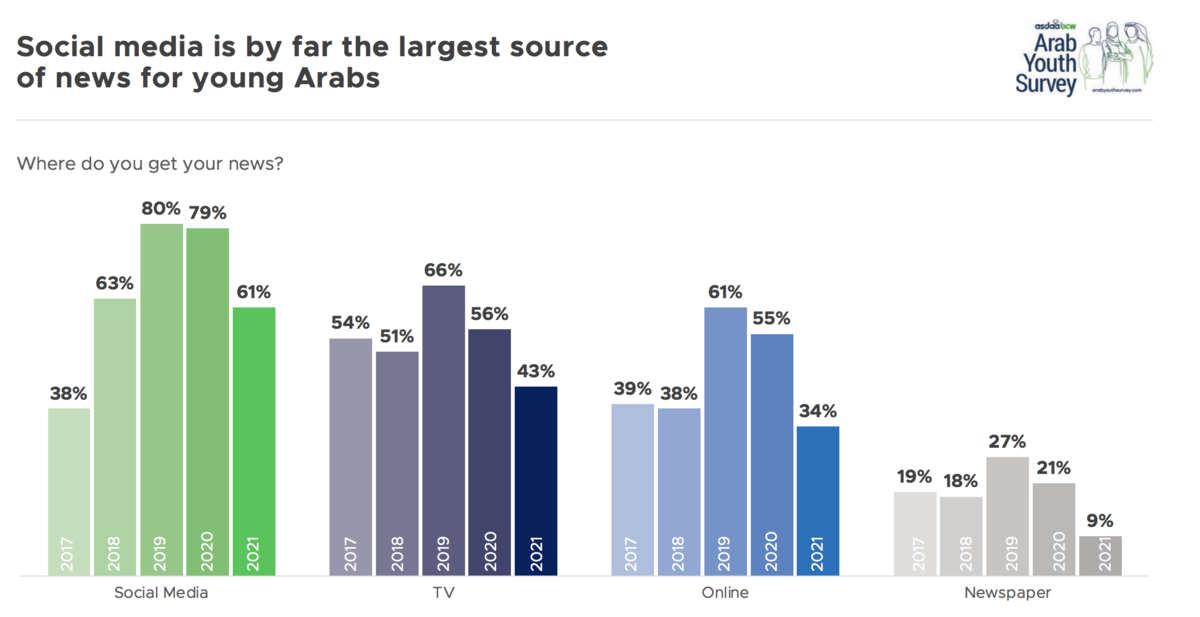
“This is another important trend to note: We’re seeing a change in the amount of news youth are consuming, but the mix, the channels they are using, have remained relatively stable. So social media continues to be more frequently used for news than TV, online news sources, or newspapers,” John added.
Print media attracted 27 percent of young Arab readers in 2019 but that figure was also steadily falling. John said that print’s declining readership did not necessarily diminish the importance of print media outlets.
“The key element that is changing is how they (Arab youth) consume that news; away from print to online and social sources.
“It is very likely that much of the news that youth are seeing online and via social media is from trusted print media outlets, so the importance of these outlets is not changing. And while we may see a decline in the print medium, online and social consumption offers new opportunities for newspapers as consumers look at news in different channels,” he added.
Despite social media commanding the largest share as a news source, it was ranked less trustworthy than TV, newspapers, and online news portals, with only 26 percent of those questioned saying that it was very trustworthy as a source of news.
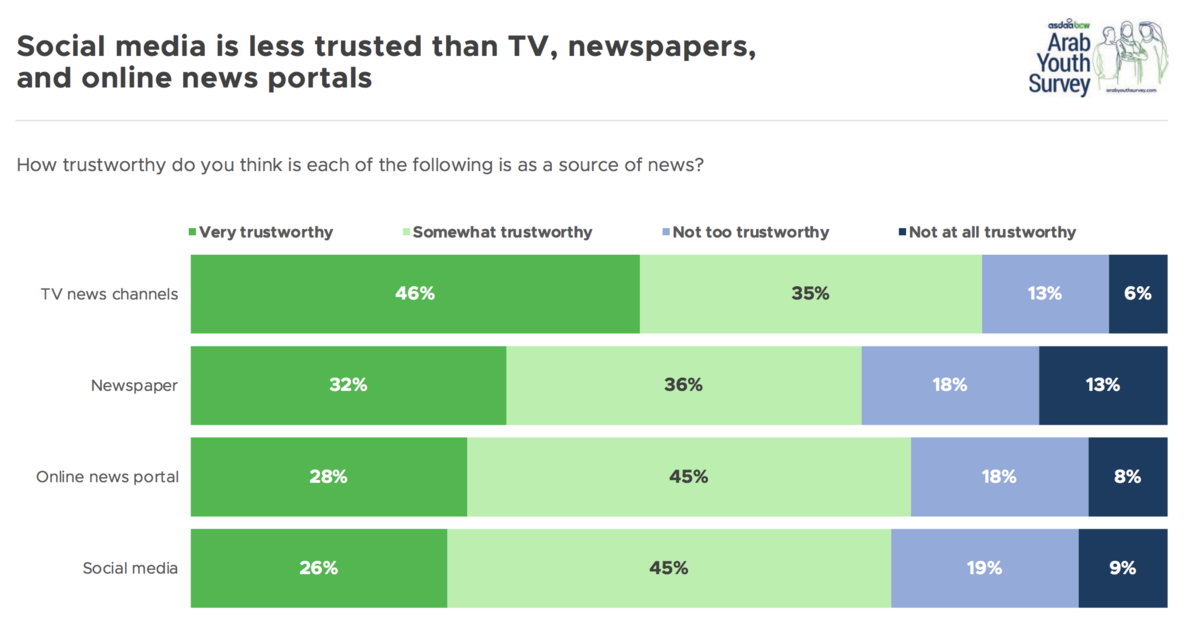
Conversely, TV emerged as the most trustworthy, with 46 percent putting it in the very trustworthy category.
“Television will always remain important for the Arab world. For decades, television has brought the voice of the Arab street into Arab living rooms,” John said.
Even though Arab youth may be consuming TV differently, such as through social media or online platforms instead of the traditional screen, he noted that trust in television was expected to continue growing.
The study’s findings suggested that print and TV news outlets still enjoyed more trust — just not in the traditional form, creating an opportunity for brands to digitize their offerings.
It was considered likely that social media would carry on being the place where young Arabs spent most of their time, with 67 percent in the MENA region and 72 percent in Gulf Cooperation Council countries finding it difficult to disconnect from social media.
“This is a global issue, affecting the current generation of youth. While we recognize the value of social media in connecting Arab youth in the region and the world and broadening their horizons, excessive usage has had a strain on personality development, social skills, et cetera,” John added.
He pointed out that youth had become increasingly active in participation with brands. “Our recently released findings on climate change showed that more than half (56 percent) of Arab youth were willing to boycott a brand that was not acting responsibly about the environment.”
They also had increased expectations from brands when it came to topics such as employment practices and taxes, he said.
For years, brands had been placing increasing emphasis on corporate social responsibility and consumers were taking notice. But during the COVID-19 pandemic there had been a shift in consumers’ attitudes that had put brands’ CSR commitments to the test.
For example, while 75 percent of those quizzed for a GfK report noticed examples of companies being a force for good during the global health crisis, 78 percent had been able to spot firms that were trying to take advantage of the situation.
A separate survey by GlobalWebIndex found that since the virus outbreak, consumers had wanted brands to focus more on supporting people during the pandemic (56 percent), be eco-friendly (51 percent), and to back social causes (41 percent).
“There is no reason the youth won’t have such high expectations from brands in the social media space as well,” John added.