Air defense test sparks loud blast near Iran nuclear site

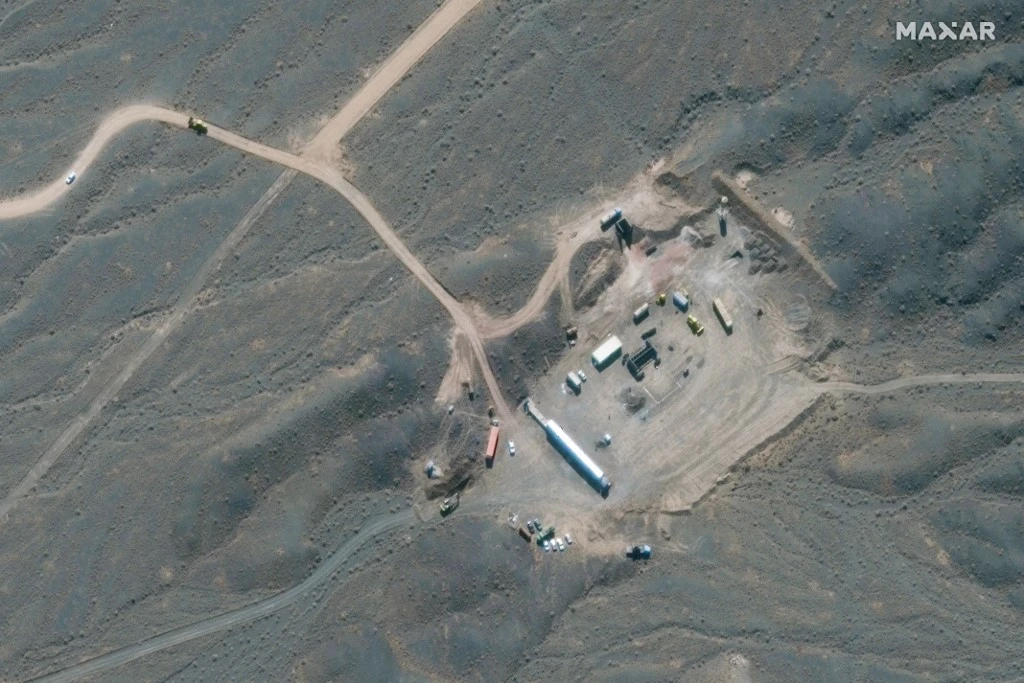
An overview of Iran’s Natanz nuclear facility, south of the capital Tehran. (File/AFP)
Short Url
Updated 06 December 2021

Air defense test sparks loud blast near Iran nuclear site

Air defense test sparks loud blast near Iran nuclear site
  • Iranian news agencies earlier reported a large explosion in the sky above Natanz
  • Fars news agency quoted its reporter as saying short blast was heard accompanied by an intense light in sky

TEHRAN: An air defense test triggered a loud explosion near Iran’s Natanz uranium enrichment facility Saturday as nuclear talks with major powers stumble.
The explosion was heard in the skies over the Iranian city of Badroud, just 20 kilometers (12 miles) from the nuclear plant, the official IRNA news agency reported.
“Badroud residents heard the noise and saw a light which showed an object had just blown up in the skies over the city,” a witness told IRNA.
But the air defense commander for the Natanz region told state television there was no cause for concern.
“An hour ago, one of our missile systems in the region was tested to assess the state of readiness on the ground, and there is nothing to fear,” the commander said.
Overuse and climate change kill off Iraq’s Sawa Lake

Overuse and climate change kill off Iraq’s Sawa Lake
Updated 41 sec ago

Overuse and climate change kill off Iraq’s Sawa Lake

Overuse and climate change kill off Iraq’s Sawa Lake

SAWA LAKE, Iraq: A “No Fishing” sign on the edge of Iraq’s western desert is one of the few clues that this was once Sawa Lake, a biodiverse wetland and recreational landmark.
Human activity and climate change have combined to turn the site into a barren wasteland with piles of salt.
Abandoned hotels and tourist facilities here hark back to the 1990s when the salt lake, circled by sandy banks, was in its heyday and popular with newly-weds and families who came to swim and picnic.
But today, the lake near the city of Samawa, south of the capital Baghdad, is completely dry.
Bottles litter its former banks and plastic bags dangle from sun-scorched shrubs, while two pontoons have been reduced to rust.
“This year, for the first time, the lake has disappeared,” environmental activist Husam Subhi said. “In previous years, the water area had decreased during the dry seasons.”
Today, on the sandy ground sprinkled with salt, only a pond remains where tiny fish swim, in a source that connects the lake to an underground water table.
The five-square-kilometer (two-square-mile) lake has been drying up since 2014, says Youssef Jabbar, environmental department head of Muthana province.
The causes have been “climate change and rising temperatures,” he explained.
“Muthana is a desert province, it suffers from drought and lack of rainfall.”
A government statement issued last week also pointed to “more than 1,000 wells illegally dug” for agriculture in the area.
Additionally, nearby cement and salt factories have “drained significant amounts of water from the groundwater that feeds the lake,” Jabbar said.
It would take nothing short of a miracle to bring Sawa Lake back to life.
Use of aquifers would have to be curbed and, following three years of drought, the area would now need several seasons of abundant rainfall, in a country hit by desertification and regarded as one of the five most vulnerable to climate change.
The Ramsar Convention on Wetlands, a global treaty, recognized Sawa as “unique... because it is a closed water body in an area of sabkha (salt flat) with no inlet or outlet.
“The lake is formed over limestone rock and is isolated by gypsum barriers surrounding the lake; its water chemistry is unique,” says the convention’s website.
A stopover for migratory birds, the lake was once “home to several globally vulnerable species” such as the eastern imperial eagle, houbara bustard and marbled duck.
Sawa is not the only body of water in Iraq facing the perils of drought.
Iraqi social media is often filled with photos of grotesquely cracked soil, such as in the UNESCO-listed Howeiza marshes in the south, or Razzaza Lake in the central province of Karbala.
In Sawa, a sharp drop in rainfall — now only 30 percent of what used to be normal for the region — has lowered the underground water table, itself drained by wells, said Aoun Dhiab, a senior adviser at Iraq’s water resources ministry.
And rising temperatures have increased evaporation.
Dhiab said authorities have banned the digging of new wells and are working to close illegally-dug wells across the country.
Latif Dibes, who divides his time between his hometown of Samawa and his adopted country of Sweden, has worked for the past decade to raise environmental awareness.
The former driving school instructor cleans up the banks of the Euphrates River and has turned the vast, lush garden of his home into a public park.
He remembers the school trips and holidays of his childhood, when the family would go swimming at Sawa.
“If the authorities had taken an interest, the lake would not have disappeared at this rate. It’s unbelievable,” he said.
“I am 60 years old and I grew up with the lake. I thought I would disappear before it, but unfortunately, it has died before me.”


Syria says Israel attacked areas near the capital, Damascus

Syria says Israel attacked areas near the capital, Damascus
Updated 58 min 7 sec ago

Syria says Israel attacked areas near the capital, Damascus

Syria says Israel attacked areas near the capital, Damascus
  • There was no comment from the Israeli military on the attacks near Damascus

DAMASCUS, Syria: Syrian air defenses were active early Wednesday as Israel fired several surface-to-surface missiles at military positions near the capital, Damascus, state media reported. There was no immediate word on casualties.
State media quoted an unidentified Syrian military official as saying that the missiles were fired from northern Israel shortly after midnight and that most of them were shot down. It added that the military was still looking into the “results of the aggression.”
The attacks came hours after the Israeli military said an Israeli drone crashed on the Syrian side of the border Tuesday, adding that an investigation was opened into the case.
The Britain-based Syrian Observatory for Human Rights, an opposition war monitor, said several missiles struck areas near Damascus International Airport on the southern edge of the capital as well as several suburbs. It said the areas hit host Syrian military positions as well as some of Iran-backed fighters.
There was no comment from the Israeli military on the attacks near Damascus.
It was the latest attack on Syria since April 14, when several missiles hit Syrian army positions near Damascus.
Israel has staged hundreds of strikes on targets in Syria over the years but rarely acknowledges or discusses such operations.
It has acknowledged, however, that it targets the bases of Iran-allied militias, such as Lebanon’s Hezbollah group that has fighters deployed in Syria. It says it attacks arms shipments believed to be bound for the militias.
Israel justifies its strikes on facilities and weapons inside Syria by saying that an Iranian presence on its northern frontier is a red line.


Lebanese PM calls for transparent probe into Tripoli boat capsize

Lebanese PM calls for transparent probe into Tripoli boat capsize
Updated 27 April 2022

Lebanese PM calls for transparent probe into Tripoli boat capsize

Lebanese PM calls for transparent probe into Tripoli boat capsize
  • Around 30 still missing since Saturday night
  • Depositors protest against capital control bill

BEIRUT: Lebanese Prime Minister Najib Mikati has called for a swift and transparent probe into a tragic boat accident that left around 10 people dead, including an 18-month-old girl and her mother.

The vessel sank off the coast of Tripoli on Saturday night.

Mikati said that investigations should be conducted quickly and transparently, away from media pressure, and should include details of what happened even before the boat set off.

Lebanese Army Commander Gen. Joseph Aoun, the director of Lebanese army intelligence Brig. Gen. Tony Kahwagi and the Commander of the Naval Forces Col. Haitham Dhanawy attended an emergency Cabinet session on Tuesday and gave a detailed presentation of what happened with the boat.

The army said the boat had left Lebanon’s coast illegally and that the boat’s captain had been trying to evade capture when the collision occurred. They said about 60 people had illegally boarded the boat and were headed to Italy and stressed that the army had nothing to do with the boat capsizing.

BACKGROUND

Mikati said that investigations should be conducted quickly and transparently, away from media pressure, and should include details of what happened even before the boat set off.

Several survivors have said that a Lebanese military vessel rammed the boat, leading it to sink. They said a security official aboard threatened to drown them if they did not comply and return to shore. They said the majority of those who were trying to escape did not know how to swim, including women and children.

Lebanese President Michel Aoun said at the beginning of the Cabinet session: “What happened in Tripoli hurt us all,” adding that the court must investigate the incident amid conflicting stories, to clarify the truth, and put an end to any contradictory interpretations or explanations.

Ahmed Tamer, director of Tripoli port, said the search to find the missing passengers was ongoing and that a Greek frigate was taking part in the operation.

Dr. Khaldoun Al-Sherif, a political analyst from Tripoli, told Arab News: “The conflicting stories urged Mikati to insist on knowing what happened before the boat’s departure. The army says that it spotted the boat before it went out to sea but was unable to catch up and intercepted it when it was at sea. There is a missing link and an inconsistent narrative. The investigation should have started immediately and everything happening now is a waste of time.”

In Beirut, people continued to protest against a controversial capital control bill. Adopting a capital control law is one of the reforms requested by the International Monetary Fund to help the crisis-hit country.

Depositors blocked the roads leading to parliament on Tuesday to stop the joint parliamentary committees from continuing their discussions over the bill and successfully prevented MPs from achieving a quorum to hold the session.

George Adwan, head of the Administration and Justice Committee, called for rescheduling the capital control discussions until after the May 15 parliamentary elections. He stressed the need for a complete and comprehensive recovery plan that explained losses and their distribution according to responsibilities and the method for paying off losses.

“Successive governments and corrupt political officials are to blame along with the Banque du Liban, which is an accomplice to the state’s policies,” he added. “So why should we hold citizens and depositors responsible for all this? Any recovery plan must tell people how the economic, financial, and monetary situation will improve and how we will create growth and preserve the banking system after fixing the loopholes, instead of hiding behind what the IMF requested to grant Lebanon $3 billion over three years.”


Tunisian opposition announces alliance against president

Tunisian opposition announces alliance against president
Updated 27 April 2022

Tunisian opposition announces alliance against president

Tunisian opposition announces alliance against president
  • The new alliance comprises five political parties including Saied’s nemesis the Islamist-inspired Ennahdha party, along with five civil society groups involving independent political figures

TUNIS: A veteran Tunisian opposition figure announced on Tuesday the creation of a new alliance to “save” the country from deep crisis following President Kais Saied’s power grab last year.

Ahmed Nejib Chebbi, 78, a prominent left-wing politician who opposed Zine El-Abidine Ben Ali’s rule, said the new National Salvation Front aimed to unite political forces, re-establish constitutional and democratic processes and guarantee freedoms and rights in the country.

“We want a return to legitimacy and democracy,” he told a news conference in the capital Tunisia.

Saied — a former law professor elected in 2019 amid public anger against the political class — on July 25 last year sacked the government, suspended parliament and seized wide-ranging powers.

He later gave himself powers to rule and legislate by decree and seized control over the judiciary.

He dissolved parliament last month, dealing another blow to the political system put in place after the North African country’s 2011 revolution.

Chebbi opposes Saied’s moves and describes them as a “coup.”

The new alliance comprises five political parties including Saied’s nemesis the Islamist-inspired Ennahdha party, along with five civil society groups involving independent political figures.

The Front’s priority is to rescue an economy ruined by a “rotten” political system that puts off investors, Chebbi said.

It also aims to involve other political groups and “influential” figures before launching a national dialogue on reforms to “save the country,” he added. Chebbi called for a “salvation government” to lead the country during a “transition period” before new elections.

Last week Saied assigned himself the power to appoint the head of the electoral commission, a move critics say aims to create a tame electoral body ahead of a referendum slated for July on constitutional reforms, and legislative elections due in December.

Last month, Saied also inaugurated a “temporary” council of judges to replace an independent watchdog he abolished when seizing sweeping powers over the judiciary.

Saied’s initial power grab last year was welcomed by many Tunisians sick of the often-stalemated post-revolution political system.

But an increasing array of critics say he has moved the country down a dangerous path back toward autocracy.


White House worried Iran could develop nuclear weapon in weeks

White House worried Iran could develop nuclear weapon in weeks
Updated 27 April 2022

White House worried Iran could develop nuclear weapon in weeks

White House worried Iran could develop nuclear weapon in weeks
  • Blinken says the US still believes a return to a nuclear deal is the best path with Iran

WASHINGTON: The White House is worried Iran could develop a nuclear weapon in weeks, press secretary Jen Psaki said on Tuesday, after Secretary of State Antony Blinken noted earlier in the day the country has accelerated its nuclear program.
“Yes it definitely worries us,” Psaki said, adding the time needed for Iran to produce a nuclear weapon is down from about a year. 
Earlier, Blinken said the US still believes a return to a nuclear deal is the best path with Iran, amid a prolonged standoff in talks.
Facing criticism of the deal during an appearance before Congress, Blinken called the 2015 agreement imperfect but better than the alternatives.
“We continue to believe that getting back into compliance with the agreement would be the best way to address the nuclear challenge posed by Iran and to make sure that an Iran that is already acting with incredible aggression doesn’t have a nuclear weapon,” Blinken told the Senate Foreign Relations Committee.
“We’ve tested the other proposition, which was pulling out of the agreement, trying to exert more pressure,” he said.
The result, he said, is that the “breakout time” for Iran to develop a nuclear bomb if it so chooses is “down to a matter of weeks” after the deal pushed it beyond a year.
Former president Donald Trump pulled out of the agreement reached under his predecessor Barack Obama and instead imposed sweeping sanctions, including trying to stop other nations from buying Iranian oil.
President Joe Biden’s administration has been engaged in more than a year of indirect talks in Vienna on reviving the agreement, which had promised Iran a relief from sanctions in return for major restrictions on its nuclear work.
Both US and Iranian officials say that most points have been settled. Disputes appear to include Iran’s demand that Biden undo Trump’s designation of the clerical state’s powerful Revolutionary Guards as a terrorist organization.
(With Reuters and AFP)

The Coptic miracle
How Egypt's historic Christian church survived and thrived
Enter
keywords