
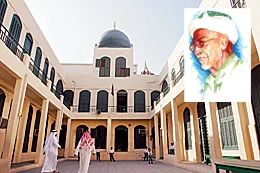
In 1905 Sheikh Muhammad Ali Zainal Alireza established the first boys’ school in Jeddah and seven years later, he did the same in Makkah. That was at a time when the Hijaz, the western part of modern Saudi Arabia, was under Ottoman Turkish rule and both poverty and illiteracy were common. Against many odds, Al-Falah School has continued to the present day, due in large part to the vision and determination of its founder Sheikh Muhammad Ali Zainal. The school was the beginning of modern education in Saudi Arabia and from it, many of the country’s ministers, businessmen, professors, doctors and other professionals have come. Later, branches of the school were opened in Bahrain, Dubai, India and other countries. Today, Al-Falah Schools still stand in old Jeddah and in Makkah as symbols of resilience and enlightenment.
Al-Falah is considered to have been the first formal school in the Arabian Peninsula. The Ottomans were not interested in educating those who lived in the Hijaz, especially teaching them Arabic. Besides Qur’anic schools, there were some elementary Turkish schools teaching basic Arabic and Islam for government employees.
Sheikh Zainal was born in 1884 and was taught Arabic by tutors at home and then went to Egypt for further studies in Islam for which he had great passion and dedication. When he returned to Jeddah, he became concerned with people’s inability to read Arabic and found it necessary to educate them in their mother tongue as well as to widen their understanding of Islam. In order to do so, he decided to open an Arabic school which the Turkish government would not allow. Until he got official permission, he rented a room and approached parents to send their sons to study in secret at night. The school began thus with six students. When official permission was granted almost two years later, his wife sold her jewelry to assist him in establishing the school. In ten years, the number of students increased from 24 to 300. In 1912, Sheikh Zainal established the Makkah Falah School which enrolled nearly 200 students in its first year.
For many years, the sheikh funded both Al-Falah Schools himself. Depending on the students’ ability to pay, he charged either nothing or a nominal fee. Some students were actually paid to come to school as encouragement and support; otherwise their families would have sent them out to work to contribute to the household income. Other business families donated to the schools and set up trusts. Sheikh Zainal’s support for the school was not only financial; he followed the progress of the schools, improved them and considered the students his children. The school expanded as the number of students increased and each year, it moved on to the next level. For years, it remained the only school in the country. “It was mainly a religious school but other subjects such as science, math and English were also taught,” said businessman Amin Abulhasan who left Al-Falah in 1947. “However, a student graduated from the school having mastered Arabic and he was trained in simple accounting,” Abulhasan said. The teachers were mostly from the Hijaz, teaching Islamic and Arabic studies but some subjects were taught by Arab teachers, especially Egyptians, because not many locals were qualified. “The books were brought from Egypt but later the curriculum was unified under the Saudi Administration of Education in the 1950s,” said Abulhasan. The school was open to anyone eager to learn and outstanding students were sent abroad for higher studies at Sheikh Zainal’s expense.
Sheikh Zainal was a pearl merchant and although he lost much of his fortune after the development of cultured Japanese pearls, he continued funding the school with help from other business families. Then King Abdul Aziz, who appreciated the great educational and social role of the school, arranged for government support which the Ministry of Education continues today.
Dr. Iyad Madani, the current minister of Haj says, “What the school best represents is the spirit of initiative.” Former minister of information, Dr. Mohammed Abdu Yamani, a graduate of the school, said, “The school was based on a solid foundation with the purpose of teaching individuals morally, behaviorally and academically.” After nine years at the school, “a student graduated and was almost a teacher himself,” said Ahmed Jamjoom whose family was one of the early supporters of the school. In fact, many older students assisted in teaching younger ones and when they graduated, they became teachers at Al-Falah, something they were proud of, even after their careers took them down different paths. In offering proof of the deep loyalty the school inspired, Amin Abulhasan said that in 1946, Aramco needed employees and the only qualified ones in the Kingdom at that time were the Al-Falah teachers. Many of them refused to go to work for Aramco even though their salary at Al-Falah was SR60 a month and Aramco was offering up to SR450 a month. “Unfortunately, none of those teachers received the recognition and appreciation they deserve in, for example, having streets named after them. Until about 1960 most, if not all government employees and ministers, were graduates of Al-Falah,” he pointed out.
Sheikh Zainal continued as head of the board of supervisors until his death in 1969. His nephew Sheikh Ahmed Yousif Zainal then became chairman, a position he still occupies. Recently, the school celebrated its centennial according to Hijri calendar. No other school in the Kingdom has attained that age.
Down the narrow winding streets of Mazloom Alley in downtown Jeddah, Arab News visited Al-Falah School and could almost feel its long and distinguished history, not only of the school but also of the era in which it was built. The floors, ceilings and doors of the school’s original building are made of wood. Ahmed Al-Abbadi, the school coordinator, explained, “When the old wooden floors aged and had to be replaced, we replaced them with wood to maintain the traditional ambience.” The supervisors, principal, teachers and students are proud of the school’s history and heritage and of being part of both. “Whenever we have to renovate or expand, we make sure that we keep the original style and structure and that we remain in the same location,” said Al-Abbadi.
The school offers three levels of education — elementary, intermediate and high school — with each having its own play ground. Today, the old U-shaped building stands in the center of the complex and is used by elementary students. The classrooms remain their original size, which is considered small by today’s standards. “At one point, we had 1200 students in the elementary school and the classes were overcrowded. With an average of 56 students, some didn’t have seats,” said Yousif Abdul Fattah, the elementary school supervisor. Now, there are 635 students enrolled and each class has 25 students. The total number of students in the school is 1500. Enrollment follows the same procedure as in other public schools although the supervisors give priority to the poor and orphans because that was the wish of the founder, Sheikh Zainal. “The curriculum has changed as well so that it is the same as in other public schools. In the old days, the curriculum included preparing older students to teach younger ones,” said Ali Al-Sulaimani, the high-school supervisor.
The original green dome still rests on top of the old building and in keeping with that design, the dome is repeated on other buildings. Enclosing the old building is the newer L-shaped building for secondary and high school students. In the old building there is a small museum with items such as a rotary telephone and an early television set as well as daggers, plates and an embalmed lion. A new library with Internet access will soon open in the old building.
Al-Falah School continues to develop and improve, connecting the old and the new. Building on its spirit of initiative, it has established the Al-Falah School Pioneer Center for Creativity that teaches talented children. The supervisors of the school are working on having a student reunion and establishing a database which will profile all the graduates of the school. A website is also under construction that will allow the generations to interact and keep up with the school and their classmates.