Under-fire Spain minister defends state agencies’ role in floods

Under-fire Spain minister defends state agencies’ role in floods
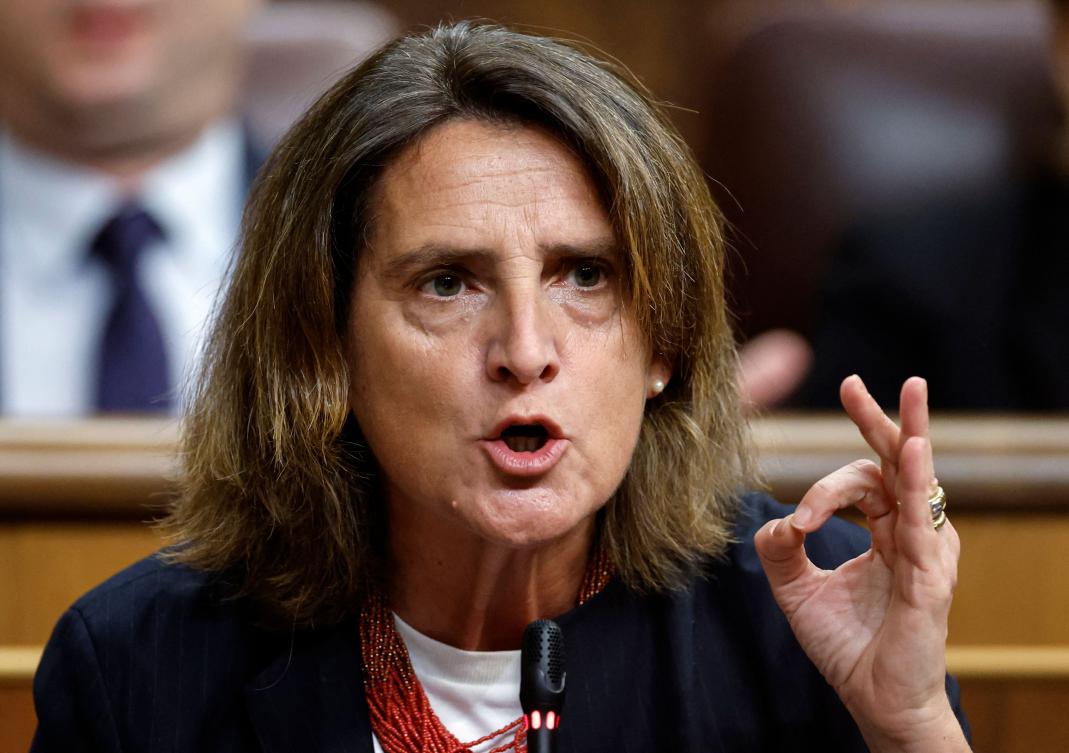
Spain’s Deputy Prime Minister and Minister of Ecological Transition and Demographic Challenge Teresa Ribera talks during a plenary session at the Spanish lower house, Congress of Deputies, in Madrid on Nov. 20, 2024. (AFP)
Short Url
Updated 20 November 2024
Follow

Under-fire Spain minister defends state agencies’ role in floods

Under-fire Spain minister defends state agencies’ role in floods
  • Doubting state agencies was “deeply unfair and deeply dangerous,” Ribera told parliament
  • “I would like to thank the work and dedication of the public servants who issued the information as was their duty“

MADRID: Spain’s under-fire ecological transition minister, a candidate for a top European Commission post, on Wednesday said questioning the role of state agencies during the country’s devastating floods was “dangerous.”
The state weather and environment services have faced intense scrutiny over their response to the October 29 disaster that wreaked widespread destruction and killed 227 people.
The European Parliament has blocked Teresa Ribera’s appointment to an influential EU commission role encompassing environment and competition, with opponents accusing her of neglecting her duties during the floods.
Regions are in charge of disaster management in Spain’s decentralized political system, but the hardest-hit Valencia region’s conservative leader Carlos Mazon said he received “insufficient, inaccurate and late” information.
Doubting state agencies was “deeply unfair and deeply dangerous,” Ribera told parliament, in a veiled retort to the conservative opposition.
“I would like to thank the work and dedication of the public servants who issued the information as was their duty,” she added.
Mazon defended his handling of the catastrophe last week, citing an “information blackout” and criticizing a government agency responsible for monitoring river levels.
But Ribera said “there was never an information blackout” and enumerated a lengthy list of warnings issued by public bodies to the regional authorities.
Although the national weather agency issued the highest red alert in the morning of October 29, Valencia residents in many cases only received telephone warnings when water was already gushing through towns.
The socialist-led central government has argued Mazon bore responsibility for the late issuing of the emergency alert.
“Having all the necessary information is of little use if the one who must respond does not know how,” Ribera added.
The right-wing opposition Popular Party (PP) has accused the government of abandoning the Valencia region before and after the floods for political gain.
Anger has coursed through Spain over the authorities’ perceived mishandling of the country’s deadliest floods in decades and the ensuing political polarization has spilled over at EU level.
The conservative EPP parliamentary group to which the PP belongs refused to approve Spain’s nomination for the commission until she reported to the Spanish parliament.
“The European Commission does not deserve to come into existence with a candidate under suspicion,” PP leader Alberto Nunez Feijoo wrote on X.
The Socialists and Democrats group have complained that the Spanish right was trying to make Ribera “the scapegoat” for its own failure to manage the floods in Valencia.
By doing so, it was “pushing the entire European Union to the brink in the most irresponsible way,” it said.
Socialist Prime Minister Pedro Sanchez on Tuesday said his party always backed PP candidates for the commission and urged “reciprocity” from them.
China Coast Guard ship formation sails through Japan-administered Senkaku Islands as tensions rise

China Coast Guard ship formation sails through Japan-administered Senkaku Islands as tensions rise
Updated 7 sec ago
Follow

China Coast Guard ship formation sails through Japan-administered Senkaku Islands as tensions rise

China Coast Guard ship formation sails through Japan-administered Senkaku Islands as tensions rise
  • Tensions rose after Japanese prime minister commented on Taiwan
  • Previous Japanese leaders maintained ‘strategic ambiguity’ over coming to Taiwan’s defense
Tensions rose after Japanese prime minister commented on Taiwan
Previous Japanese leaders maintained ‘strategic ambiguity’ over coming to Taiwan’s defense
BEIJING: A China Coast Guard ship formation passed through the waters of the Senkaku Islands on Sunday on a “rights enforcement patrol,” the China Coast Guard said in a statement, as Beijing ramps up tensions with Japan over its prime minister’s remarks on Taiwan.
A diplomatic spat between China and Japan has
intensified since Japanese Prime Minister Sanae Takaichi told parliament on November 7 that a hypothetical Chinese attack on democratically-ruled Taiwan could trigger a military response from Tokyo.
The remarks sparked an angry response from Beijing, which has signalled that it expects Takaichi to retract them in some fashion.
China claims Taiwan as its own territory and has not ruled out the use of force to take control of the island, which sits just 110 km (68.35 miles) from Japanese territory. Taiwan’s government rejects Beijing’s sovereignty claims.
“China Coast Guard vessel 1307 formation conducted patrols within the territorial waters of the Diaoyu Islands. This was a lawful patrol operation conducted by the China Coast Guard to uphold its rights and interests,” the statement said.
China and Japan have repeatedly faced off around the Japan-administered islands, which Beijing calls Diaoyu and Tokyo calls the Senkaku.
The Japanese Embassy in Beijing did not immediately respond to a request for comment.
Japan has been facing mounting pressure from China since Takaichi made her remarks, with China’s Consul General in Osaka commenting: “The dirty head that sticks itself out must be cut off,” prompting a formal protest from Tokyo.
Beijing then summoned the Japanese ambassador for the first time in more than two years, and China’s defense ministry declared that any Japanese intervention would be doomed to fail.
On Friday, China cautioned its citizens against traveling to Japan, prompting Tokyo to urge Beijing to take “appropriate measures” though it did not elaborate.
Three Chinese airlines said on Saturday that tickets to Japan could be refunded or changed for free.
In Taiwan, the defense ministry said on Sunday morning it had detected 30 Chinese military aircraft operating around the island and seven navy ships over the past 24 hours.
Late on Saturday, the ministry said China had been carrying out another “joint combat patrol” to “harass the air space and sea around us.” It added Taiwan had sent its own aircraft and ships to monitor the situation. Taiwan reports such Chinese patrols a couple of times a month as part of what Taipei says is an ongoing military pressure campaign.
Taiwan’s government says only the island’s people can decide its future.
Japanese leaders have previously avoided publicly mentioning Taiwan when discussing such scenarios, maintaining a “strategic ambiguity” also favored by Tokyo’s main security ally, the United States.