Russia fires what appears to be intercontinental ballistic missile at Ukraine, Kyiv says

Russia fires what appears to be intercontinental ballistic missile at Ukraine, Kyiv says
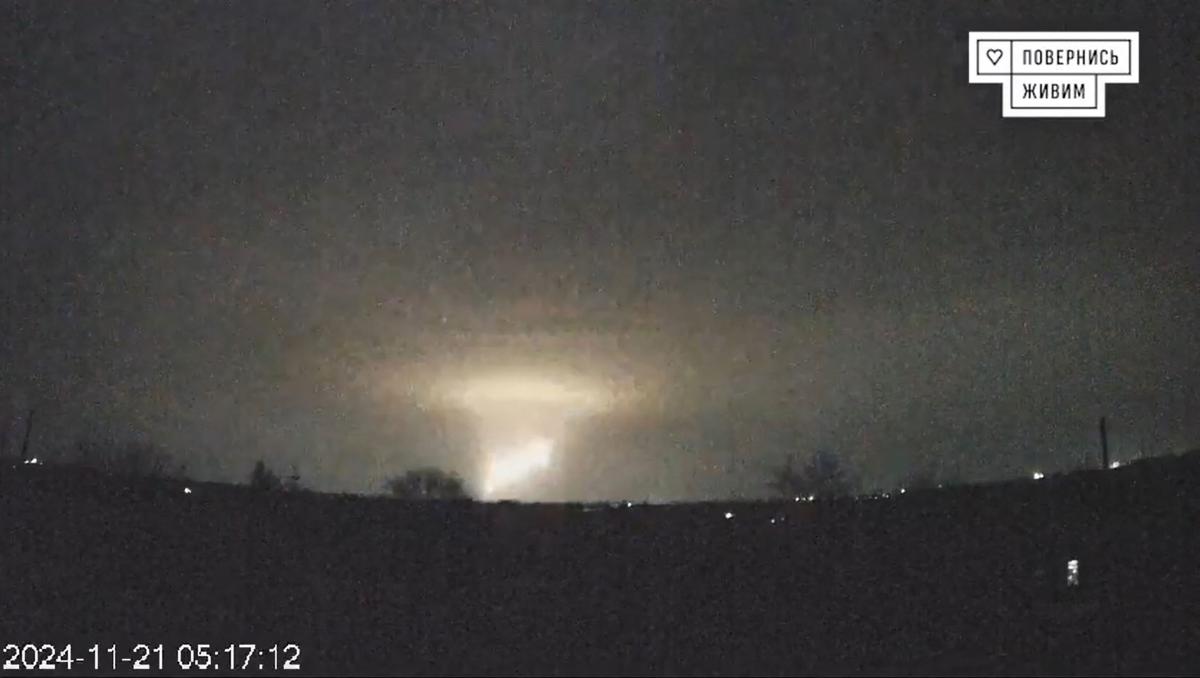
A grab taken from footage released online on Nov. 21, 2024 by the Ukrainian charity “Come Back Alive” shows flashes over the Ukrainian city of Dnipro. (AFP)
Short Url
Updated 21 November 2024
Follow

Russia fires what appears to be intercontinental ballistic missile at Ukraine, Kyiv says

Russia fires what appears to be intercontinental ballistic missile at Ukraine, Kyiv says
  • Western officials, who spoke on condition of anonymity, later told Reuters their initial analysis showed it was not an intercontinental ballistic missile
  • Regardless of its classification, the latest strike highlighted rapidly rising tensions in the 33-month-old war

KYIV: Ukraine said Russia fired what appeared to be an intercontinental ballistic missile at the city of Dnipro on Thursday, in what would be the first use in war of a weapon designed to deliver long-distance nuclear strikes.
Western officials, who spoke on condition of anonymity, later told Reuters their initial analysis showed it was not an intercontinental ballistic missile, though they left open the possibility that conclusion could change.
Regardless of its classification, the latest strike highlighted rapidly rising tensions in the 33-month-old war.
Ukraine fired US and British missiles at targets inside Russia this week despite warnings by Moscow that it would see such action as a major escalation.
Security experts said that if Thursday’s strike involved an intercontinental ballistic missile, it would be the first use of such a missile in war. ICBMs are strategic weapons designed to deliver nuclear warheads and are an important part of Russia’s nuclear deterrent.
“Today there was a new Russian missile. All the characteristics – speed, altitude – are (of an) intercontinental ballistic (missile). An expert (investigation) is currently underway,” Ukrainian President Volodymyr Zelensky said in a video statement.
Ukraine’s foreign ministry urged the international community to react swiftly to the use of what it said was “the use by Russia of a new type of weaponry.”
The Ukrainian air force said the missile was fired from the Russian region of Astrakhan, more than 700 km (435 miles) from Dnipro in central-eastern Ukraine. It did not specify what kind of warhead the missile had or what type of missile it was. There was no suggestion it was nuclear-armed.
Asked about the air force statement, Kremlin spokesman Dmitry Peskov told reporters to contact Russian military for comment.
Ukrainska Pravda, a Kyiv-based media outlet, cited anonymous sources saying the missile was an RS-26 Rubezh, a solid-fueled intercontinental ballistic missile with a range of 5,800 km, according to the Arms Control Association.
The RS-26 was first successfully tested in 2012, and is estimated to be 12 meters (40 ft) long and weigh 36 tons, according to the Center for Strategic and International Studies (CSIS). It said the RS-26 can carry an 800-kg (1,765-pound)nuclear warhead.
The RS-26 is classified as an ICBM under a nuclear arms reduction treaty between the United States and Russia, but it can be seen as an intermediate-range ballistic missile when used with heavier payloads at ranges below 5,500 km, CSIS said.


US Senate passes bill to end government shutdown, sends to House

US Senate passes bill to end government shutdown, sends to House
Updated 5 sec ago
Follow

US Senate passes bill to end government shutdown, sends to House

US Senate passes bill to end government shutdown, sends to House
  • Senate passes bill to end shutdown, heads to House for approval
  • Deal restores funding, stalls Trump’s workforce downsizing until January 30

WASHINGTON: The US Senate on Monday approved a compromise that would end the longest government shutdown in US history, breaking a weeks-long stalemate that has disrupted food benefits for millions, left hundreds of thousands of federal workers unpaid and snarled air traffic. The 60-40 vote passed with the support of nearly all of the chamber’s Republicans and eight Democrats, who unsuccessfully sought to tie government funding to health subsidies that are due to expire at the end of the year. While the agreement sets up a December vote on those subsidies, which benefit 24 million Americans, it does not guarantee they will continue.
The deal would restore funding for federal agencies that lawmakers allowed to expire on October 1 and would stall President Donald Trump’s campaign to downsize the federal workforce, preventing any layoffs until January 30.
It next heads to the Republican-controlled House of Representatives, where Speaker Mike Johnson has said he would like to pass it as soon as Wednesday and send it on to Trump to sign into law. Trump has called the deal to reopen the government “very good.” The deal would extend funding through January 30, leaving the federal government for now on a path to keep adding about $1.8 trillion a year to its $38 trillion in debt. Coming a week after Democrats won high-profile elections in New Jersey, Virginia and elected a democratic socialist as the next mayor of New York City, the deal has provoked anger among many Democrats who note there is no guarantee that the Republican-controlled Senate or House would agree to extend the health insurance subsidies.
“We wish we could do more,” said Senator Dick Durbin of Illinois, the chamber’s No. 2 Democrat. “The government shutting down seemed to be an opportunity to lead us to better policy. It didn’t work.”
A late October Reuters/Ipsos poll found that 50 percent of Americans blamed Republicans for the shutdown, while 43 percent blamed Democrats.
US stocks rose on Monday, buoyed by news of progress on a deal to reopen the government.
Trump has unilaterally canceled billions of dollars in spending and trimmed federal payrolls by hundreds of thousands of workers, intruding on Congress’s constitutional authority over fiscal matters. Those actions have violated past spending laws passed by Congress, and some Democrats have questioned why they would vote for any such spending deals going forward.
The deal does not appear to include any specific guardrails to prevent Trump from enacting further spending cuts.
However, the deal would fund the SNAP food-subsidy program through September 30 of next year, heading off any possible disruptions if Congress were to shut down the government again during that time.