Saudi Arabia and Tajikistan ink deal to boost non-oil trade

Saudi Arabia and Tajikistan ink deal to boost non-oil trade
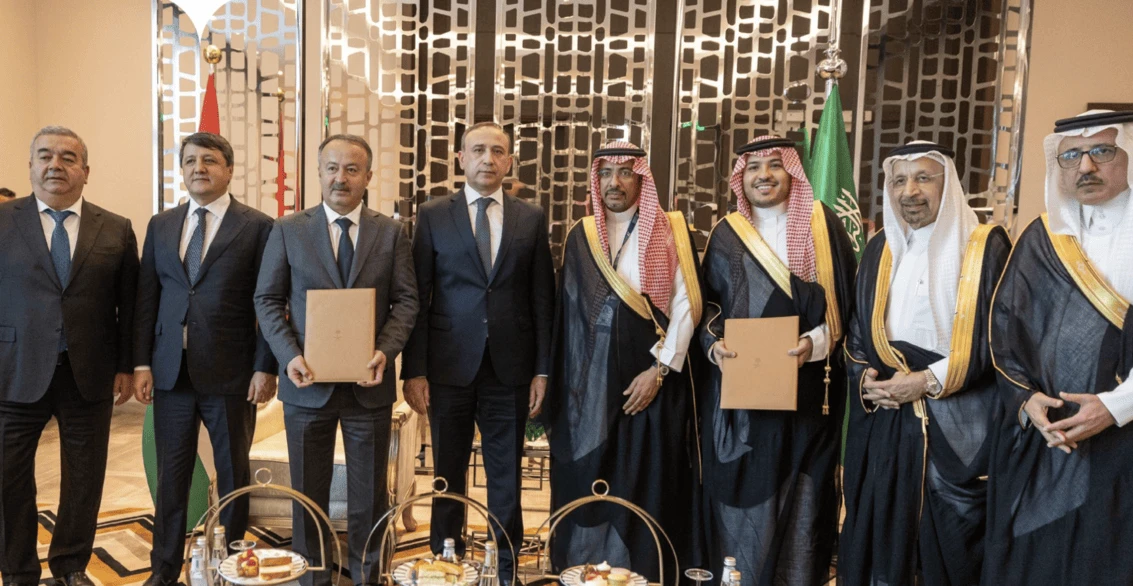
The memorandum of understanding was signed on the sidelines of the Saudi-Tajik Joint Committee. X/@SaudiExports
Short Url
Updated 27 November 2024
Follow

Saudi Arabia and Tajikistan ink deal to boost non-oil trade

Saudi Arabia and Tajikistan ink deal to boost non-oil trade

RIYADH: Saudi Arabia and Tajikistan have signed a memorandum of understanding to accelerate non-oil exports and knowledge sharing.

According to the Kingdom’s press agency, the MoU was signed by the Saudi Export Development Authority and the Export Agency of Tajikistan on the sidelines of an event which agreed to establish a bilateral business council between the countries.

That agreement was reached by the Federation of Saudi Chambers and the Chamber of Commerce and Industry in Tajikistan, and will see the promotion of trade and investment relations.

Bolstering non-oil exports and promoting trade between nations is a crucial goal outlined in Saudi Arabia’s Vision 2030 agenda, as the Kingdom is on an economic diversification journey by reducing its dependence on crude revenues. 

The Saudi-Tajik Business Council is expected to serve as a platform for private sector communities in the Kingdom and Tajikistan to network, showcase their activities, and foster commercial partnerships.

The council will also work to open new areas for economic collaboration, facilitate continuous interaction between the private sectors of both countries, and exchange information on market opportunities.

During the ongoing 28th edition of the World Investment Conference in Riyadh, Bandar Alkhorayef, Saudi Arabia’s minister of industry and mineral resources, held a bilateral meeting with the First Deputy Prime Minister of Tajikistan, Hakim Khalikzoda, and discussed ways to enhance cooperation in the mining and industrial sectors. 

Alkhorayef also met with the Tunisian Minister of Economy and Planning, Samir Abdel Hafeez, and discussed ways to develop bilateral relations in the industrial sector between both nations. 

Earlier this month, the Kingdom and Tunisia signed an MoU to strengthen bilateral cooperation and promote direct investments between the two nations.

The deal, which was inked by Saudi Arabia’s Minister of Investment Khalid Al-Falih and Tunisia’s Minister of Economy and Planning, focuses on sharing regulations and laws to enhance the investment environment in both countries.

The agreement between Tunisia and Saudi Arabia is seen as a crucial step in deepening the economic and industrial ties between both nations as they seek to diversify their economies and create new growth opportunities through strategic partnerships.

A report released by Saudi Arabia’s General Authority for Statistics in November revealed that the country’s non-oil exports reached SR79.48 billion ($21.16 billion) in the third quarter of this year, representing a rise of 16.76 percent compared to the same period in 2023.

Saudi Arabia, Canada explore ways to enhance cooperation in technology, innovation 

Saudi Arabia, Canada explore ways to enhance cooperation in technology, innovation 
Updated 04 November 2025
Follow

Saudi Arabia, Canada explore ways to enhance cooperation in technology, innovation 

Saudi Arabia, Canada explore ways to enhance cooperation in technology, innovation 

RIYADH: Saudi Arabia’s technology and innovation partnership with Canada is set to receive a boost after senior ministers met to explore new avenues of cooperation and strengthen trade ties. 

Saudi Minister of Investment Khalid Al-Falih said in a post on X that he met with Canada’s Minister of Artificial Intelligence and Digital Innovation Evan Solomon to discuss ways to strengthen relations between the countries and to build partnerships that contribute to mutual economic growth, particularly in priority investment sectors. 

This comes as trade between the two nations continues to expand. In February, Saudi Arabia exported SR641 million ($170 million) to Canada, marking an 86.6 percent increase from SR344 million in February 2024, according to data from the Observatory of Economic Complexity.

It also follows an agreement in January 2024 for both countries to re-exchange trade delegations to enhance economic relations and boost trade and investment flows. 

In a subsequent post on X, Al-Falih stated: “The dialogue took place between me and Anita Anand, the Canadian Minister of Foreign Affairs, in the presence of the Saudi ambassador to Canada, Amal Yahya Al-Moallimi.” 

He added: “We discussed supporting and strengthening relations between our two countries, and facilitating investment exchange, in order to achieve more fruitful cooperation in the most important sectors, which will bring success to both peoples.” 

Artificial intelligence has become a central pillar of Saudi Arabia’s post-oil economic strategy, with the Kingdom leveraging advanced technologies to drive data-led industries and automation. 

Now at the halfway point of Vision 2030, the country is accelerating efforts to position itself as a global technology leader, balancing innovation with sustainability goals. 
Key initiatives — including the Project Transcendence program, valued at around $100 billion — aim to further establish Saudi Arabia as a global hub for AI innovation. 

Over the past five years, Saudi Arabia has made significant progress toward establishing itself as a regional artificial-intelligence hub. PwC projects that AI could contribute about $235 billion — or 12.4 percent — to the Kingdom’s gross domestic product by 2030.