British Muslims plan MCB alternatives to represent communities

British Muslims plan MCB alternatives to represent communities
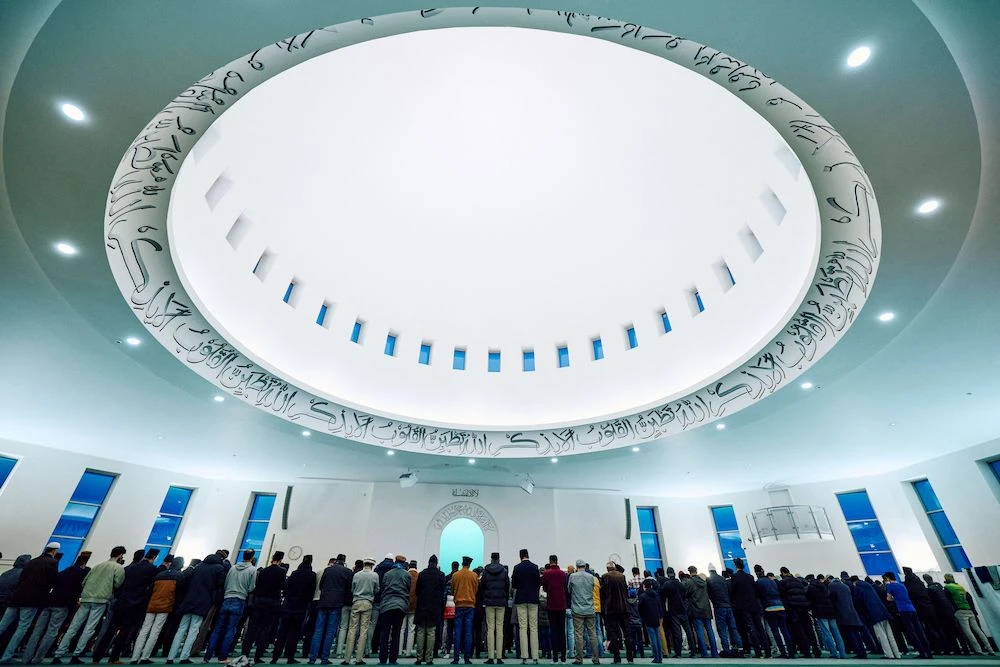
Above, members of the Ahmadiyya Muslim Community pray at the Baitul Futuh Mosque in Morden, southwest London on March 30, 2024. (AFP file photo)
Short Url
Updated 11 January 2025
Follow

British Muslims plan MCB alternatives to represent communities

British Muslims plan MCB alternatives to represent communities
  • New bodies to provide civil, political support to Muslims in UK
  • Successive governments have refused to fully engage with established Muslim bodies

LONDON: A number of British imams are in the process of establishing new organizations to represent the UK’s Muslim communities, The Times reported on Saturday.

A series of governments have refused to engage with established Muslim bodies, including the Muslim Council of Britain, creating a “vacuum” between politicians and British Muslims, according to community leaders.

Other groups — such as the Mosques and Imams National Advisory Board, the British Board of Imams and Scholars, and Tell Mama, an organization monitoring Islamophobia — are deemed too small to effectively lobby for or represent the UK’s 3.8 million Muslims.

The MCB represents around 500 mosques, schools and charities in the UK on social issues, but does not issue religious declarations.

The Labour government under Tony Blair had ties with it, but saw those severed in 2009 under Gordon Brown after the MCB’s then-deputy leader signed a declaration that was viewed as a call for violence against the Royal Navy and Israel.

The current Labour government talks to various Muslim groups on an “ad hoc” basis, said Qari Asim, senior imam at the Makkah Mosque in Leeds.

A source told The Times that rather than “simply a new entity to replace the MCB,” a “series of new initiatives” would be established “focused on increasing connection between British Muslims and the British government and trying to better represent and engage British Muslims.”

Another source told the newspaper: “It is a group of people from broad civil society who happen to be Muslim, from lawyers to doctors to economists to accountants.

“It’s a huge community (but) there is a lack of serious engagement (from government) and a whole load of expertise and experience not being tapped into by policymakers and others.”

Sariya Cheruvallil-Contractor, professor in the sociology of Islam at Coventry University, told The Times that the government is “missing a trick” by not engaging with the MCB, warning that there is “a lot of suspicion within Muslim communities of new initiatives.”
Escaping two wars, Iraqi vlogger emerges as China’s top food influencer

Ahmed Mohammed Jaber Al-Kalthoom, center, poses with Chinese fans during CreatorWeek in Macao, Oct. 25, 2025. (AN photo)
Updated 11 sec ago
Follow

Escaping two wars, Iraqi vlogger emerges as China’s top food influencer

Ahmed Mohammed Jaber Al-Kalthoom, center, poses with Chinese fans during CreatorWeek in Macao, Oct. 25, 2025. (AN photo)
  • Ahmed Mohammed Jaber Al-Kalthoom was raised in Iraq and Syria before moving to China in 2014
  • Posting in Mandarin as ‘Lao Wang in China,’ he has 38 million followers on Chinese platforms

MACAO: Among the many queues of fans waiting to meet their idols at the largest content creator event in Macao, one stands apart and does not seem to end. It is for a man instantly recognizable throughout the Chinese-speaking influencer scene: Iraqi food vlogger Ahmed.

Dressed in a suit — as he typically does in his videos — he steps forward to warmly greet each guest, posing for photos, signing autographs, sharing laughs, and chatting about their lives in fluent Mandarin.

Born in Baghdad, Ahmed Mohammed Jaber Al-Kalthoom began learning the language after arriving in Northwestern China in 2014. Four years later, he released his first viral video in Chinese, which brought him to social media fame.

The video, filmed in Inner Mongolia, was about noodles.

“There are more than 1,000 types of noodles in China. It’s incredible. Every type has its own distinct flavor and ingredients,” Ahmed told Arab News on the sidelines of CreatorWeek Macao, one of the largest creator economy events in Asia.

“I made that video just for me. But the next day, people came knocking on my door, saying, ‘your video went viral, you’ve become an influencer, famous!’ It was such a beautiful feeling. It pushed me to move forward with this.”

He continued regularly uploading videos of himself eating, commenting on the food, and interacting with restaurant owners, waiters and other diners. Within a month he had gained more than half a million followers.

Ahmed has been living in China since the age of 20, after fleeing two wars in the Middle East. His family first left Iraq following the US-led invasion in 2003 and settled in Latakia, Syria. They lived there in relative peace for several years, until the Syrian civil war broke out and Ahmed was severely wounded.

At that time, his uncle who had been living in China for many years, invited him to come.

Eleven years later, posting under the name “Lao Wang in China,” he has become one of the country’s most recognizable content creators, with 38 million followers across major Chinese social media and short-video platforms, including Bilibili, Douyin, Weibo, Kuaishou, Baidu, and Xiaohongshu.

He now hopes to reach audiences beyond China and connect it with the Arab world.

“The program that I present is in Chinese and for the Chinese ... Now, I’m trying to do it on YouTube and Facebook, and I hope to put it out in Arabic,” he said.

“China has so many beautiful places, but many people don’t know about them, don’t know the food, the culture. I’ve documented much of it, I’ve traveled to many cities, and I wish my Arab brothers and sisters could get to see it.”