- Philippe Lazzarini tells Arab News we are witnessing a ‘crisis of impunity’ and international humanitarian law is becoming irrelevant in absence of ways to address this impunity
- UNRWA’s mandate and capacity to provide services ‘far exceed any other entity’ and they could only be transferred to a functioning Palestinian state institution, he says
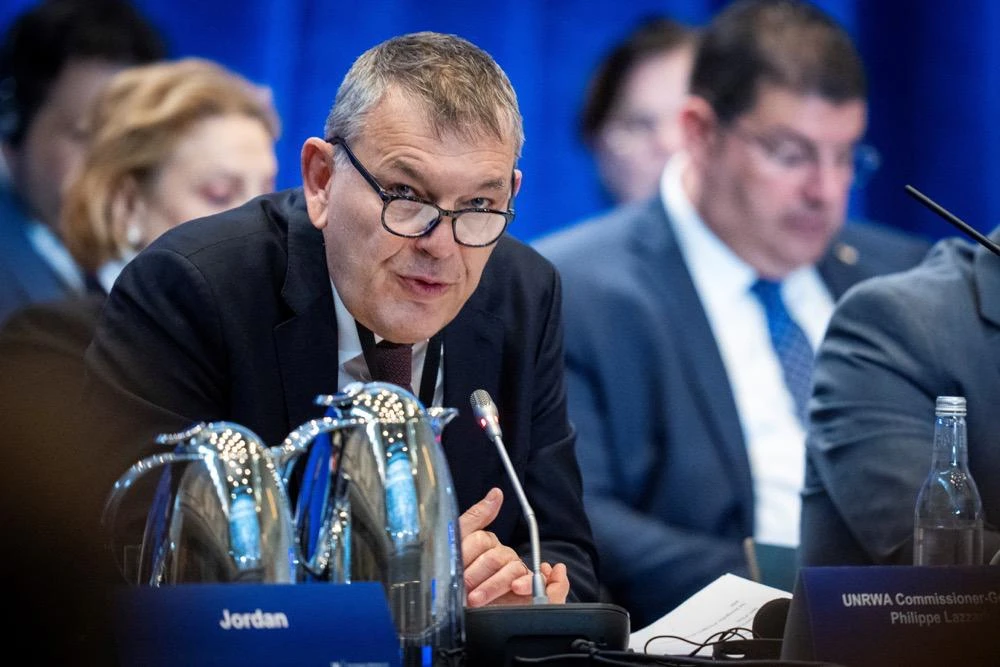
NEW YORK CITY: The head of the largest aid agency for Palestinians has warned that the full implementation of a new Israeli law preventing its workers from operating within the country would be “catastrophic” for Gaza, “massively” weaken the international humanitarian response there, and make already “dire and catastrophic” living conditions “immeasurably” worse.
It would also undermine the Gaza ceasefire agreement, said Philippe Lazzarini, the commissioner general of the UN Relief and Works Agency for Palestine refugees.
He was speaking in New York where he earlier briefed the UN Security Council on the plight of the UNRWA, less than two weeks before the Israeli ban on the agency is due to take effect.
Lazzarini welcomed the recent ceasefire agreement and hostage-release deal in Gaza as a “starting point,” and stressed the “absolute” need for “rapid, unfettered” access for humanitarians to respond to the “tremendous suffering” in the territory.
The anti-UNRWA legislation, approved overwhelmingly by the Knesset in October, would bar the agency from operating within Israel and ban the country’s authorities from any contact with it.
The delivery of aid to Gaza and the West Bank requires close coordination between UNRWA and Israeli authorities. If the legislation is implemented as planned, Israel would no longer issue agency staff with work or entry permits, and the coordination with the Israeli military that is essential for ensuring safe passage for aid deliveries will no longer be possible.
Since the start of the war in Gaza, Israel has relentlessly condemned and attacked the aid agency. More than 260 of its staff have been killed; its schools, where displaced Palestinians sought shelter, were bombed; and a coordinated Israeli media campaign has attempted to discredit the agency by portraying it as a tool of Hamas.
Lazzarini said that though the Israeli government suggests the services provided by UNRWA could be delivered by other agencies, its mandate and capacity to provide public services to an entire population — including education for more than 600,000 Palestinian children, and healthcare — are “unique and far exceed any other entity.”
This means “these services, in reality, can only be transferred to a functioning state public institution,” said Lazzarini, adding that this is in line with the aims of the Global Alliance for the Implementation of the Two-State Solution, initiated last year by Saudi Arabia, the EU and the Arab League.
“UNRWA’s services are also tightly woven into the social fabric of Gaza,” he said. “The disintegration of the agency would intensify the breakdown of social order. So dismounting UNRWA outside the political process would undermine the ceasefire agreement, and sabotage Gaza’s recovery and the political transition.”
Turning to the situation in the West Bank, Lazzarini said the Palestinian Authority has stated clearly that it does not have the financial resources or capacity to make up for any loss of UNRWA services.
“A chaotic dismantling of UNRWA will irreversibly harm the lives and the future of the Palestinians, and I believe it will obliterate their trust in the international community and any solution it attempts to facilitate,” he added.
He reminded the Security Council during his briefing earlier in the day of “the fierce global disinformation campaign” mounted against the agency, and what he described as “the intense diplomatic lobbying by the government of Israel, as well as affiliated nongovernmental organizations, targeting UNRWA and governments of donor countries.”
According to Knesset figures, Israel has allocated an additional $150 million to its 2025 propaganda budget in an effort to reshape global opinions about its actions in Gaza, which critics allege amount to genocide.
Lazzarini said that “misinformation campaigns” have endangered UNRWA staff in the West Bank and Gaza, where 269 of them had been killed as of Friday.
“It has also created a permissive environment for the harassment of UN representatives wherever they are, including in Europe and in the United States,” he added.
Lazzarini said he urged the Security Council and UN member states to do what they can to persuade Israel not to implement the new legislation, and to ensure that the funding crisis the UNRWA faces does not abruptly halt the life-saving services it provides.
The agency was established by UN General Assembly in the aftermath of the 1948 Arab-Israeli War to provide direct relief and works programs for Palestinian refugees.
Lazzarini said the attacks against the agency are attacks on the international multilateral system itself. While UN member states and donor countries, including EU countries, continue to publicly assert that UNRWA is irreplaceable in the absence of a Palestinian state, these statements of support have not been backed up by pressure on Israel to rethink its ban on the agency.
Asked by Arab News about this discrepancy between public statements of support and meaningful action, and whether or not it means Western countries are, through lack of action, undermining the very multilateral values upon which they were founded, Lazzarini said: “The same question could be asked about the importance of international humanitarian law and the blatant and constant disregard of that law.
“You can ask the same question about the disrespect for the resolutions of the Security Council and the General Assembly. And you can ask the same question about” the International Court of Justice’s ruling that Israel’s presence in the West Bank and East Jerusalem is illegal, and the court’s call for its withdrawal.
“And so it’s obviously frustrating,” Lazzarini added. “What we have witnessed is an extraordinary ‘crisis of impunity,’ to the extent that international humanitarian law is almost becoming irrelevant if no mechanism is put in place to address this impunity.”