McLaren has ominous pace, Lewis Hamilton has work to do: 5 takeaways from F1’s season-opener

McLaren has ominous pace, Lewis Hamilton has work to do: 5 takeaways from F1’s season-opener
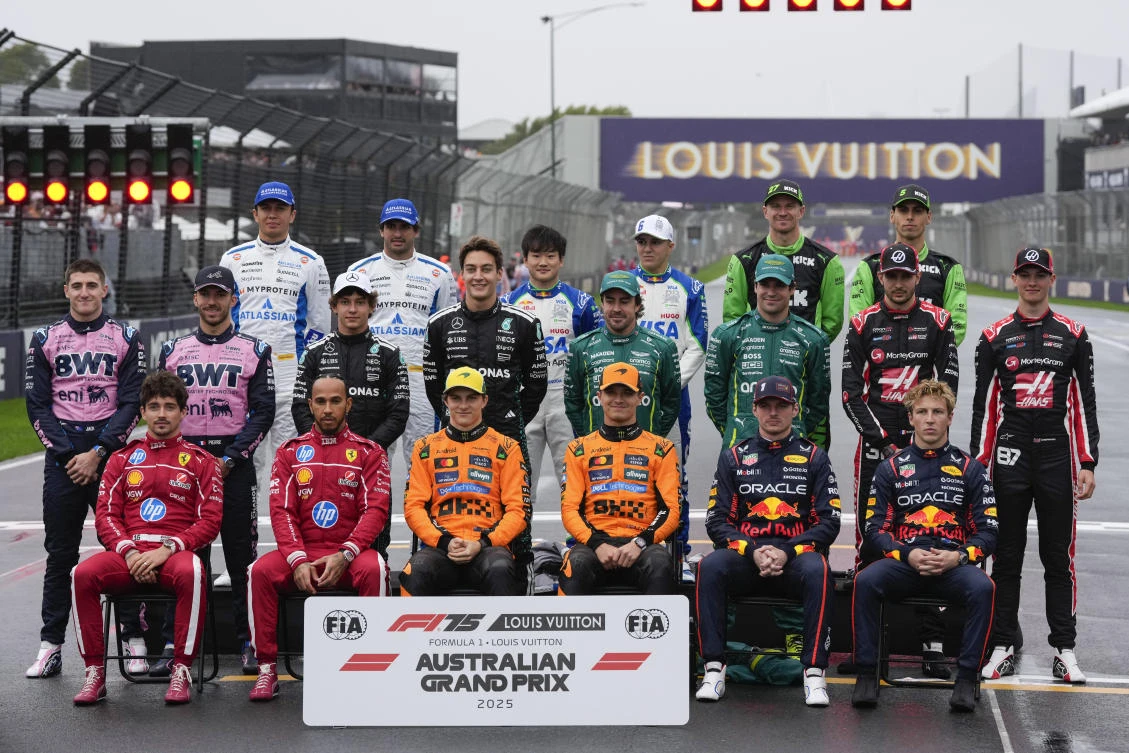
Lando Norris heads to the second round of the Formula 1 season in China with a lead over champion Max Verstappen after winning a thrilling race in Australia. (AP)
Short Url
Updated 17 March 2025
Follow

McLaren has ominous pace, Lewis Hamilton has work to do: 5 takeaways from F1’s season-opener

McLaren has ominous pace, Lewis Hamilton has work to do: 5 takeaways from F1’s season-opener
  • Among the takeaways ahead of Sunday’s race in Shanghai are that McLaren is the team to beat and that Lewis Hamilton and Ferrari have a lot of work to do
  • Lando Norris heads to the second round of the Formula 1 season in China with a lead over champion Max Verstappen after winning a thrilling race in Australia

Lando Norris heads to the second round of the Formula 1 season in China with a lead over champion Max Verstappen after winning a thrilling race in Australia.
Ahead of Sunday’s race in Shanghai, here are five takeaways from the season-opening Australian Grand Prix:
McLaren is the team to beat
Without the rain and the safety car, the Australian Grand Prix might not have been much of a contest. The two McLarens of Norris and Oscar Piastri quickly built a lead of more than 15 seconds to Verstappen in third early in the race. The McLarens were also three-tenths of a second faster than anyone else in qualifying. So much for preseason predictions that this year could be exceptionally close between multiple teams.
Norris acknowledged McLaren are favorites but warned the team shouldn’t get complacent. “If you start thinking things are good and groovy, that’s when you get caught,” he said. “We will have races where we struggle.”
Hamilton and Ferrari have work to do
Lewis Hamilton briefly led on his Ferrari debut. Unfortunately for the seven-time champion, a strategy blunder meant Ferrari left Hamilton and his new teammate Charles Leclerc on dry tires in increasingly heavy rain. “Missed a big opportunity,” Hamilton told Ferrari over the radio. Hamilton finished 10th, two places behind Leclerc.
Hamilton and Ferrari may need to work on their communication. After more than a decade working with Peter “Bono” Bonnington at Mercedes, Hamilton was frustrated at regular radio updates from his new engineer Riccardo Adami. “Leave me to it, please,” he said repeatedly.
Lawson’s old teammate may be his closest rival
No one expected Liam Lawson, in his 12th career F1 race, to beat his four-time champion teammate Verstappen. However, Lawson also underperformed compared to Yuki Tsunoda, his old teammate, after being picked over Tsunoda for the Red Bull seat. Lawson qualified 18th and made little progress before crashing out. Tsunoda qualified fifth and was competitive, though a team strategy error meant he finished 12th. If Lawson doesn’t improve, Red Bull could face even more scrutiny of its decision to pick him.
Antonelli is the standout rookie
Formula 1’s biggest rookie class in years struggled — with one big exception. The 18-year-old Andrea Kimi Antonelli became the second-youngest driver ever to score F1 points, behind only Verstappen, as he finished fourth with a strong drive from 16th.
Of the other drivers starting their first full F1 seasons, Lawson, Sauber’s Gabriel Bortoleto and Alpine’s Jack Doohan crashed out, Racing Bulls’ Isack Hadjar crashed before the start and Haas’ Oliver Bearman was the last finisher in 14th.
Teamwork helps Williams make its mark
Alex Albon benefited from his new teammate as he finished fifth for Williams’ best result since 2021. Carlos Sainz, Jr. crashed out early but joined the team staff on the pit wall to offer Albon advice over the radio on how best to handle the rapidly changing weather. “We’re a very bonded team,” Albon said.


Another stage in the evolution of women’s cricket

Another stage in the evolution of women’s cricket
Updated 50 min 14 sec ago
Follow

Another stage in the evolution of women’s cricket

Another stage in the evolution of women’s cricket
  • The development of women’s cricket has gathered significant pace in the last three years

In the afterglow of the 2025 Women’s ODI World Cup, the International Cricket Council has announced that it is keen to build on the success of the tournament. It was hosted by India and Sri Lanka and was won for the first time by the former, who beat South Africa in the final. In itself that pairing may come to be seen as the moment when the domination by Australia and England was broken. This would be unfair on New Zealand who won the 2000 edition, beating Australia by four runs. However, the view exists that, for India, with its playing resources underpinned by strong finances and fierce support, the victory heralds the start of a sustained era of success.

The anguished faces of the defeated Australians and their limp body language at the end of their semifinal against India spoke of a recognition that a serious new challenger to their dominance had emerged. Australia has won seven of the 13 Women’s ODI World Cups, England four, including the first one in 1973. The semifinal loss to India was Australia’s first defeat in 16 ODI World Cup matches. It was made worse for them in that India had chased down a record run chase of 339 with nine deliveries remaining.

It is sobering to recall that the early years of the event were beset by funding difficulties, with gaps of up to six years occurring between tournaments. It was not until 2005 that a regular four-year interval was established. The number of participating teams has varied between four in 1978 and 11 in 1997. In 2000 the number was fixed at eight, but the ICC decided, as far back as International Women’s Day 2021, that the number would be expanded to 10 for the 2029 edition. This will increase the number of matches from 31 to 48. The 2026 Women’s T20 World Cup, hosted by England and Wales, will feature 12 teams, an increase of two from 2024.

Attendances at matches have also increased. The crowd for the India-Australia semifinal at the DY Patil Stadium, Navi Mumbai, was 34,651, while the ICC reported that “nearly 300,000 fans watched matches in stadiums, breaking the record for tournament attendance for any women’s cricket event.” Viewership growth was also reported with “new records being set for on-screen audiences across the world and nearly 500 million viewers in India.”

Global interest in cricket will be boosted by its inclusion in the 2028 Olympic Games in Los Angeles, where 28 matches have been scheduled across both the men’s and women’s competitions. The ICC has announced that the six teams in each competition will comprise the top-ranked side from each of the five regions — Africa, Asia, Europe, Oceania, and the Americas. The sixth team will be identified through a qualifier. On current rankings, South Africa, India, England, Australia and either the US or the West Indies will qualify for both competitions.

Before the 2028 Olympics, cricket for both men and women will feature in multi-sport games at the Asian Games in 2026 in Aichi-Nagoya, Japan; and the African Games in Cairo, Egypt, and the Pan American Games in Lima, Peru, both in 2027. More immediately, the Southeast Asian Games will be held in Thailand from Dec 9-20, 2025. Six countries will contest T10 and T20 cricket — Thailand, Malaysia, Indonesia, Singapore, the Philippines, and Myanmar.

These are all significant steps forward for cricket’s presence on the global sporting landscape, and are not just for men.

My impression is that the development of women’s cricket has gathered significant pace in the last three years. One catalyst for this has been the introduction of franchise cricket for women. Although this happened first in Australia in 2015, it was followed by England/Wales in 2021, the West Indies in 2022 and India in 2023. In England and Wales, the double heading of men’s and women’s matches on the same day at international stadiums brought enhanced opportunities to watch women’s cricket. A second catalyst has been the increase in ICC tournaments. Each year there is now a major women’s event, increasing visibility.

A third potential catalyst is the effects of the Indian women’s team’s World Cup win. All over India it is possible to imagine that the win has stirred ambitions in young girls, fundamentally changing what they believe they can achieve in life. It is also possible to visualize that their families and communities also believe in the possibility. The sight of women cricketers being celebrated and feted with the same intensity, level of analysis and adoration as male cricketers represents a significant transformation in cricket’s contemporary evolution.

None of these developments would be possible without the fourth catalyst of funding. Pay for professional women cricketers is still lower than their male counterparts, but moves toward greater parity are in place. Indian players and support staff received a handsome bonus after their World Cup win. The England and Wales Cricket Board has put in place a restructuring of the women’s game, part of which is that minimum starting salaries are now equal across men’s and women’s professional domestic cricket.

In March 2025 The Professional Cricketers’ Association said the increasing disparity between the top salaries of men’s and women’s players in The Hundred “cannot be allowed to continue.” This was after it became apparent that the gap in pay between the top men’s and women’s players widened from £75,000 to £135,000 for 2025. The PCA report also noted that the average salary of a female player had increased from £8,000 in 2021 to £29,100 for 2025.

The sale of equity in The Hundred has brought additional funding. In 2026 the overall salary pot in The Hundred Men’s Competition will increase by 45 percent, rising to £2.05 million per team. The overall salary pot in The Hundred Women’s Competition will increase 100 percent for the 2026 season, rising to £880,000 per team, while the base price salaries for the lowest-paid player increase to £15,000, up by 50 percent.

The Board of Control for Cricket in India made a landmark decision in October 2022 to introduce equal match fees for men and women cricketers at international level. After the World Cup victory, a former women’s team captain, Mithali Raj, spoke of her time, not so long ago, when there were either low or no match fees, few facilities, no sponsorship, and travel was by public transport. How times have changed.

Women’s cricket has been symbolized by decades of struggle and resilience. It has now bloomed into being more than sport, becoming a blueprint for how visibility, investment, facilities and opportunity can transform not just a game, but the lives of talented individuals and their supporters.