- Zelensky said the discussion with Trump had focused specifically on the Russian-occupied Zaporizhzhia Nuclear Power Plant
- It has been under Russian control since the early days of the war, making it unclear what future US involvement could look like
KYIV: During a call between US President Donald Trump and his Ukrainian counterpart, the US leader apparently suggested Volodymyr Zelensky consider transferring ownership of Ukraine’s power plants to the US for long-term security, according to a US statement.
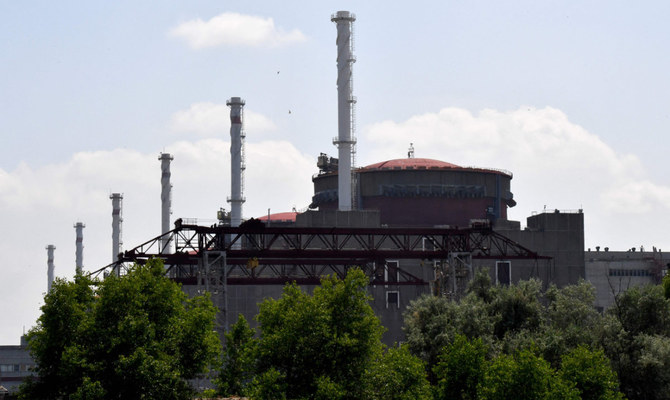
Briefing the media later, Zelensky said the discussion with Trump had focused specifically on the Russian-occupied Zaporizhzhia Nuclear Power Plant, ZNPP, in southern Ukraine.
While the facility remains connected to Ukraine’s energy grid without producing electricity, it has been under Russian control since the early days of the war, making it unclear what future US involvement could look like.
Who controls the Zaporizhzhia Nuclear Power Plant?
The Zaporizhzhia Nuclear Power Plant is one of the world’s 10 largest and Europe’s biggest. Located in Ukraine’s southern Zaporizhzhia region, Russian forces occupied it shortly after Moscow’s February 2022 invasion.
While Russia declared the region annexed in fall 2022, its largest city, Zaporizhzhia, remains under Ukrainian control.
Ukraine has accused Russia of stationing troops and weapons at the plant and using it as a launchpad for attacks across the Dnipro River. Russia denies this, accusing Ukraine of shelling the facility.
How many nuclear power plants does Ukraine have?
Besides Zaporizhzhia, Ukraine operates three active nuclear power plants, which generate the majority of the country’s electricity following sustained Russian attacks on thermal and hydroelectric plants.
These facilities are located in southern, western and northwestern Ukraine, away from frontline areas.
What did Trump and Zelensky discuss and are there negotiations over Zaporizhzhia’s fate?
During their call on Wednesday, Trump suggested that Zelensky should consider giving the US ownership of Ukraine’s power plants to ensure their long-term security, according to a White House statement from US Secretary of State Marco Rubio and National Security Adviser Mike Waltz.
“American ownership of those plants could be the best protection for that infrastructure,” Trump suggested, according to the statement.
Zelensky later told journalists their conversation focused on the Zaporizhzhia nuclear power plant, and the following day, made it clear that “the issue of ownership” of the other three plants was never discussed.
“All nuclear power plants belong to the people of Ukraine,” he said.
Zelensky said that when they discussed Zaporizhzhia, the US leader had inquired about the facility’s future. “Trump asked my thoughts on the plant,” Zelensky said. “I told him that if it is not Ukrainian, it will not operate. It is illegal.”
Even though ZNPP is a state-owned plant, Zelensky acknowledged that if the US were to claim it from Russian control, invest in it and modernize it, Ukraine might consider it. “That is a separate question, an open one,” he said.
What is the current state of Zaporizhzhia’s nuclear plant?
Since falling under Russian control, the plant’s conditions have deteriorated. While its six reactors have been shut down for years, they still require power and qualified staff to maintain cooling systems and safety features.
Energoatom, Ukraine’s state nuclear operator, said that after Russian forces took over, Ukrainian personnel were forced to sign contracts with Russian authorities and take Russian citizenship. Those who refused faced abduction or threats, forcing thousands to flee, leaving the facility understaffed and harder to manage.
The collapse of a dam in June 2023 further jeopardized the plant’s cooling systems, which relied on water from the reservoir. In response, plant administrators dug wells, according to the International Atomic Energy Agency (IAEA).
Zelensky said extensive repairs would be needed before the plant could operate again, estimating the process could take at least two years.
The IAEA has repeatedly warned the war could cause a radiation leak. While the plant no longer produces electricity, it still holds large amounts of nuclear fuel, requiring constant cooling.
Regular blackouts caused by the fighting have disrupted the facility, though power has been quickly restored each time.
IAEA experts permanently stationed there still face restricted access, with Russian authorities blocking some inspection requests, according to IAEA head Rafael Grossi.
Is any kind of deal imminent?
Zelensky said the discussions with Trump on restoring Zaporizhzhia were a positive step, but cautioned that no one would work at the plant if Russian forces remained stationed nearby.
Control over the plant is likely to remain a legal and logistical challenge, intertwined with a highly divisive issue for both warring sides: control over the land itself. Russian troops hold the area, while Ukrainian forces are separated from it by the Dnipro River and more than 100 kilometers (62 miles) of terrain.
“Simply handing over the plant while everything within a meter of it remains occupied or armed by Russia — no one will work under such conditions,” Zelensky said after the call with Trump. “It’s impossible.”
He said there would be no way to operate securely in such a scenario. “That would mean that the plant could start operating tomorrow, only to be blown up by the Russians the following day.”