Philippine police face mandatory fitness training to stay in service

Special Philippine police face mandatory fitness training to stay in service
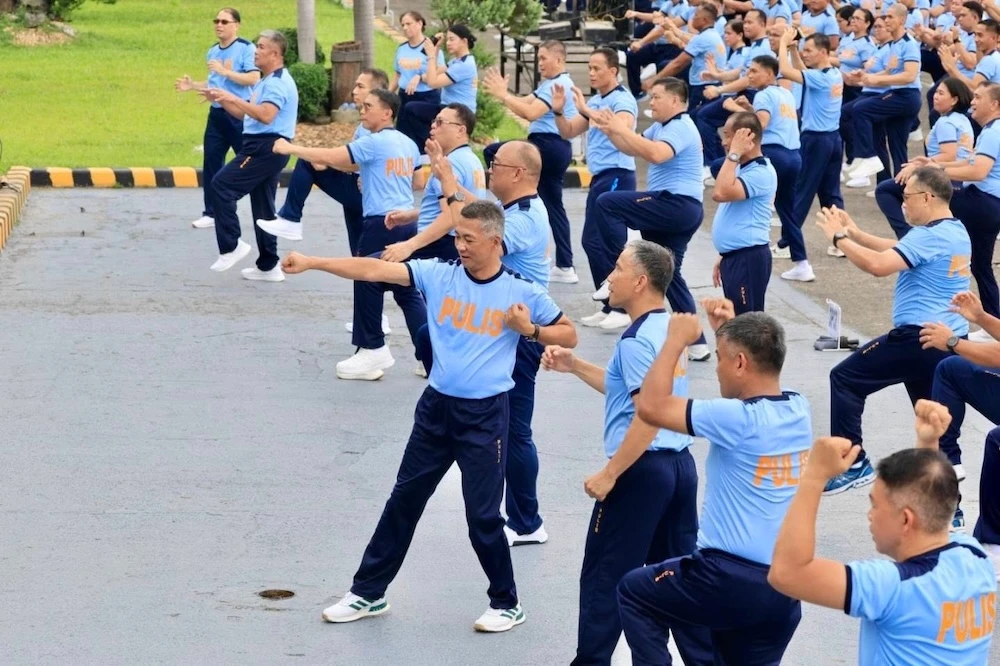
The Philippine National Police launched a regular physical conditioning program at Camp General Rafael T. Crame, Quezon City on June 24, 2025. (Philippine National Police)
Short Url
Updated 26 June 2025
Follow

Philippine police face mandatory fitness training to stay in service

Philippine police face mandatory fitness training to stay in service
  • New program is called Pulisteniks, from ‘pulis’ – police in Tagalog – and ‘calisthenics’
  • Program mandates police units across the country to dedicate Tuesdays and Thursdays to fitness

MANILA: The Philippine National Police has kicked off a new fitness initiative for officers, vowing to get overweight personnel back in shape or out of the service.

Launched this week, the campaign is called Pulisteniks, from “pulis,” which means police in Tagalog, and “calisthenics.”

The program mandates PNP units nationwide to dedicate Tuesdays and Thursdays to fitness, including various physical activities such as running, walking, jogging, biking, Zumba, and combat sports like arnis – the national martial art and sport of the Philippines – aikido, boxing, karate-do, judo, muay thai, swimming, table tennis, and taekwondo.

“The directive of our chief PNP is clear. We need our police officers to be physically fit. This program has been in place for a long time, but now we’re putting more focus on it because we’re also aiming to meet our target response time,” Maj. Philipp Ines, Manila Police District spokesperson, told Arab News.

“What is happening now is just a reiteration of our ongoing programs. The good thing is we’re now being given time to focus on physical conditioning every Tuesday and Thursday from 4 p.m. to 5 p.m. This is a good program to help our officers reduce weight and be able to keep up with the demands of public service.”

Under the Department of the Interior and Local Government Act of 1990 all PNP officers are required to keep their body weight within 5 kg – either above or below – a standard weight based on their height and sex.

“We undergo quarterly check-ups, where they check if our BMI – body mass index – is within the acceptable range. If it’s not, the health or medical officer tells our personnel to lose weight. That’s why now there’s a program in place to help with that because before it was hard for many officers due to the lack of time,” Ines said.

“The Manila Police District Health Service is monitoring our progress so we can track whether we’re able to comply. And every year, there’s a required physical fitness test that we all have to pass. If you fail those tests twice in a row, it could be grounds for separation from service.”

Philippine Police Chief Gen. Nicolas Torre III said that officers are given a target of six months to a year to lose weight.

“After a year, if they don’t meet the standards, they can be removed from the service,” he said in a radio interview.

The fitness program has already gained support from Filipino netizens whose comments on Facebook ranged from “I hope they lose weight to look better” to “It’s embarrassing to see all fat police officers these days,” and “your uniform doesn’t fit you.”

Remedios Borejon, retired National Police Commission public affairs officer, told Arab News the program should help improve how the police are seen.

“I’m in favor of the program. This is also to help make our police officers look prim and proper, like gentlemen. Because it really doesn’t look good if a police officer looks sloppy or overweight,” she said.

“In the past, you rarely saw overweight police officers. I support this. It helps improve their image and boosts professionalism.”


Shout-out for yodeling? Swiss seek recognition from UN cultural agency as tradition turns modern

Updated 3 sec ago
Follow

Shout-out for yodeling? Swiss seek recognition from UN cultural agency as tradition turns modern

Shout-out for yodeling? Swiss seek recognition from UN cultural agency as tradition turns modern
LUCERNE: Yodel-ay-hee ... what?! Those famed yodeling calls that for centuries have echoed through the Alps, and more recently have morphed into popular song and folk music, could soon reap a response — from faraway Paris.
Switzerland’s government is looking for a shout-out from UN cultural agency UNESCO, based in the French capital, to include the tradition of yodeling on its list of intangible cultural heritage. A decision is expected by year-end.
Modern-day promoters emphasize that the yodel is far more than the mountain cries of yesteryear by falsetto-bellowing male herders in suspenders who intone alongside giant Alphorns atop verdant hillsides. It’s now a popular form of singing.
Over the last century, yodeling clubs sprouted up in Switzerland, building upon the tradition and broadening its appeal — with its tones, techniques and tremolos finding their way deeper into the musical lexicon internationally in classical, jazz and folk. US country crooners prominently blended yodels into their songs in the late 1920s and 30s.
About seven years ago, the Lucerne University of Applied Sciences and Arts, or HSLU by its German-language acronym, became the first Swiss university to teach yodeling.
“For me, actually, in Switzerland we have four languages but I think really we have five languages. We have a fifth: The yodel,” said HSLU professor Nadja Räss, alluding to the official German, French, Italian and Romansh languages in Switzerland. Yodeling exists in neighboring Austria, Germany and Italy, but Swiss yodeling is distinctive because of its vocal technique, she said.
In its early days, yodeling involved chants of wordless vowel sounds, or “natural yodeling,” with melodies but no lyrics. More recently, “yodeling song” has included verses and a refrain.
The Swiss government says at least 12,000 yodelers take part through about 780 groups of the Swiss Yodeling Association.
In Switzerland, Räss said, yodeling is built on the “sound colors of the voice” and features two types: one centering on the head — with a “u” sound — and one emanating from deeper down in the chest — with an “o” sound.
And even within Switzerland, styles vary: Yodeling in the northern region near Appenzell is more “melancholic, slower,” while in the country’s central regions, the sounds are “more intense and shorter,” she said.
What began as mostly a male activity is now drawing more and more women in a country that only finalized the right to vote for all women in the 1980s — long after most of its European neighbors.
Julien Vuilleumier, a scientific adviser for the Federal Office of Culture who is spearheading the Swiss request, said it’s tough to trace the origins of yodeling, which factors into the imagery of the Swiss Alps.
“Some say it’s a means of communication between valleys, using these very distinctive sounds that can carry a long way. Others believe it’s a form of singing,” he said. “What we know is that ... yodeling has always been transformed and updated.”
UNESCO’s government-level committee for Intangible Heritage in New Delhi will decide in mid-December. The classification aims to raise public awareness of arts, craftsmanship, rituals, knowledge and traditions that are passed down over generations.
Also among the 68 total nominations this year are traditions like Thanakha face powder in Myanmar; Ghanaian highlife music; the fermented Kyrgyz beverage Maksym; and the El Joropo music and dance tradition in Venezuela.
The list is different from the UNESCO World Heritage List, which enshrines protections for physical sites that are considered important to humanity, like the Pyramids of Giza in Egypt.
Last year, Japan’s famed sake — the smooth rice wine — was one of more than 60 honorees in the intangible heritage list, alongside things like the Nowruz spring festival in parts of central Asia, and the skills and knowledge of zinc roofers in Paris.
Räss of the Lucerne university says that candidates for the intangible heritage list are asked to specify the future prospects of cultural traditions.
“We figured out some projects to bring it to the future. And one of those is that we bring the yodel to the primary school,” said Räss, who herself grew up yodeling. She said 20 Swiss school teachers know how to yodel and are trying it with their classes.
“One of my life goals is that when I will die, in Switzerland every school child will be in contact with yodeling during their primary school time,” she said. “I think it’s a very good chance for the future of the yodel to be on that (UNESCO) list.”