Gaza hospital: 21 children dead from starvation, malnutrition in 72 hours

Update Gaza hospital: 21 children dead from starvation, malnutrition in 72 hours
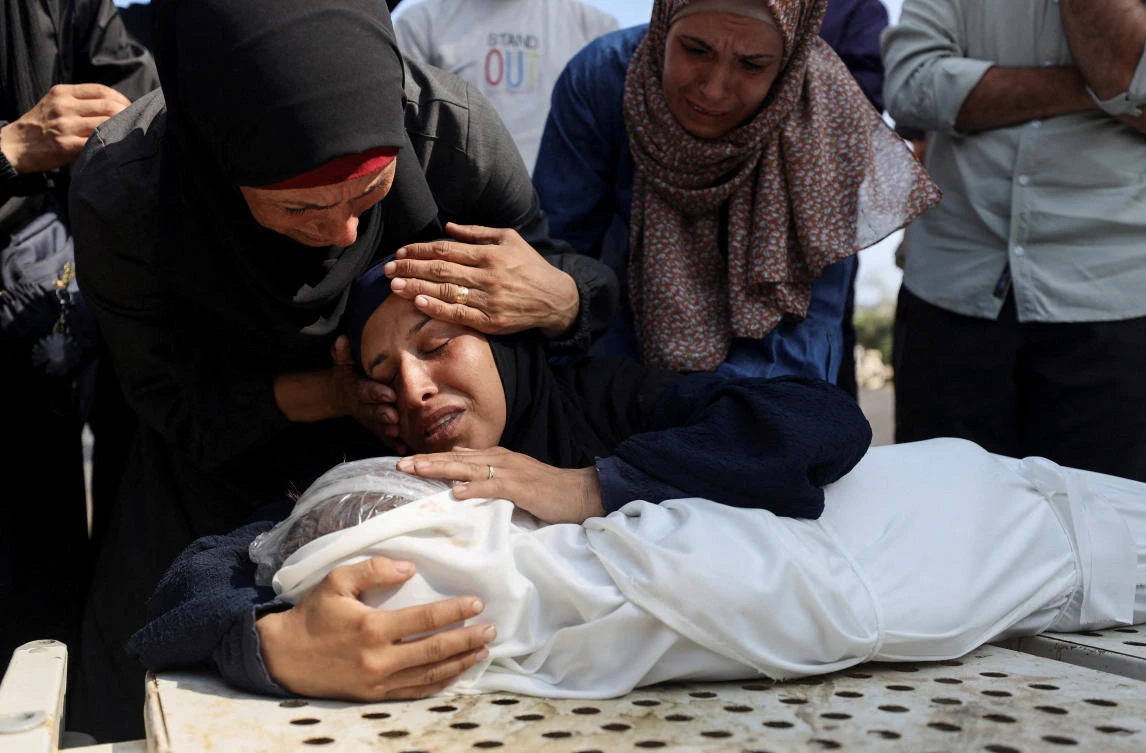
Mourners react next to the body of a Palestinian child killed in an Israeli strike, at Shifa hospital in Gaza City on July 22, 2025. (Reuters)
Short Url
Updated 22 July 2025
Follow

Gaza hospital: 21 children dead from starvation, malnutrition in 72 hours

Gaza hospital: 21 children dead from starvation, malnutrition in 72 hours
  • More than 1,000 Palestinians have been killed by Israeli forces while attempting to access food

DUBAI: Twenty-one children have died from starvation across the Gaza Strip over a 72-hour period, the head of Al-Shifa Hospital in Gaza City said Tuesday.

“These deaths were recorded at hospitals in Gaza, including Al-Shifa in Gaza City, Al-Aqsa Martyrs Hospital in Deir el-Balah, and Nasser Hospital in Khan Yunis,” Dr. Mohammed Abu Salmiya told reporters. He attributed the deaths to severe malnutrition and hunger-related complications amid ongoing shortages of food and medical supplies.

The figures add to growing concerns over the humanitarian situation in Gaza, where aid access remains severely limited.

According to the United Nations, more than 1,000 Palestinians have been killed by Israeli forces while attempting to access food since the start of operations by the Gaza Humanitarian Foundation, which is backed by the United States and Israel. Of those, 766 were killed near GHF distribution sites, and 288 were killed near UN and other aid convoys, UN human rights office spokesman Thameen Al-Kheetan said Tuesday. He stated that the deaths were caused by Israeli military fire.

In a separate statement Tuesday, UN High Commissioner for Human Rights Volker Türk warned that Israeli evacuation orders and subsequent military operations in Deir al-Balah could result in further civilian deaths.

“It seemed the nightmare couldn’t possibly get worse. And yet it does... Given the concentration of civilians in the area, and the means and methods of warfare employed by Israel until now, the risks of unlawful killings and other serious violations of international humanitarian law are extremely high,” he said.

Also on Tuesday, at least 20 people were killed by Israeli airstrikes, according to Palestinian health officials. The strikes occurred in areas that had previously seen relatively little direct fighting during the 21-month conflict.

The European Union's top diplomat, Kaja Kallas, issued a statement on social media condemning the killing of civilians at aid distribution points. “The killing of civilians seeking aid in Gaza is indefensible,” she said. Kallas added that she had spoken with Israeli Foreign Minister Gideon Saar to reinforce expectations regarding humanitarian access and warned that “all options are on the table” should current pledges not be met.
Lebanon warns Israeli violations threaten stability as UN peacekeepers enter final phase of mission

Lebanon warns Israeli violations threaten stability as UN peacekeepers enter final phase of mission
Updated 18 sec ago
Follow

Lebanon warns Israeli violations threaten stability as UN peacekeepers enter final phase of mission

Lebanon warns Israeli violations threaten stability as UN peacekeepers enter final phase of mission
  • UN envoy accuses Israel of jeopardizing ‘hard-won progress’ by undermining Lebanese sovereignty and territorial integrity through airstrikes and border violations
  • He says Lebanon’s army commander has presented to ministers his second progress report on a plan to extend state authority country-wide and limit weapons to state control

NEW YORK CITY: Lebanon has warned that Israeli airstrikes and border violations risk undermining progress toward achieving stability in southern Lebanon, as the UN peacekeeping mission in the country begins preparations for its withdrawal.

Speaking before the UN General Assembly’s Fourth Committee, Lebanon’s permanent representative to the organization, Ahmad Arafa, welcomed the recent renewal of the UN Interim Force in Lebanon’s mandate under Security Council Resolution 2790. This authorized the extension of the force’s operations until Dec. 31, 2026, followed by an “orderly, safe and coordinated” drawdown within a year.

“The Lebanese Armed Forces have been working tirelessly to ensure full implementation of Resolution 1701,” Arafa said, referring to the 2006 resolution that ended the war that year between Israel and Hezbollah.

It calls for the disarmament of all militias in Lebanon, including Hezbollah. The US has consistently pressured Lebanese authorities to disarm the group, designating it a terrorist organization.

The November 2024 ceasefire deal with Israel also requires Lebanon to disarm Hezbollah and establish a state monopoly on arms. The agreement states that only state security forces should bear arms, which is interpreted by Israel and others as requiring the full disarmament of Hezbollah. The group insists it applies only to southern Lebanon.

Arafa said the commander of the Lebanese army has presented to the Council of Ministers his second progress report on a plan to extend state authority throughout the country and confine possession of weapons to legitimate state institutions.

However, he accused Israel of jeopardizing the “hard-won progress” that has been made, through what he described as ongoing violations of Lebanon’s sovereignty and territorial integrity, including airstrikes, the continued occupation of Lebanese territory, and the creation of “so-called buffer zones.”

UNIFIL spokesperson Dany Ghafri said last week that Israel had carried out more than 7,000 airspace violations since the cessation of hostilities in November last year, Arafa noted. UNIFIL has warned that the airstrikes breach Resolution 1701, “threaten the safety of civilians, and undermine progress toward a political and diplomatic solution,” he added

Lebanon also condemned Israeli attacks on UNIFIL personnel and positions, describing them as “a blatant violation of international law.”

Arafa expressed gratitude to the leadership of the UN force, and the countries that contribute troops, for their “dedication and sacrifice” since the mission was established in 1978. He called for the avoidance of any “security vacuum” during the upcoming transitional period, while maintaining stability and respect for Lebanon’s sovereignty.