Thousands in Australia march against immigration, government condemns rally

Thousands in Australia march against immigration, government condemns rally
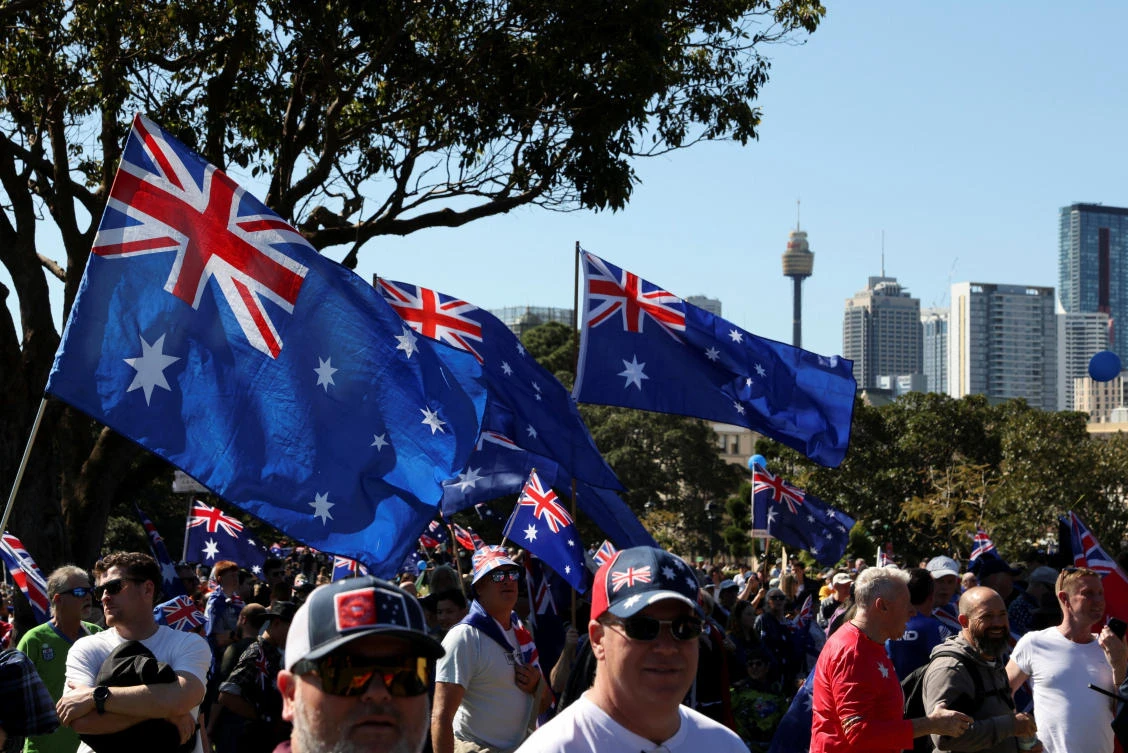
Demonstrators carry Australian flags during the ‘March for Australia’ anti-immigration rally in Sydney on Aug. 31, 2025. (Reuters)
Short Url
Updated 31 August 2025
Follow

Thousands in Australia march against immigration, government condemns rally

Thousands in Australia march against immigration, government condemns rally
  • March for Australia rallies against immigration were held in Sydney and other state capitals and regional centers

SYDNEY: Thousands of Australians joined anti-immigration rallies across the country on Sunday that the center-left government condemned, saying they sought to spread hate and were linked to neo-Nazis.
March for Australia rallies against immigration were held in Sydney and other state capitals and regional centers, according to the group’s website.
“Mass migration has torn at the bonds that held our communities together,” the website says. The group posted on X on Saturday that the rallies aimed to do “what the mainstream politicians never have the courage to do: demand an end to mass immigration.”
The group also says it is concerned about culture, wages, traffic, housing and water supply, environmental destruction, infrastructure, hospitals, crime and loss of community.
Australia – where one in two people is either born overseas or has a parent born overseas – has been grappling with a rise in right-wing extremism, including protests by neo-Nazis.
“We absolutely condemn the March for Australia rally that’s going on today. It is not about increasing social harmony,” Murray Watt, a senior minister in the Labor government, told Sky News television, when asked about the rally in Sydney, the country’s most-populous city.
“We don’t support rallies like this that are about spreading hate and that are about dividing our community,” Watt said, asserting they were “organized and promoted” by neo-Nazi groups.
March for Australia organizers did not immediately respond to a request for comment about the neo-Nazi claims.
Laws banning the Nazi salute and the display or sale of symbols associated with terror groups came into effect in Australia this year in response to a string of antisemitic attacks on synagogues, buildings and cars since the beginning of Israel’s war in Gaza in October 2023.
Counter-protesters express ‘disgust, anger’
Some 5,000 to 8,000 people, many draped in Australian flags, had assembled for the Sydney rally, the Australian Broadcasting Corp. reported. It was held near the course of the Sydney Marathon, where 35,000 runners pounded the streets on Sunday, finishing at the city’s Opera House.
Also nearby, a counter-rally by the Refugee Action Coalition, a community activist organization, took place.
“Our event shows the depth of disgust and anger about the far-right agenda of March For Australia,” a coalition spokesperson said in a statement. Organizers said hundreds attended that event.
Police said hundreds of officers were deployed across Sydney in an operation that ended “with no significant incidents.”
A large March for Australia rally was held in central Melbourne, the capital of Victoria state, according to aerial footage from the ABC, which reported that riot officers used pepper spray on demonstrators. Victoria Police did not confirm the report but said it would provide details on the protest later on Sunday.
Bob Katter, the leader of a small populist party, attended a March for Australia rally in Queensland, a party spokesperson said, three days after the veteran lawmaker threatened a reporter for mentioning Katter’s Lebanese heritage at a press conference when the topic of his attendance at a March for Australia event was being discussed.
Katter was “swarmed with hundreds of supporters” at the rally in Townsville, Brisbane’s Courier-Mail reported.
In Sydney, March for Australia protester Glenn Allchin said he wanted a “slowdown” in immigration.
“It’s about our country bursting at the seams and our government bringing more and more people in,” Allchin said. “Our kids struggling to get homes, our hospitals – we have to wait seven hours – our roads, the lack of roads.”
No deal yet on EU climate targets as COP30 looms

Updated 2 sec ago
Follow

No deal yet on EU climate targets as COP30 looms

No deal yet on EU climate targets as COP30 looms
BRUSSELS: The European Union’s member states have not yet reached an agreement on key emissions targets before the UN’s COP30 summit in Brazil, and ministers will meet again on Wednesday to thrash out a deal, according to Brussels officials.
EU countries have been haggling for months over two separate targets for slashing greenhouse-gas emissions: one for 2035 that they must bring to the UN climate talks, and the other for 2040.
Talks in Brussels ended on Tuesday without an accord and continued through the night.
“We believe we have the basis for a political deal. We expect to formally conclude a deal when we resume in a few hours,” a spokesman for Denmark, which currently holds the EU’s rotating presidency, said early on Wednesday.
EU officials have stressed the importance of the talks, which come ahead of the COP30 summit next week in Brazil.
French Environment Minister Monique Barbut had warned that turning up empty-handed to the summit would spell “disaster” for the EU.
Behind only China, the United States and India in terms of emissions, the EU has been the most committed of the major polluters to climate action and has already cut emissions by 37 percent compared to 1990 levels.
But after blazing a trail, the EU’s political landscape has shifted right, and climate concerns have taken a backseat to defense and competitiveness — with concerns in some capitals that greening Europe’s economy is harming growth.
“It’s very, very difficult,” said an EU diplomat, summing up the state of play in Brussels late Tuesday.
Denmark was understood to be working hard to win over Italy, one of the countries most skeptical of the proposed targets.
The most urgent challenge for ministers is to reach a unanimous deal on an EU emissions target for 2035, known as a Nationally Determined Contribution (NDC), which Paris Agreement signatories are supposed to bring to the COP30.
“I want our heads of state and government to go to Brazil with a very strong mandate, a clear leadership role for Europe,” German Environment Minister Carsten Schneider said.
The EU also hopes to lock in the support of a weighted majority of countries for the next big climate target set out by the European Commission on the path to carbon neutrality by 2050.
The EU executive said in July it wanted to cut emissions by 90 percent by 2040, compared to 1990 levels — a major stride toward net zero.
But member states have yet to endorse that next step, which would require sweeping changes to industry and daily life at a time of growing concern over adverse impacts on Europe’s economy.
Spain and the Nordic countries support the 2040 proposal, as does Germany, with some caveats. But Hungary, Poland, the Czech Republic and Italy remain opposed, citing risks to their industrial sectors.
Heavyweight France, meanwhile, has kept observers guessing on its position — demanding guarantees that its nuclear sector would not lose out under green transition plans and wiggle room on emissions should Europe’s forests absorb less carbon than expected.

- ‘Not pretty’ -

To win over the staunchest skeptics, Tuesday’s talks covered a range of “flexibilities” for member states, including letting countries count carbon credits purchased to finance projects outside Europe.
A commission pledge for credits to account for up to three percent of a nation’s 2040 emission cuts failed to win over hard-liners, with countries pushing for a higher threshold of five percent.
Some also want the overall objective reassessed every two years.
Environmental groups have accused countries of undermining the EU’s climate ambitions with loopholes.
But a diplomat involved in the process defended the compromise shaping up in Brussels, while conceding it was “not necessarily pretty.”
“In the muddy, messy, nasty real world out there, we are trying to achieve something good,” said the diplomat, granted anonymity to discuss the sensitive deliberations.
The EU insists it remains committed to its role as global climate leader, having mobilized 31.7 billion euros ($36.4 billion) in public climate finance in 2024, making it the world’s largest donor.