- Subdued optics fueled speculation, but analysts say the US-Israel alliance remains fundamentally intact
- Analyst says private talks likely focused on Iran, Lebanon and regional security amid ongoing conflict
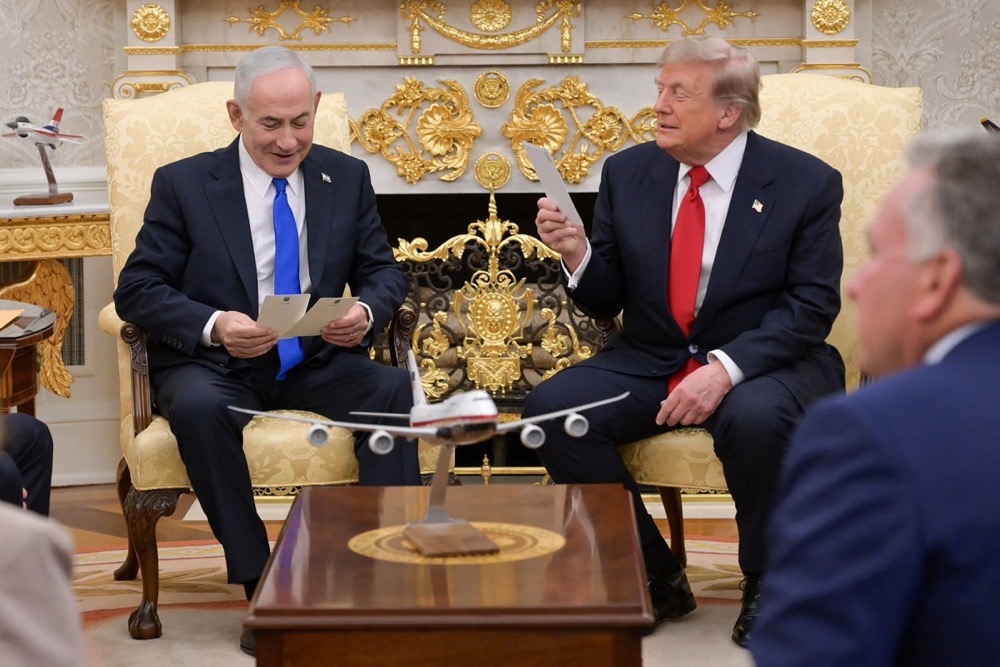
LONDON: Commentators from the US to Israel have speculated whether Prime Minister Benjamin Netanyahu’s visit this week to the White House revealed cracks in the relationship between an American president looking for an exit ramp from the Iran conflict and an Israeli prime minister hoping to cling to office by keeping it going.
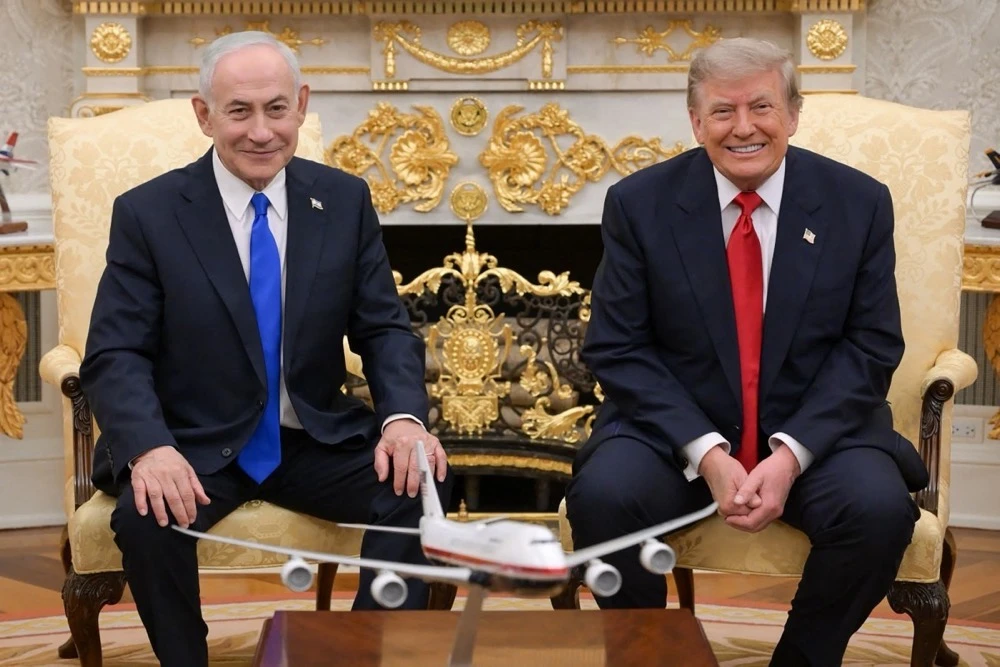
Contrary to US President Donald Trump’s usual “ringmaster” approach to Oval Office diplomacy, his meeting with Netanyahu on Tuesday, on the five-month anniversary of the start of the US-Israel war with Iran, was held behind closed doors.
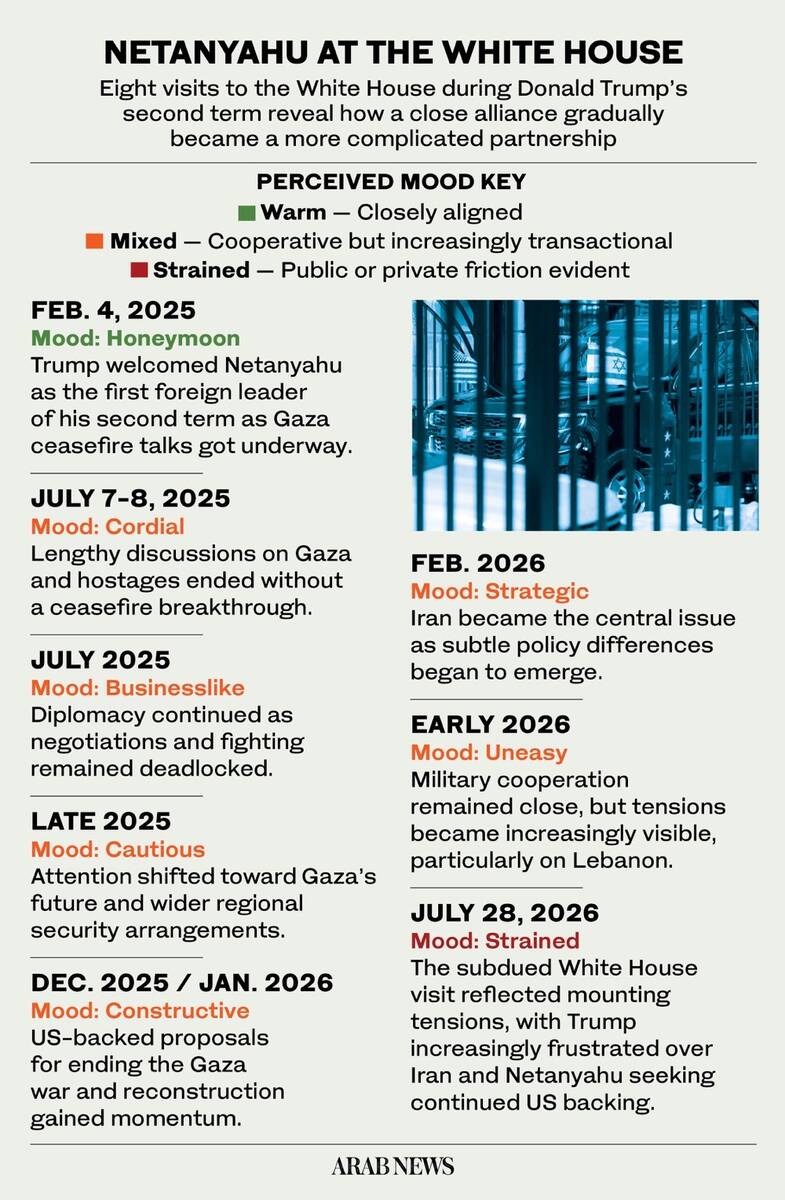
Afterward, Trump had nothing specific to say about the meeting, Netanyahu’s eighth with him since the start of his second term, posting on social media only that it was “very good” and that “many important subjects were discussed.”
Netanyahu’s comments were equally generic. He had had “an excellent meeting with President Trump … a conversation of full partnership, of mutual support, with an understanding of the shared goal to ensure that Iran will not have nuclear weapons, and also other goals.”
Back home, the Israeli media had a different take. Haaretz summed up the meeting in four words: “Trump’s irritation, Netanyahu’s desperation.”
However, the lackluster response, as reported by analysts and media, should not be misconstrued as “degradation of relationship,” former US intelligence officer Norman Roule told Arab News.

“Prime Minister Netanyahu’s visits generally include a ceremonial reaffirmation of the alliance, and that was absent from this trip,” he said. “But that should not be interpreted as any degradation of the relationship.”
The meeting, he added, “would also have provided an opportunity to discuss the challenge of Hezbollah in Lebanon and how to make further progress to resolve the long-standing Israeli-Lebanon crisis.
“The US administration has made good progress on this issue, bringing Israel and Lebanon to direct talks, arranging the first withdrawals of Israeli troops from Lebanon, and assurances from Beirut that it will disarm Hezbollah.
“The US has also prevented Iran from becoming a part of the Lebanese talks, and Beirut has formally asked Iran to stay out of its affairs. All of this is positive, but the issue in this meeting was likely how to build on this progress.”
Haaretz, however, argued that the visit reflected a more strained dynamic. Trump, it said, “was not eager to see Netanyahu,” and had reluctantly agreed to do so “only after Netanyahu decided to attend the funeral of Republican Sen. Lindsey Graham.”

Graham, who died suddenly on July 11, was one of Israel’s strongest advocates in Washington.
The visit, in Haaretz’s view, “was critical for Netanyahu for both strategic (his hope of influencing moves in Iran) and for campaign purposes (by emphasizing his personal relationship with Trump).”
Ahead of the meeting, Trump had reacted irritably to a report in the New York Post that Netanyahu was preparing to hand him an Israeli intelligence briefing on Pickaxe Mountain, an underground Iranian nuclear facility.
“I don’t need Bibi to tell me that,” Trump told Fox News. “Bibi is telling me that because he wants me to stay involved.”
Netanyahu’s team scrambled to make amends. An Israeli official anonymously told AP that during the meeting “Netanyahu made it clear to Trump and his Cabinet that if Iran were to attack Israel, they would respond, but that beyond that, they would trust the judgment of the president regarding next steps.”
Haaretz — no friend of Netanyahu’s government — concluded that “it seems that the US president has no intention of taking orders from someone who got him embroiled in a prolonged entanglement in the Gulf.”
A little over five hours after Netanyahu left the White House, US Central Command reported that “Islamic Revolutionary Guard Corps forces launched multiple ballistic missiles from Iran in an attempted surprise attack on US forces based in the Middle East.”
The target was a US base in Jordan. “All Iranian missiles were successfully intercepted,” CENTCOM said, adding: “US forces remain vigilant and at a high state of readiness.”
“The optics of the strikes coinciding with Netanyahu’s visit are unmistakable, and they could be read as a sign of Tehran’s coercive signalling,” said Burcu Ozcelik, senior research fellow on the Middle East, North Africa and Turkiye at the London-based Royal United Services Institute.
“Iran is trying to re-establish credible deterrence and establish new ground truths that will incentivise the US to back down from the war rather than achieve a mere pause.
“Meanwhile, there are reports of Pakistani and Qatari backchannels possibly hammering out a new ceasefire deal. We are in the midst of a very opaque information environment.”
The Iranian strikes on Jordan, hours after the Trump-Netanyahu meeting, “show that Iran’s military capacity remains,” said Roule.
“But while Netanyahu was in Washington, they didn’t strike Israel, and what isn’t happening is usually more important in the Iran dynamic than what is happening.”
It was the following evening before CENTCOM responded, unleashing “a heavy wave of strikes against Iran,” aimed at “military command centers, missile and drone facilities, coastal surveillance and defense sites, and maritime capabilities.”
The strikes, it added, “aimed to further diminish threats posed by Iran and its proxies to American forces, commercial shipping, and neighboring Gulf countries.”
One of those Gulf countries is Saudi Arabia, which has endured its share of unprovoked drone and missile attacks from Iran since Feb. 28.

Starting on Sunday, the Kingdom was the target of a renewed series of assaults over several days from Iranian proxy groups in Iraq, which launched multiple drone attacks targeting oil facilities in its Eastern Province.
The response was swift and surgical. On Wednesday, the Saudi Defense Ministry said that, in coordination with US CENTCOM, it had carried out attacks against Iran-backed groups in Iraq. It was not seeking escalation, it added, but would respond to any “aggression.”
The Iranian strikes on Jordan, hours after the Trump-Netanyahu meeting, “allow Iran to demonstrate defiance, attack US partners, and show that Iran will continue to use its military to bring pressure on Washington and the region to make concessions on Iran’s demand to control the Strait (of Hormuz) and other issues,” said Roule.
“But it is notable that Iran did not strike Israel and indeed has not attacked Israel directly since early June.”
Furthermore, “Iran has also held back on strikes against Saudi Arabia, relying instead on proxies in Iraq and Yemen.
“The Kingdom has responded forcefully to these attacks, demonstrating that while it is interested in a diplomatic solution to the ongoing crisis, it will protect its people from all aggressors.”
The “very public Saudi military role was one of the more significant developments in the past few days,” said Ozcelik.
“Saudi Arabia has supported US regional security operations before, but openly participating in strikes against Iran-aligned targets in Iraq represents a more direct and visible posture.
“It suggests that Riyadh may be moving beyond protecting its own territory and infrastructure toward imposing costs on the networks attacking it.”
The Kingdom is tackling a three-pronged problem: Iran’s blockade of the Strait of Hormuz, the Houthis’ copycat activity in the Red Sea, and now Iran-backed attacks from Iraq.
“Riyadh’s participation may therefore be intended as a deterrent signal: attacks on Saudi territory or economic infrastructure will no longer necessarily be answered only defensively or confined to the Yemeni theater.”
Iran, she added, is walking a precariously narrow tightrope.

“Iran’s targeting of a US military facility in Jordan follows an established rationale. The IRGC presents attacks on US military assets as retaliation against Washington while trying to distinguish them from indiscriminate attacks on Gulf civilian targets.
“This may be intended as a calibrated choice of target, but it is not risk-free or necessarily below the threshold for a forceful US response, particularly if American personnel are killed.
“The more dangerous threshold would be sustained Iranian attacks on civilian, dual-use or critical economic infrastructure in Gulf states.
“That could transform the conflict from a US-Iran military exchange into a wider confrontation in which Gulf governments demand or directly participate in stronger military action against Iran.”