UN official says conflicts, disasters and funding cuts a ‘perfect storm’ causing acute hunger

UN official says conflicts, disasters and funding cuts a ‘perfect storm’ causing acute hunger
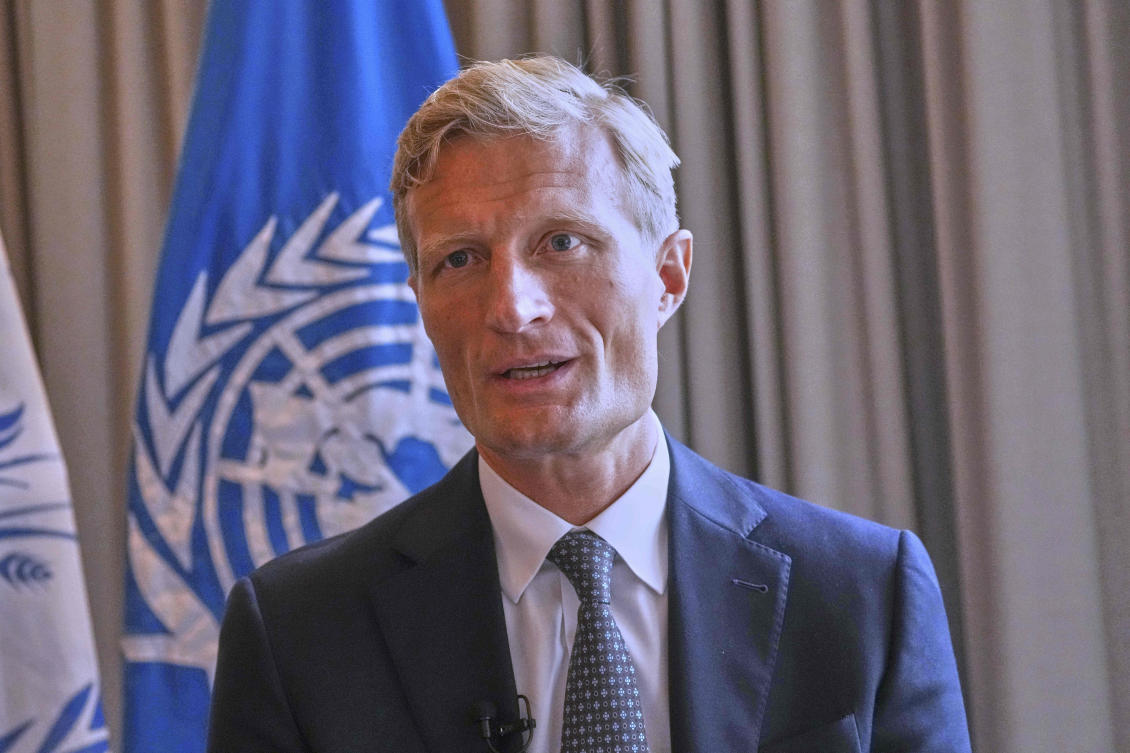
Carl Skau, deputy executive director and chief operating officer of the World Food Program, talks to The Associated Press during an interview in Bangkok, Thailand, Tuesday, Sept. 16, 2025. (AP)
Short Url
Updated 16 September 2025
Follow

UN official says conflicts, disasters and funding cuts a ‘perfect storm’ causing acute hunger

UN official says conflicts, disasters and funding cuts a ‘perfect storm’ causing acute hunger
  • Conflicts in Myanmar, Sudan and Gaza have made it extremely difficult to reach people in need, and the latter two are already facing famine conditions

BANGKOK: A string of natural disasters and global conflicts, combined with drastic cuts to international aid means that some of the world’s neediest people are suffering from serious food shortages, and will face further reductions in assistance soon, a United Nations official said Tuesday.
Carl Skau, deputy executive director and chief operating officer of the World Food Program, said that with needs rising and funding dropping, the agency is pushing every efficiency it can find, promoting greater self-reliance in the communities it helps, and looking for new sources of donations to help fill the growing gap.
“We are managing globally a perfect storm... with food security needs going up dramatically,” Skau told The Associated Press during a visit to Bangkok, where he was to meet with Thai officials to press for assistance, following a trip to India.
“We’ve seen a three-fold increase only in the past five years, and this year has been really tough also with conflict increasing, extreme climate events and on top of that we now have a funding crunch where the WFP is losing some 40 percent of our funding.”
In the region, he said recent flooding in Pakistan and a massive earthquake and drought in neighboring Afghanistan have exacerbated already difficult situations in both countries, leaving millions in need.
The decision by US President Donald Trump earlier this year to cut more than 90 percent of the United States Agency for International Development’s foreign aid contracts and $60 billion in overall assistance around the world — coupled with cuts to international aid from several European countries — has meant that the WFP and others have less means to respond, he said.
“In Afghanistan two years ago we were assisting 10 million people, today we are at around 1.5 (million) and we don’t have the resources to preposition food in areas that won’t be accessible during the winter,” Skau said.
Already in Afghanistan, there has been a surge in malnutrition recorded, particularly among young children, over the last few months, he said.
“We know that through this winter, children will die and it’s not only about children dying, I mean when children are severely, acutely malnourished, there are damages to their brains and to their organs that will remain with them for their life,” Skau said.
Meantime, conflicts in Myanmar, Sudan and Gaza have made it extremely difficult to reach people in need, and the latter two are already facing famine conditions. A 7.7 magnitude earthquake in Myanmar in March has led to even greater needs there, and new challenges in reaching people with humanitarian assistance.
The civil war in Myanmar has also meant that even more Rohingya refugees have fled to Cox’s Bazar in neighboring Bangladesh, and there are no immediate prospects for them to safely return home, Skau said.
“So we have a situation where we basically have 1.3 million people in a camp that is like a prison where they do 100 percent depend on international assistance,” said Skau, who visited Cox’s Bazar earlier this month.
The WFP currently provides refugees there with a $12 monthly voucher for food that has been enough for them to survive, but with funding running out for that by the end of November, it may have to either reduce the amount or the number of people it supports.
When the agency temporarily had to reduce monthly assistance to $8 in 2023, it saw tension and violence spike in the camp and people turning to criminality, and many desperate people piling into boats to head to Indonesia, Malaysia or elsewhere, Skau said.
“There are all kinds of negative implications,” he said. “Frankly, regional stability is somewhat at stake here, and that also has implications beyond the immediate region.”
UK train attack hero named as British-Arab rail worker Samir Zitouni

Samir Zitouni, who shielded passengers from a knife attack on a train, is in a critical condition in hospital. (LNER)
Updated 39 min 9 sec ago
Follow

UK train attack hero named as British-Arab rail worker Samir Zitouni

Samir Zitouni, who shielded passengers from a knife attack on a train, is in a critical condition in hospital. (LNER)
  • London North Eastern Railway employee Zitouni is in a critical but stable condition after he was injured shielding passengers from the attacker
  • His family, colleagues, police and politicians praise his bravery, which is credited with saving many lives during mass stabbing

LONDON: A British-Arab railway worker credited with saving many lives during a mass stabbing on a UK train was named on Tuesday as Samir Zitouni.

The 48-year-old, who shielded passengers from the attack, remains in a critical but stable condition in hospital, British Transport Police said.

Zitouni, a customer experience host who has worked for London North Eastern Railway for more than 20 years, was on duty on the Doncaster to London King’s Cross service on Saturday evening when the attack took place. Witnesses, colleagues, police and politicians have praised his actions as “courageous” and “heroic.”

David Horne, LNER’s managing director, said: “In a moment of crisis, Sam did not hesitate as he stepped forward to protect those around him. His actions were incredibly brave and we are so proud of him, and of all our colleagues who acted with such courage that evening.

“Our thoughts and prayers remain with Sam and his family. We will continue to support them, and wish him a full and speedy recovery.”

Zitouni’s family said they were “deeply touched by the outpouring of love and kindness” toward him.

“We are immensely proud of Sam and his courage,” they added. “The police called him a hero on Saturday evening, but to us he’s always been a hero.”

The statements on Tuesday did not provide any further details about Zitouni. Some social media posts described him as Algerian-born.

Transport police said on Sunday that CCTV footage of the attack showed an LNER employee, now identified as Zitouni, attempting to stop the attacker.

“The actions of the member of rail staff were nothing short of heroic and undoubtedly saved people’s lives,” Deputy Chief Constable Stuart Cundy said.

Home Secretary Shabana Mahmood on Monday paid tribute to the “breathtaking bravery” of those on the train, including Zitouni.

“On Saturday, he went to work to do his job — today, he is a hero and forever will be,” she said.

Passengers told how a man wielding a knife began attacking people on the train as it passed through Cambridgeshire on Saturday evening. Ten people were taken to hospital for treatment after the train stopped at Huntingdon station and another admitted themselves later. Seven have been discharged and three remain in hospital in a stable condition, along with Zitouni.

Anthony Williams, 32, has been charged with 10 counts of attempted murder related to the train attack, and an additional count of attempted murder in connection with a separate incident in London on Saturday.