RIYADH: The Saudi edition of Money20/20 Middle East this week offered a snapshot of how rapidly artificial intelligence is moving from hype to hard deployment in the Kingdom’s financial sector.
With more than 450 fintech companies and over 1,050 global investors gathering under the theme “Where Money Does Business,” the event showed how central AI has become to Saudi Arabia’s Vision 2030 ambitions and how urgent the conversation around regulation, infrastructure and talent has become.
The message across panels was clear: AI is no longer an experiment. It is increasingly embedded in every corner of finance, from fraud detection and onboarding to risk modeling and compliance. The more AI promises to accelerate growth, the more scrutiny it invites.
For Saudi Arabia, the challenge now is scaling adoption while maintaining trust, regulatory alignment and data integrity.
The Kingdom is projected to reap nearly $135.2 billion from AI by 2030, equivalent to about 12.4 percent of gross domestic product, according to PwC. That potential is driving urgency, with nearly all financial-sector leaders saying the pressure to deploy AI has grown over the past six months. Regulators are responding in parallel.
The Saudi Central Bank has expanded its sandbox programs and is introducing clearer guidelines to ensure innovation happens under strong consumer-protection and data-governance frameworks. Industry insiders at the event said this collaboration between regulators and the private sector is essential if the Kingdom is to balance speed with safety in AI rollouts.
Khalid Al-Sharif, CEO of Abdul Latif Jameel Finance, said the next stage of AI adoption in finance will depend on coordination between regulators, financial institutions and technology providers.
“The next phase is about coordination,” he said. “Regulators must keep issuing workable standards, financial institutions must document and monitor models, and technology providers must build for local requirements rather than import generic systems.”
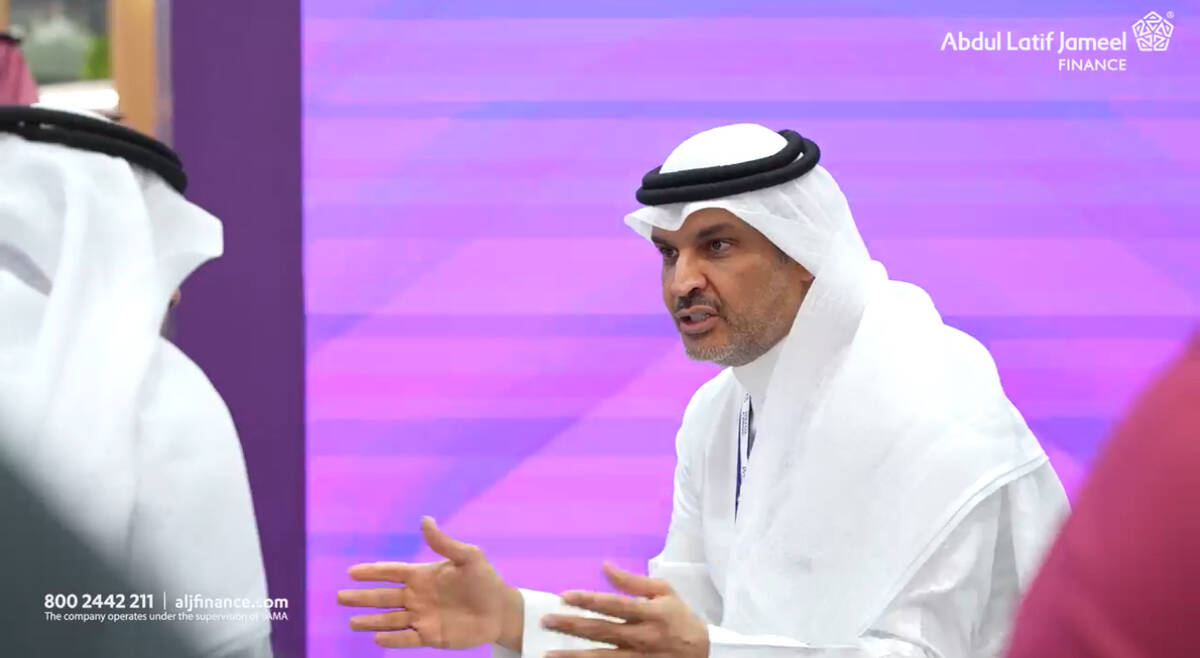
He added that enabling micro and small businesses is central to Vision 2030 and pointed to Abdul Latif Jameel Finance’s Bab Rizq Jameel Microfinance program, which has issued loans to nearly 300,000 beneficiaries since 2004 — 81 percent of them women. “Our goal is to empower entrepreneurs and women-led enterprises so they can contribute more strongly to national GDP,” he said.
Al-Sharif also emphasized the importance of building trust as technology advances. “Saudi Arabia’s financial sector is ready for this leap,” he said. “But success will depend on responsible innovation that protects consumers and uses data ethically while enabling growth.”
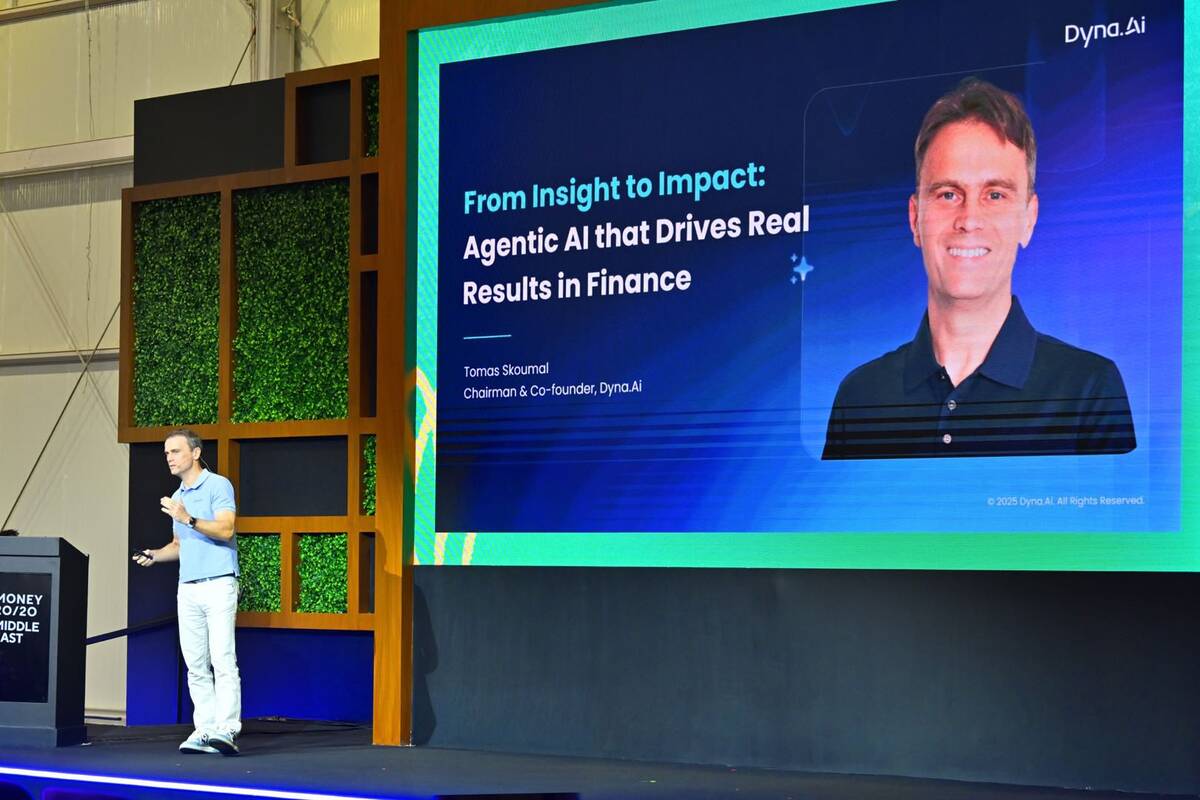
Among the announcements at the Money20/20 conference in Riyadh was Singapore-based Dyna.Ai’s decision to expand in the Kingdom with the launch of its Agentic AI Suite and Arabic-first AI Employees.
These digital teammates, including an AI credit underwriter, knowledge partner and recruiter adviser, are designed to integrate into enterprise workflows and support compliance, customer service and operational efficiency.
“AI Employees are advanced digital teammates that augment human capabilities,” said Tomas Skoumal, chairman and co-founder of Dyna.Ai. “They deliver faster, more accurate, and personalized customer experiences while collaborating directly with human workers.”
The company says its tools deliver more than 95 percent accuracy with response times under 200 milliseconds. Importantly, the suite was built with Arabic capabilities from day one, meaning it can understand dialects, cultural nuances and regulatory requirements specific to the Kingdom.
While announcements like Dyna.Ai’s show confidence in the market, Saudi Arabia’s journey toward AI at scale still faces hurdles. Executives at Money20/20 pointed to a shortage of AI specialists and data scientists even as universities and training programs accelerate talent development.
Infrastructure gaps also persist, with demand growing for high-performance computing, sovereign data centers and faster data-processing capabilities.
Regulatory certainty is another area to watch. Though sandboxes and ethical frameworks are already in place, binding rules for algorithmic transparency, privacy and bias mitigation are still being developed.
Industry experts warn that without clear, enforceable guidelines, trust in AI systems could be undermined before they are fully mainstream.
Money20/20 is more than a showcase. It is one of the few places where regulators, legacy banks, fintech startups and investors meet under one roof to compare strategies and align on priorities.
This year, announcements such as Google Pay’s launch in the Kingdom, Alipay+ acceptance by 2026, and a series of capital markets reforms highlighted the pace at which Saudi Arabia is trying to modernize its financial ecosystem.
For companies including Dyna.Ai, the event serves as a stress test, a chance to prove whether their solutions can meet Saudi-specific expectations for speed, accuracy, compliance and cultural fit.
For regulators and policymakers, it is an opportunity to gauge market readiness and identify where rules and infrastructure must catch up with innovation.
Saudi Arabia’s AI story is now entering what many at the conference called its execution phase.
The big-picture goals have been set: billions of dollars in AI-driven GDP impact, a skilled workforce of 20,000 specialists by 2030 and a digitally transformed financial system. What comes next is a test of implementation, how quickly these ambitions can translate into measurable outcomes.
Dyna.Ai’s Arabic-first approach offers one glimpse of what the future might look like: instant, personalized and compliant digital interactions that support growth while keeping human workers focused on higher-value tasks. But it is just one piece of a much larger transformation.
The Kingdom’s AI moment is no longer just a promise. Its success will be measured by the ability to build trust, close infrastructure gaps, nurture talent and ensure every algorithm deployed works for both the economy and the people it serves.