Saudi Arabia inks deals with Chinese entities to strengthen industrial cooperation 

Saudi Arabia inks deals with Chinese entities to strengthen industrial cooperation 
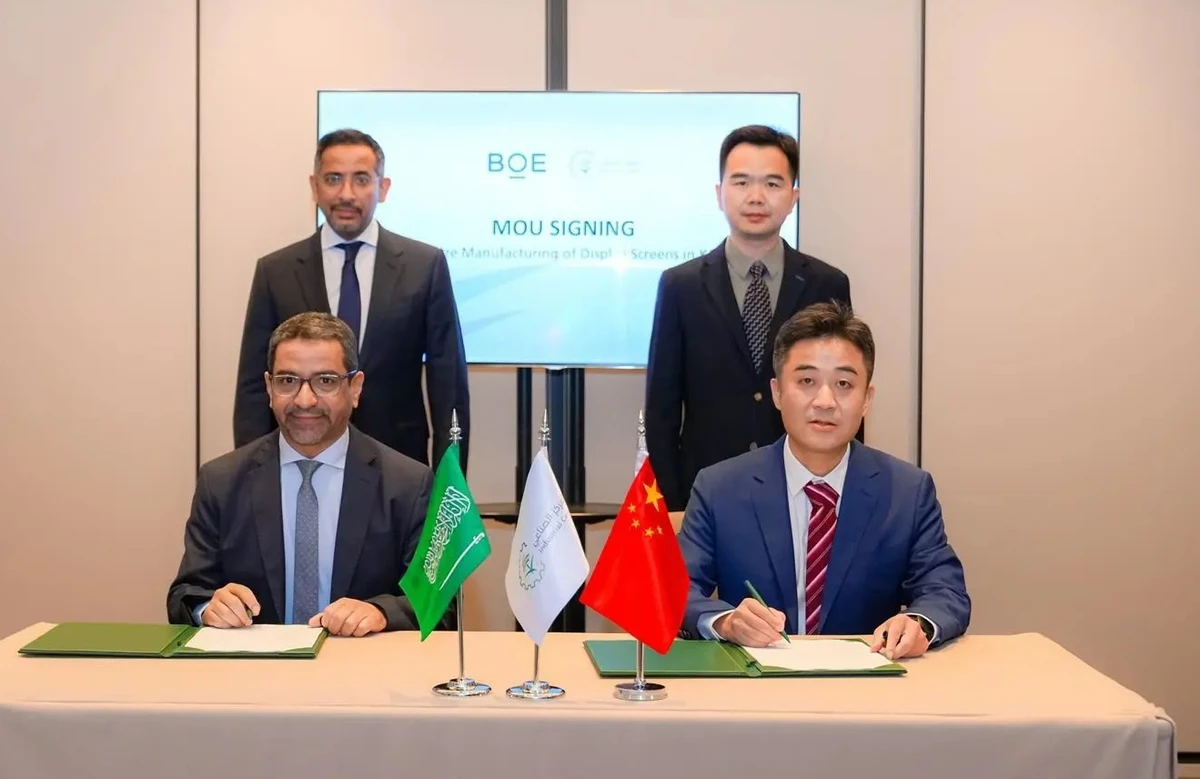
On the sidelines of Minister Bandar Alkhorayef’s visit to Beijing, Saudi Arabia signed MoUs with BOE Technology Group for display screen technologies. SPA
Short Url
Updated 24 September 2025
Follow

Saudi Arabia inks deals with Chinese entities to strengthen industrial cooperation 

Saudi Arabia inks deals with Chinese entities to strengthen industrial cooperation 

RIYADH: Saudi Arabia has signed multiple memorandums of understanding with Chinese business leaders to enhance industrial cooperation and promote the localization of advanced manufacturing technologies in the Kingdom. 

These agreements were signed on the sidelines of Saudi Arabia’s Minister of Industry and Mineral Resources Bandar Alkhorayef’s visit to Beijing, the Saudi Press Agency reported.  

The first MoU was signed with BOE Technology Group in the field of display screen technologies, while the second agreement with Kyland Technology focuses on intelligent industrial control technologies.  

The third deal was signed with Tsinghua Unigroup in the semiconductor industry, with the aim of localizing these advanced industrial technologies in the Kingdom.  

These initiatives build on the deepening economic and trade relationship between Saudi Arabia and China. The Asian giant is the Kingdom’s largest trading partner, accounting for 14 percent of the Kingdom’s exports and 28.9 percent of its imports in May, according to official statistics. 

SPA reported that during his meeting with Chinese business leaders, Alkhorayef “discussed opportunities in developing the industrial digital infrastructure, intelligent industrial control technologies, and the semiconductor industry, in addition to highlighting the Kingdom’s enablers that attract quality industrial investments and facilitate the investor journey.”  

The meetings also reviewed the Kingdom’s strategic advantages, including its geographic position that connects three continents, abundant natural resources, competitive energy pricing, advanced infrastructure, and industrial cities, as well as streamlined government procedures. 

These meetings were attended by Saleh Al-Solami, CEO of Saudi Arabia’s National Industrial Development Center and leaders from the industry ecosystem in the Kingdom and China. 

During the visit, Alkhorayef met with leaders of ZGC Group, a government-backed innovation platform, to explore collaborations including advanced manufacturing, renewable energy, smart mobility, and aerospace technologies. 

These discussions included plans for ZGC to establish operations in Riyadh in partnership with the National Industrial Development and Logistics Program. 

In a separate press statement, Saudi Arabia’s Ministry of Industry and Mineral Resources said that the minister’s visit to China “aims to broaden economic partnerships between the two countries, attract high-quality investments, and transfer the latest technologies in the industrial and mining sectors.”  

GCC insurance outlook stable on growth, diversification gains: Moody’s 

GCC insurance outlook stable on growth, diversification gains: Moody’s 
Updated 5 sec ago
Follow

GCC insurance outlook stable on growth, diversification gains: Moody’s 

GCC insurance outlook stable on growth, diversification gains: Moody’s 

RIYADH: The Gulf Cooperation Council’s insurance sector is expected to remain stable over the next 12 to 18 months, supported by strong economic growth and rising non-oil investments, according to Moody’s Ratings. 

In its latest GCC Insurance Outlook, Moody’s said economic diversification and compulsory insurance schemes are expected to underpin the sector’s growth. 

The region’s non-life segment, which represents more than 80 percent of premium revenues, will benefit from government-backed infrastructure and diversification projects, particularly in Saudi Arabia and the UAE, which together generate 80 percent of the GCC’s total insurance premiums. 

S&P Global Ratings has similarly projected sustained expansion for the Gulf’s insurance industry, particularly within the Islamic segment, which it expects to grow by around 10 percent annually in 2025 and 2026. 

In its latest report, Moody’s stated: “The industry will also benefit from the spread of compulsory insurance and rising demand for health and life cover.” 

It added: “Larger insurers will continue to outperform smaller ones, which will struggle to remain profitable because of intense price competition, rising claims, and high technology and regulatory costs.” 

Moody’s forecasted real gross domestic product growth of around 4 percent for 2026, led by the UAE and Saudi Arabia, with additional contributions from Kuwait, Oman, and Qatar. 

Expansion in construction, tourism, and manufacturing is expected to increase demand for property, liability, health, and specialty insurance, while greater consumer awareness and reduced subsidies in utilities and education are expected to boost demand for life and savings policies. 

According to the report, “Profitability is improving overall,” with non-life insurance prices rising in 2025, particularly in the UAE, where insurers raised premiums following heavy storm-related claims in 2024. 

Moody’s said the sector should post “positive underwriting profit for the remainder of 2025 and into 2026.” 

However, the agency noted that large insurers will capture most of the profitability gains next year due to economies of scale, while smaller peers “will struggle to make an underwriting profit amid intense competitive pressure.” 

Increased reinsurance prices, regulatory expenses, and technology investments are squeezing margins for smaller firms, and the dominance of insurance aggregators is further driving competition based on price. 

Moody’s also cautioned that GCC insurers’ high exposure to equities and real estate raises asset risks, particularly amid geopolitical uncertainty in the Middle East. 

“This increases the sector’s investment risk and magnifies its exposure to downside scenarios related to geopolitical tension,” the report said. 

Saudi insurers face additional strain on capital buffers due to slower profit growth and higher risk exposures, while UAE insurers have benefited from stronger profitability and price adjustments. 

Regulators across the GCC are tightening capital and risk requirements, which Moody’s expects will accelerate consolidation— especially in Saudi Arabia, where authorities have taken a more assertive stance on compliance. 

The agency added that while the sector’s outlook remains stable, market dynamics are shifting toward larger, better-capitalized players. Consolidation, it added, will ultimately “support the sector’s credit strength over time.”