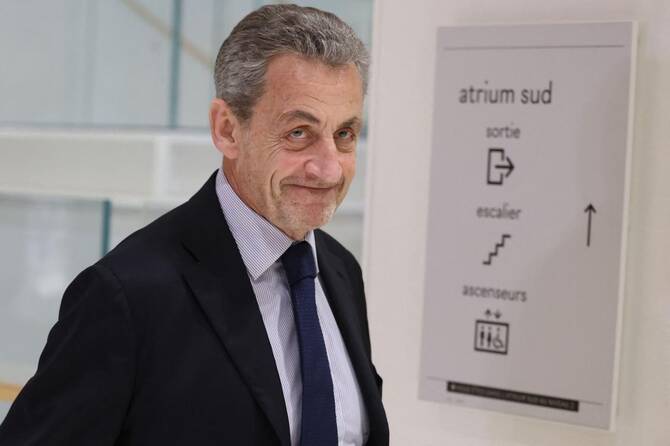
- The conviction comes at a deeply sensitive moment, with France in political deadlock and the far-right sensing its best ever chance to come to power
- Henri Guaino, a former special adviser to Sarkozy, called the conviction “a humiliation for the state and its institutions“
PARIS: The dramatic decision to send former president Nicolas Sarkozy to prison for criminal conspiracy has laid bare France’s stark political divisions, with the move cheered by the left but slammed by the ascendant right.
Sarkozy, seen as a mentor to many conservative politicians, was convicted on Thursday over a scheme enabling late Libyan dictator Muammar Qaddafi to fund his 2007 presidential run.
He must serve his sentence while awaiting the outcome of his appeal, and will be the first French postwar leader to serve jail time.
The conviction comes at a deeply sensitive moment, with France in political deadlock and the far-right sensing its best ever chance to come to power.
Speaking to broadcaster RTL, Henri Guaino, a former special adviser to Sarkozy, called the conviction “a humiliation for the state and its institutions.”
Guaino urged President Emmanuel Macron to pardon Sarkozy, who was president of France from 2007 to 2012, allowing him to avoid prison.
There was no immediate reaction from Macron’s office.
Despite his legal troubles, Sarkozy still enjoys considerable influence and popularity on the French right and has on occasion had private meetings with Macron.
- ‘It’s Nicolas who pays’ -
In an editorial, conservative French daily Le Figaro denounced the court ruling as “absurd and incomprehensible,” claiming there was no “tangible evidence” of Sarkozy’s wrong-doing.
Left-leaning Liberation featured Sarkozy’s face on its front page, with the words “The slammer” printed over it.
Far-right leader Marine Le Pen, who has herself been convicted of embezzlement and insists she is a target of a “witch hunt,” criticized Thursday’s ruling.
She argued on X that the use of provisional enforcement represented “a great danger, in view of the fundamental principles of our law, foremost among which is the presumption of innocence.”
In France, provisional enforcement means that a judicial decision will be implemented even as the appeals process plays out.
Le Pen drew parallels between her own case — which saw her banned from standing for office for five years, scuppering her chances of running in France’s 2027 presidential election unless she wins her appeal — and that of Sarkozy.
“A number of magistrates have a kind of scorecard where they try to pin down as many politicians as possible,” she told broadcaster LCI.
But some on the left expressed their satisfaction.
“In the end, it’s Nicolas who pays,” quipped hard-left lawmaker Anais Belouassa-Cherifi, referring to a right-wing viral meme denouncing the tax burden on ordinary French people.
But Liberation daily said it did not see the conviction as a cause for celebration.
In an editorial, the newspaper said Sarkozy’s case as well as various other political scandals only serve to widen the gap between the French people and the elites.
There is “only one winner in the long run: the far right.”
The court ordered that Sarkozy should be placed in custody at a later date, with prosecutors to inform him on October 13 when he should go to prison.
He has already been convicted in two separate trials but always avoided jail.