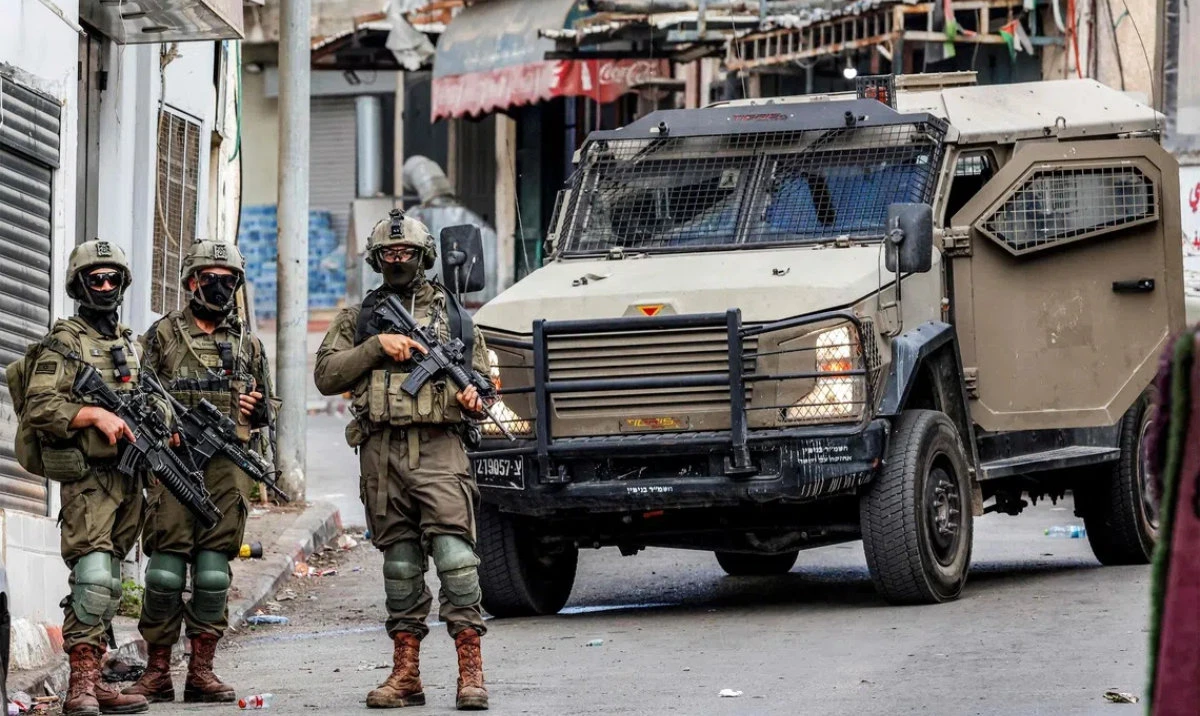
- Israel has kept up near daily strikes on Lebanon, usually saying it is targeting Hezbollah operatives or sites, despite the truce that sought to end more than a year of hostilities including two months of open war with the Iran backed group
BEIRUT: Two engineers were killed on Thursday when an Israeli drone strike hit their car on the Khardali road, a key route linking the Nabatieh and Marjayoun districts across the Litani River in southern Lebanon.
The Lebanese Ministry of Health said the latest escalation of cross-border attacks killed two people and wounded another. Hezbollah-affiliated outlets identified the dead as engineers Ahmed Saad and Mustafa Rizk, who were working with the group’s Jihad Al-Bina foundation.
The Lebanese Order of Engineers said in a statement that the two killed “were carrying out their professional and national duty” as they were heading to the Khiam area to assess the damage left by last year’s war with Israel.
The Israeli escalation comes as anxiety grows in Lebanon over the prospect of renewed war, with Hezbollah’s hardline refusal, backed by Iranian officials, to hand over its weapons to the state.
Less than 24 hours earlier, an Israeli drone killed a Hezbollah member, Ali Qaraouni, while he was driving his car in his hometown of Kafra, and wounded five others.
Secretary of the Supreme National Security Council Ali Larijani said in a televised interview on Thursday published by the Fars News Agency: “If Hezbollah is not taking any action at the moment, it is because it does not want to breach the ceasefire agreement between Lebanon and the Zionist regime. Otherwise, it has the capability to tip the balance on the ground.”
Larijani said that during his visit to Lebanon last week, he noted that Hezbollah was “rebuilding itself quickly.”
An official Lebanese source confirmed to Arab News that the concern about a new war was legitimate but “exaggerated and for internal reasons.”
He said that amplifying the prospect of war and fueling such tension may be Israel’s way of pressuring Hezbollah to abide by the ceasefire agreement and the government’s decision to keep weapons under state control.
The Lebanese Army Command is expected to submit its first monthly report to the cabinet in its upcoming session within the next few days, detailing the progress it has made in its mission to monopolize weapons in the hands of the state.
The official source said the report will present what the army has done in terms of surveying and confiscating weapons in the area south of the Litani River, while noting the obstruction posed by the continued Israeli occupation of five key positions in Lebanese territory to fully accomplish the mission.
After meeting Prime Minister Nawaf Salam on Thursday, former Justice Minister Ashraf Rifi praised his “steadfast commitment” to upholding the state and its institutions.
Rifi also criticized Hezbollah, saying: “To those who live under the illusion of absolute power, we say: the prestige of the state will not be compromised.”
He added: “Beirut will not be violated and its free people will not be provoked. The so-called statelet must realize that the era of arrogance has come to an end, and that retreating inward after failed external adventures is futile.”
Rifi said the dangers threatening Lebanon are immense during the pressing regional developments. He urged officials to fully implement the government’s plan to restrict weapons to the state, calling it “the most effective path to protect Lebanon and restore the sovereignty of the state and its institutions.”
He warned that the country can only be shielded through legitimacy, reinforced by Arab and international support, and by the unity of its people and communities.
Academic and writer Mona Fayad said Hezbollah’s intransigence stems from Iran’s stance.
“Just as Tehran exploited Lebanon in 2006, dragging it into a war with Israel to leverage negotiations with the US, it may resort to the same approach today.”
Fayad added that despite internal divisions between supporters and opponents of integration with the state, Hezbollah ultimately cannot defy Iran’s demands.
“Lebanon is in no position to withstand another war, not even within Hezbollah’s own circles,” she said, noting that foreign powers, particularly the US, have no desire for a renewed Israeli war on Lebanon. Washington has repeatedly warned that Lebanon must implement the arms embargo to avoid being dragged into conflict.
Investigations are ongoing into Hezbollah’s alleged breach of Salam’s directive after images of the party’s slain leaders, Hassan Nasrallah and Hashem Safieddine, were projected onto Raouche Rock last week to commemorate their assassination by Israel.
Last Thursday, two people were questioned under judicial supervision, including the owner of the laser device used for the projection, while three others were summoned for questioning on Friday.