Oman’s non-oil exports climb 11.3% to over $10bn by July   

Oman’s non-oil exports climb 11.3% to over $10bn by July   
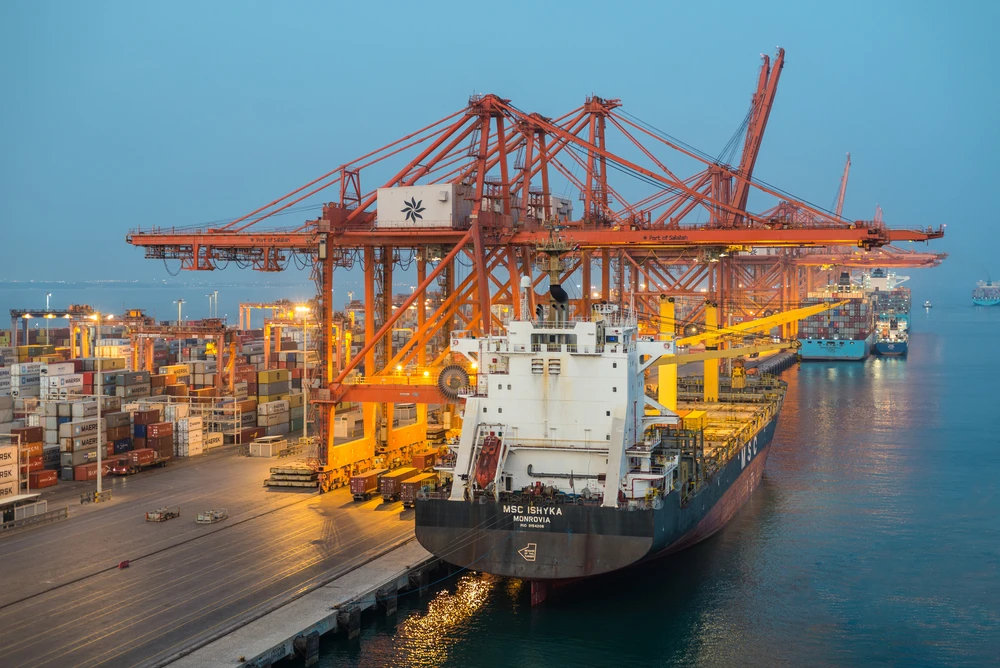
Port of Salalah in Oman. Shutterstock
Short Url
Updated 06 October 2025
Follow

Oman’s non-oil exports climb 11.3% to over $10bn by July   

Oman’s non-oil exports climb 11.3% to over $10bn by July   

RIYADH: Oman’s non-oil exports rose 11.3 percent to 3.89 billion Omani rials ($10.12 billion) by the end of July compared to the same period last year, new data has revealed.

According to preliminary figures from the National Centre for Statistics and Information, as reported by the Oman News Agency, the country’s overall trade surplus narrowed to 3.55 billion rials in the January–July period, down 34.6 percent compared to 5.43 billion rials during the same period last year. 

The decline is attributed mainly to a 17 percent drop in oil and gas exports, which fell to 8.58 billion rials, from 10.34 billion rials a year earlier.   

The increase in non-oil merchandise reflects growing demand for Omani industrial and manufacturing goods across key regional and international markets. 

As part of Oman Vision 2040, the government is actively working to reduce the economy’s dependence on hydrocarbons by promoting non-oil industries, enhancing local production capabilities, and expanding access to global markets. 

“The statistics revealed that Oman’s non-oil merchandise exports achieved notable growth of 11.3 percent, reaching a value of RO 3.890 billion by the end of July 2025, compared to RO 3.497 billion during the corresponding period in 2024,” the ONA report stated. 

The latest trade figures highlight the dual nature of Oman’s economic landscape. While the country remains exposed to volatility in energy markets, its diversification agenda is beginning to yield measurable results. 

This mirrors similar diversification efforts in regional peers such as Saudi Arabia’s Vision 2030 and the UAE’s industrial and logistics strategies, though Oman’s smaller economy and resource base present unique challenges and opportunities. 

The report also shed light on the composition of Oman’s non-oil trade. Re-exports rose marginally by 0.5 percent to 1.4 billion rials, while total imports increased by 5.5 percent to 9.92 billion rials, reflecting resilient domestic demand and ongoing infrastructure development. 

The UAE emerged as Oman’s top non-oil trading partner, with non-oil exports to the Emirates climbing 27.8 percent to 698 million rials. Saudi Arabia ranked second with 653 million rials, followed by India at 398 million rials.  

On the re-exports front, Iran and Saudi Arabia followed the UAE, while China and Kuwait were among the top import sources into Oman. 

The sustained growth in non-oil exports signals a slow but steady transformation in Oman’s trade structure, supporting long-term efforts to build a more balanced and resilient economy. 


GCC insurance outlook stable on growth, diversification gains: Moody’s 

GCC insurance outlook stable on growth, diversification gains: Moody’s 
Updated 04 November 2025
Follow

GCC insurance outlook stable on growth, diversification gains: Moody’s 

GCC insurance outlook stable on growth, diversification gains: Moody’s 

RIYADH: The Gulf Cooperation Council’s insurance sector is expected to remain stable over the next 12 to 18 months, supported by strong economic growth and rising non-oil investments, according to Moody’s Ratings. 

In its latest GCC Insurance Outlook, Moody’s said economic diversification and compulsory insurance schemes are expected to underpin the sector’s growth. 

The region’s non-life segment, which represents more than 80 percent of premium revenues, will benefit from government-backed infrastructure and diversification projects, particularly in Saudi Arabia and the UAE, which together generate 80 percent of the GCC’s total insurance premiums. 

S&P Global Ratings has similarly projected sustained expansion for the Gulf’s insurance industry, particularly within the Islamic segment, which it expects to grow by around 10 percent annually in 2025 and 2026. 

In its latest report, Moody’s stated: “The industry will also benefit from the spread of compulsory insurance and rising demand for health and life cover.” 

It added: “Larger insurers will continue to outperform smaller ones, which will struggle to remain profitable because of intense price competition, rising claims, and high technology and regulatory costs.” 

Moody’s forecasted real gross domestic product growth of around 4 percent for 2026, led by the UAE and Saudi Arabia, with additional contributions from Kuwait, Oman, and Qatar. 

Expansion in construction, tourism, and manufacturing is expected to increase demand for property, liability, health, and specialty insurance, while greater consumer awareness and reduced subsidies in utilities and education are expected to boost demand for life and savings policies. 

According to the report, “Profitability is improving overall,” with non-life insurance prices rising in 2025, particularly in the UAE, where insurers raised premiums following heavy storm-related claims in 2024. 

Moody’s said the sector should post “positive underwriting profit for the remainder of 2025 and into 2026.” 

However, the agency noted that large insurers will capture most of the profitability gains next year due to economies of scale, while smaller peers “will struggle to make an underwriting profit amid intense competitive pressure.” 

Increased reinsurance prices, regulatory expenses, and technology investments are squeezing margins for smaller firms, and the dominance of insurance aggregators is further driving competition based on price. 

Moody’s also cautioned that GCC insurers’ high exposure to equities and real estate raises asset risks, particularly amid geopolitical uncertainty in the Middle East. 

“This increases the sector’s investment risk and magnifies its exposure to downside scenarios related to geopolitical tension,” the report said. 

Saudi insurers face additional strain on capital buffers due to slower profit growth and higher risk exposures, while UAE insurers have benefited from stronger profitability and price adjustments. 

Regulators across the GCC are tightening capital and risk requirements, which Moody’s expects will accelerate consolidation— especially in Saudi Arabia, where authorities have taken a more assertive stance on compliance. 

The agency added that while the sector’s outlook remains stable, market dynamics are shifting toward larger, better-capitalized players. Consolidation, it added, will ultimately “support the sector’s credit strength over time.”