Macron warns Israeli settlements threaten Palestinian state

Macron warns Israeli settlements threaten Palestinian state
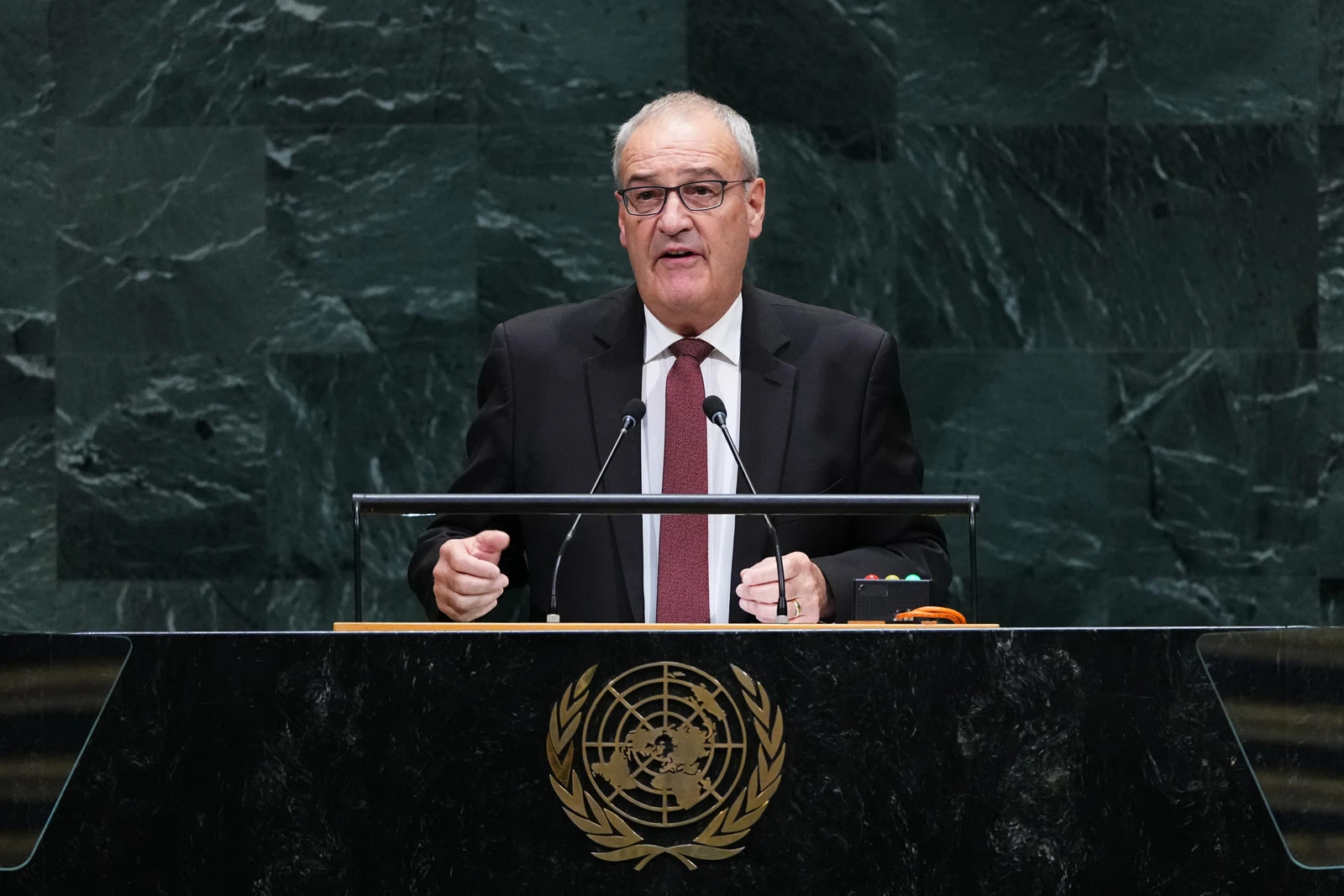
France’s President Emmanuel Macron, next to Saudi Foreign Minister Prince Faisal bin Farhan, speaks during a ministerial meeting on the implementation of the Middle East peace plan. (REUTERS)
Short Url
Updated 09 October 2025
Follow

Macron warns Israeli settlements threaten Palestinian state

Macron warns Israeli settlements threaten Palestinian state
  • Macron hailed ceasefire deal in Gaza as “great hope” for the region
  • He said Israeli settlement “fuels tensions, violence, and instability”

PARIS: French President Emmanuel Macron warned Thursday that expanding Israeli settlements threatened a Palestinian state and US-led peace efforts, as France hosted Arab and European ministers to find ways to boost the Palestinians after a Gaza ceasefire deal was announced.

Macron hailed the ceasefire deal as a “great hope” for the region, but said the “acceleration” of settlement construction in the occupied West Bank was an “existential threat” to a Palestinian state.

It was “not only unacceptable and contrary to international law” but “fuels tensions, violence, and instability,” he said in opening remarks to the meeting in Paris.

“It fundamentally contradicts the American plan and our collective ambition for a peaceful region.”

Israel and Hamas earlier agreed a Gaza ceasefire deal to free the remaining living Israeli hostages held by the Palestinian militant group.

It is being seen as a major step toward ending a war that has killed tens of thousands of people and unleashed a humanitarian catastrophe.

The deal brokered through indirect talks in the Egyptian resort of Sharm el-Sheikh came two years after the October 7, 2023 attack by Hamas on Israel, which triggered a relentless retaliatory assault on Hamas-ruled Gaza.

While Europe has strongly supported the ceasefire efforts led by US President Donald Trump, Washington and several European countries are at odds over whether it is the right moment to recognize a Palestinian state.

Macron, in a September 22 speech at the United Nations, recognized a Palestinian state on the heels of similar announcements by Canada, Portugal and the United Kingdom.

The Paris meeting brought together the top diplomats of five key Arab states — Egypt, Jordan, Saudi Arabia, Qatar and the United Arab Emirates — with European counterparts from France, Italy, Germany, Spain and the United Kingdom.

Turkiye and the European Union were also represented.

‘Unnecessary and harmful’

“A ceasefire is not yet a lasting peace,” said French Foreign Minister, Jean-Noel Barrot. “It is the first step on a long road to a political solution that will guarantee Israel’s security while recognizing the legitimate rights of the Palestinians to a state.”

France is hoping that backing up its recognition of a Palestinian state by discussing what happens the “day after” the war ends can boost the prospects of a two-state solution, which Paris still regards as the sole chance for long-term regional peace.

The ministers discussed participating in the International Stabilization Force evoked by Trump as part of his peace plan and support for the Palestinian Authority which runs the occupied West Bank.

Before the ceasefire deal was announced, the Paris meeting had angered Israel, further straining French-Israeli relations in the wake of Macron’s recognition of a Palestinian state.

Israeli Foreign Minister Gideon Saar had in a message on X denounced the “unnecessary and harmful” meeting “concocted behind Israel’s back” at the sensitive moment of the negotiations in Sharm el-Sheikh.

Former UK minister in U-turn over Israel’s killing of Palestinian nurse

Former UK minister in U-turn over Israel’s killing of Palestinian nurse
Updated 5 sec ago
Follow

Former UK minister in U-turn over Israel’s killing of Palestinian nurse

Former UK minister in U-turn over Israel’s killing of Palestinian nurse
  • Alistair Burt says govt was wrong to trust Israeli probe over 2018 killing of Razan Al-Najjar
  • Popular 20-year-old nurse was shot dead amid protests on the Gaza border, prompting global outrage

LONDON: A former Conservative minister in the UK has admitted a change of heart over the killing of a prominent young Palestinian nurse and accused the Israeli government of murdering her, The Independent reported.

The government of Prime Minister Benjamin Netanyahu was also accused by Alistair Burt of carrying out fake inquiries into the death of Razan Al-Najjar in 2018.

The young nurse, who was killed aged 20, was popularly dubbed the “Angel of Mercy.”

She was shot dead by Israeli forces while coming to the aid of a wounded demonstrator on Gaza’s border with Israel in 2018, prompting international condemnation.

Burt, who at the time served as Middle East minister in the Conservative government led by Theresa May, said the UK was wrong not to “call out” Israel after Al-Najjar’s killing.

After the killing, Burt refused to criticize Israel and urged the Israel Defense Forces to investigate the death.

Yet a UN probe found “reasonable grounds” to believe that Al-Najjar had been deliberately targeted by Israeli security forces responding to the demonstrations, despite posing no threat.

The UK minister had also blamed Palestinians for the violence and argued that “extremist elements exploited the protests for their own violent purposes.”

However, Burt now regrets his “grim” reaction to the killing, and says he is now certain Al-Najjar was “clearly targeted and murdered” by Israel.

The UK had been wrong to trust Israeli government denials and promises to investigate the killing, he added, describing the internal probes as bogus.

“I know exactly what I did. I know why I did it. And it’s grim. I have thought about this a lot. The strongest memory I have was the shooting of the young paramedic Razan Al-Najjar. She was clearly targeted and murdered by the Israelis,” he said.

“We relied on the Israeli response that they know all about every shot that was fired by the IDF. My suspicion then — since confirmed — is that these investigations were effectively useless and used as a cover by the Israelis for the killing and covering up such as this.

“I and the UK should have been more bold in calling this out.”

The former minister’s U-turn is described in a new book on Britain’s ties to the war in Gaza, “Complicit, Britain’s Role In The Destruction of Gaza,” by journalist Peter Oborne.

Burt’s change of heart is emblematic of a wider shift in Western attitudes toward Israel in the wake of the Gaza war.

The IDF cleared itself of wrongdoing after Al-Najjar’s death, but was accused of conducting a smear campaign against the young nurse after releasing a film in which she appeared to describe herself as a “human shield.”

But it later emerged that the video had been manipulated, and the nurse had instead called herself a “human shield to save the injured.”

Before her death, Al-Najjar had become an icon among Palestinians in the occupied territories and beyond. Thousands of Gazans attended her funeral.