
Protesters persist in demanding Microsoft cut all ties to Israel, despite Azure military restrictions

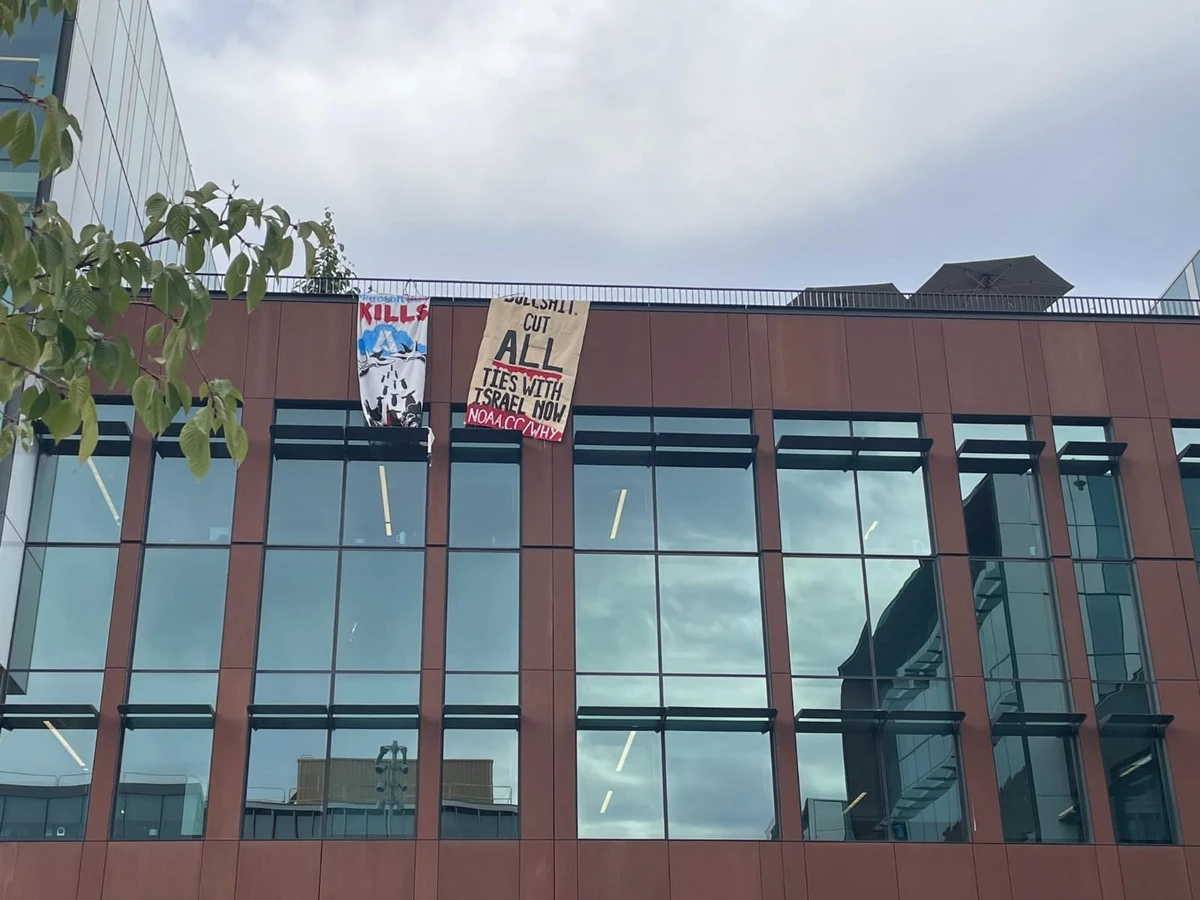
On Thursday, protesters unfurled banners at Microsoft’s headquarters in Redmond, Washington, one reading “MICROSOFT BUILD KILLS,” adorned with images of warplanes and missiles dropping from the Azure cloud logo. (Supplied)
Short Url
Updated 11 October 2025
Follow

Protesters persist in demanding Microsoft cut all ties to Israel, despite Azure military restrictions

Protesters persist in demanding Microsoft cut all ties to Israel, despite Azure military restrictions
  • Protesters displayed banners at company HQ, accusing tech giant of ‘insufficient half-measures’ 
  • Microsoft halted access to some Azure cloud and AI services for a key Israeli military unit after expose revealed its technology was used in surveillance system collecting data on Palestinians

LONDON: Microsoft workers and activists are continuing to demand that the tech giant cut all ties with Israel, even after the company halted access to some Azure cloud and artificial intelligence services for a key Israeli military unit.

On Thursday, protesters unfurled banners at Microsoft’s headquarters in Redmond, Washington, one reading “MICROSOFT BUILD KILLS,” adorned with images of warplanes and missiles dropping from the Azure cloud logo.

The demonstration followed news that Microsoft had ended Israeli military Unit 8200’s access to certain Azure services, after reports that its technology was used in a surveillance system collecting millions of Palestinian phone calls in Gaza and the West Bank.

The campaign, led by current and former Microsoft employees under the banner “No Azure for Apartheid,” says these steps do not go far enough.

“Even after announcing the Unit 8200 cut, why does Microsoft continue to shut down the conversation? It’s the only way they can continue to get away with their half-measure,” said Scott Suftin-Glowski, a former Microsoft worker who resigned in protest, accusing the company of “continued complicity in genocide.”

Suftin-Glowski and fellow demonstrators gathered at what they dubbed the “Martyred Palestinian Children’s Plaza” outside the East Campus, distributing flyers demanding that Microsoft end all contracts with Israeli authorities, conduct a transparent, independent audit of its technology and investments, and ensure protections for Palestinian, Arab, and Muslim employees.

The group also called for transparency about Microsoft’s Israeli business ties, a full investigation of contracts in line with the Geneva Conventions, and support for Amazon workers opposing the transfer of surveillance data from Azure to Amazon Web Services.

Recent reports, including an expose in The Guardian, revealed Microsoft data centers hosted vast troves of phone call recordings swept up by Israeli military surveillance.

Microsoft responded by severing a limited set of services for the unit in question, but, under pressure from campaigners, has not ended all business with Israel’s government or military.

“No Azure for Apartheid” called Microsoft’s partial step “an unprecedented win” achieved through sustained pressure but said it remains “insufficient,” demanding a full termination of all Azure contracts with the Israeli government and military.

The protests are unfolding as a Gaza ceasefire negotiated by Hamas and Israel, with US President Donald Trump’s administration brokering the deal, goes into effect after two years of war.

Despite the breakthrough and expected release of hostages and prisoners, observers stress that major risks and unresolved issues remain.


White House restricts reporters’ access to part of press office

White House restricts reporters’ access to part of press office
Updated 01 November 2025
Follow

White House restricts reporters’ access to part of press office

White House restricts reporters’ access to part of press office
  • Journalists are now barred if they do not have prior approval to access the area known as Upper Press, near the president's office
  • he policy comes amid wider restrictions on journalists by the Trump administration, including new rules at the Pentagon 

WEST PALM BEACH: US President Donald Trump’s administration on Friday barred reporters from accessing part of the White House press office without an appointment, citing the need to protect “sensitive material.”
Journalists are now barred if they do not have prior approval to access the area known as Upper Press — which is where Press Secretary Karoline Leavitt’s office is located and is near the Oval Office.
Reporters have until now been able to freely visit the area, often wandering up to try to speak to Leavitt or senior press officers to seek information or confirm stories.
Media are still allowed to access the area known as “Lower Press,” next to the famed White House briefing room, where more junior press officers have their desks, the memo said.
The policy comes amid wider restrictions on journalists by the Trump administration, including new rules at the Pentagon that major outlets including AFP refused to sign earlier this month.
The change at the White House was announced by the National Security Council in a memorandum titled “protecting sensitive material from unauthorized disclosure in Upper Press.”
“This memorandum directs the prohibition of press passholders from accessing... ‘Upper Press,’ which is situated adjacent to the Oval Office, without an appointment,” said the memo, addressed to Leavitt and White house Communications Director Steven Cheung.
“This policy will ensure adherence to best practices pertaining to access to sensitive material.”
It said the change was necessary because White House press officers were now routinely dealing with sensitive materials following “recent structural changes to the National Security Council.”
Trump has gutted the once powerful NSC, putting it under the control of Secretary of State Marco Rubio, after former National Security Adviser Mike Waltz was reassigned in May following a scandal over the use of the Signal app to plan strikes on Yemen.
Trump’s administration has made a major shake-up to access rules for journalists since his return to power in January.
Many mainstream outlets have seen their access to areas like the Oval Office and Air Force One reduced, while right-wing, Trump-friendly outlets have been given more prominence.
The White House also banned the Associated Press news agency from key areas where Trump speaks after it refused to recognize his order changing the name of the Gulf of Mexico to the Gulf of America.