Hamas kills 32 ‘gang’ members in Gaza City/node/2618770/middle-east
Hamas kills 32 ‘gang’ members in Gaza City
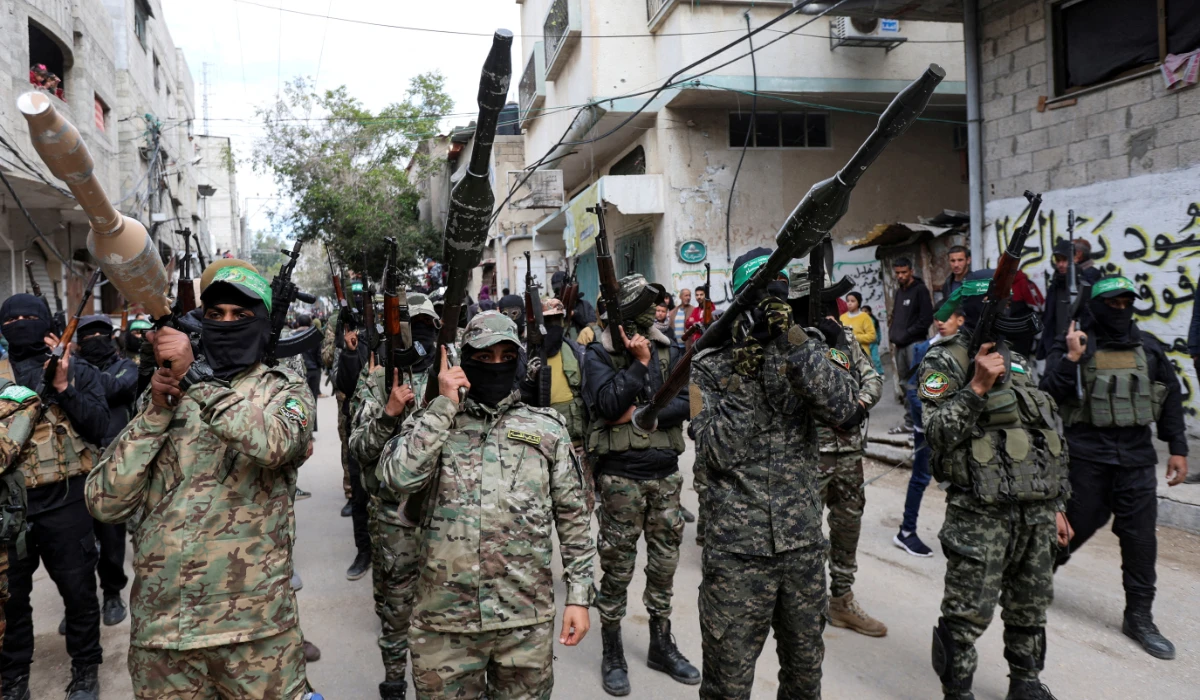
Hamas militants carry grenade launchers at the funeral of Marwan Issa, a senior Hamas deputy military commander who was killed in an Israeli airstrike during the conflict between Israel and Hamas, amid a ceasefire between Israel and Hamas, in the central Gaza Strip, February 7, 2025. (REUTERS)
On Monday, Hamas deployed members of its Qassam Brigades military wing as it freed the last living hostages seized two years ago
Updated 13 October 2025
Reuters
GAZA CITY: Hamas has sought to reassert itself in Gaza since a ceasefire took hold, killing dozens of people in a crackdown on groups that have tested its grip and appearing to get a US nod to police the shattered enclave temporarily.
Pummelled by Israel during the war ignited by the Oct. 7, 2023, attacks, Hamas has gradually sent its men back into the streets of Gaza since the ceasefire began on Friday, moving cautiously in case it suddenly collapses, according to two security sources in the territory.
On Monday, Hamas deployed members of its Qassam Brigades military wing as it freed the last living hostages seized two years ago. It was a reminder of one of the significant challenges facing US President Donald Trump’s effort to secure a lasting deal for Gaza, as the US, Israel, and many other nations demand that Hamas disarm.
Reuters footage showed dozens of Hamas fighters lined up at a hospital in southern Gaza, one wearing a shoulder patch identifying him as a member of the elite “Shadow Unit” that Hamas sources say was tasked with guarding hostages.
Trump’s plan foresees Hamas out of power in a demilitarized Gaza run by a Palestinian committee under international supervision.
It calls for deploying an international stabilization mission to train and support a Palestinian police force.
But Trump, speaking on his way to the Middle East, suggested Hamas had been given a temporary green light to police Gaza.
“They do want to stop the problems, and they’ve been open about it, and we gave them approval for a period of time,” he said, responding to a journalist’s question about reports that Hamas was shooting rivals and instituting itself as a police force.
After the ceasefire took effect, Ismail Al-Thawabta, head of Hamas’ Gaza government media office, said the group would not allow a security vacuum and that it would maintain public safety and property.
Hamas has ruled out any discussion of its arsenal, saying it would be ready to surrender its arms to a future Palestinian state. The group has said it seeks no role in Gaza’s future governing body, but that Palestinians should agree upon this with no foreign control.
As the war dragged on, a diminished Hamas faced growing internal challenges to its control of Gaza from groups with which it has long been at odds, often affiliated with clans.
Israeli Prime Minister Benjamin Netanyahu said earlier this year that Israel had been arming clans that oppose Hamas, without identifying them.
One of the Gaza sources, a security official, said that since the ceasefire, Hamas forces had killed 32 members of “a gang affiliated with a family in Gaza City,” while six of its personnel had also been killed.
The Gaza City clashes mostly pitted Hamas against members of the Doghmosh clan, residents and Hamas sources said.
The security official did not identify the group, nor say whether it was one of those suspected of receiving support from Israel.
The most prominent anti-Hamas clan leader is Yasser Abu Shabab, who is based in the Rafah area — an area from which Israel has yet to withdraw.
Offering attractive salaries, his group has recruited hundreds of fighters, a source close to Abu Shabab said earlier this year. Hamas calls him a collaborator with Israel, which he denies.
The Gaza security official said that, separate from the clashes in Gaza City, Hamas security forces had killed Abu Shabab’s “right-hand man” and efforts were underway to kill Abu Shabab himself.
Abu Shabab did not immediately respond to questions on the official’s comments.
Hussam Al-Astal, another anti-Hamas figure based in Khan Younis in areas controlled by Israel, taunted the group in a video message on Sunday, saying that once it hands over the hostages, its role and rule in Gaza would be over.
Palestinian analyst Reham Owda said Hamas’s actions were aimed at deterring groups that had collaborated with Israel and contributed to insecurity during the war. Hamas also aimed to show that its security officers should be part of a new government, though this would be rejected by Israel, she said.
After brutal torture and 2.5 years of captivity, Israeli-Russian researcher is grateful to survive
Updated 4 sec ago
Tsurkov said she knew the risks but thought she took sufficient precautions, entering on her Russian passport and avoiding contact with militias “They electrocuted me. They constantly touched me inappropriately. They forced me into positions that were very painful to me because of my herniated” discs
TEL AVIV: Ta’aliq — “to hang” in Arabic — is Iraqi slang for a torture technique that hoists victims into the air, their hands handcuffed above their heads. The akrab, or “scorpion,” is the more painful version, in which the victims’ hands are handcuffed together behind their back before they’re hoisted. Elizabeth Tsurkov experienced both, and other excruciating torture, during 2 1/2 years held captive in Iraq by an Iranian-backed militia. The 38-year-old Israeli-Russian doctoral student at Princeton, who speaks fluent Arabic and has researched the Middle East for over a decade, was studying social political movements in Iraq in March 2023 when she was forced into an SUV, blindfolded, sexually assaulted and beaten, then taken to a torture facility on the outskirts of Baghdad. Her release in September was announced by President Donald Trump. Now she is recovering in Israel as Iraqis head to the polls Tuesday for a parliamentary election that includes candidates linked to the militia Tsurkov says kidnapped her, Kataib Hezbollah. A $600 million ransom demanded Israelis are prohibited by law from traveling to Iraq, which Israel classifies as an “enemy country.” In an interview with The Associated Press, Tsurkov said she knew the risks but thought she took sufficient precautions, entering on her Russian passport and avoiding contact with militias. She hadn’t counted on Kataib Hezbollah’s deep penetration of activist circles in Baghdad. She said her captors didn’t know she was Israeli at first and believes they kidnapped her to try to get a large ransom for a foreigner. While Kataib Hezbollah has never publicly claimed her kidnapping, it has released social media statements that include fake information she gave during torture, a sign of its involvement. The group, an ally of Hezbollah in Lebanon, is part of a coalition of Iranian-backed militias that are officially part of Iraq’s armed forces but often act on their own. The US has listed Kataib Hezbollah as a terrorist organization since 2009. A month into Tsurkov’s captivity, her captors found Hebrew messages and other evidence she was Israeli on her phone. That’s when the torture began, she said, as they accused her of being a spy. Their starting ransom demand was $600 million, she was told by Israeli officials. “The torture was incredibly brutal,” said Tsurkov, now recovering at a friend’s home near Tel Aviv. “They electrocuted me. They constantly touched me inappropriately. They forced me into positions that were very painful to me because of my herniated” discs, she said, adding she had back surgery just eight days before the kidnapping. The AP generally does not identify victims of sexual abuse except in cases where they publicly identify themselves or share their stories openly. Tsurkov’s captors used a plastic whip, especially on her feet, because feet heal slowly. They threatened to kill her with a gun stamped property of the Iraqi security services. She would pray to pass out to end the torture sessions. She said she made up false confessions to appease the torturers, careful to avoid implicating Iraqi acquaintances. After 4 1/2 months, Tsurkov was moved to what she believes is a Kataib Hezbollah base on the border with Iran, where the torture stopped. She was allowed sufficient food and water, and eventually a TV, while kept in solitary confinement in a windowless cell. Hopes for release plummeted after the Oct. 7, 2023, Hamas-led attack on southern Israel, when Tsurkov became just one of over 250 hostages of concern to Israel. Shedding light on militias The torture has left Tsurkov with likely permanent nerve damage. Between doctor’s appointments and physical therapy, she mostly reclines on a couch, shifting positions to try to find relief. The details of the torture facility are impossible to forget, she said: Splashes of blood on the walls, desperate scrawls of people held in the cell before her. It’s uncomfortable to share them publicly. “Any human being doesn’t want the details about their worst experiences in their life to be known,” Tsurkov said. Still, she knows that as a Westerner she is in a unique position to shed light on Iraqi militias. Few people survive Iraq’s torture facilities, and the Iraqis who do are terrified speaking out could endanger them or their families. Iraqi militias are not as familiar globally because they are mostly active inside Iraq. Iraqi militias targeted US forces in the region after the Oct. 7 attack because of Washington’s support for Israel, but that largely stopped after a US retaliatory attack killed a high-ranking Kataib Hezbollah commander. “Their focus is overwhelmingly just oppressing their own people,” Tsurkov said. She knew the militia was well-funded, she said, because of the plush leather and new-car smell of the luxury vehicles that transported her blindfolded. Suffering a third generation incarceration Tsurkov, who was born in Russia, moved to Israel around age 4. Before that her parents were imprisoned in Russia for opposing the communist government. Her mother was incarcerated for three years, her father for seven, plus two years of hard labor in Siberia. For a few months, Tsurkov’s father was held in a cell with former Soviet dissident Natan Sharansky, who later became an Israeli cabinet minister. Her grandfather was imprisoned under Stalin. Tsurkov’s family fought for her release, launching a campaign focused mostly on the US Her sister, Emma Tsurkov, is married to a US citizen. Israel also invested “great efforts and many resources” to help secure Tsurkov’s release, said an Israeli official who was not authorized to speak to the media and spoke on condition of anonymity. The Russian Foreign Ministry didn’t respond to an AP request for comment. US exerts pressure As far as she knows, Tsurkov was not exchanged for any prisoners. Her release followed significant pressure from Adam Boehler, the Trump administration’s special envoy for hostage affairs who held multiple meetings and regularly took to social media to demand Tsurkov’s freedom. White House spokeswoman Anna Kelly said that with Tsurkov’s Princeton enrollment and other ties to the US, Trump “was willing to leverage our country’s strength and his negotiating skills to intervene.” Tsurkov also credits the involvement of an Iraqi-American businessman and Trump donor Mark Savaya. As she was recuperating in Israel, Tsurkov said Savaya told her he had warned Iraqi Prime Minister Mohammed Shia Al-Sudani during a meeting to release her or the Trump administration would attack Kataib Hezbollah. Savaya was later named the US special envoy for Iraq. Tsurkov’s release came after Israel decimated many of Iran’s proxies and hit Iran hard during a devastating 12-day war, a campaign so intense that Tsurkov said she felt the building shake where she was held over the border in Iraq. The Iraqi government and Kataib Hezbollah did not respond to AP requests for comment. But militia security chief Abu Ali Al-Askari wrote on Telegram that the Iraqi government demanded Tsurkov’s release to avoid a possible strike against Iraq. A Shiite political official, who spoke on condition of anonymity because they were not authorized to speak to the media, confirmed militia leaders worried they would be targeted by the US About a week after Tsurkov believes Savaya met with Al-Sudani, she was brought to Baghdad and handed over to an Iraqi security official in a nondescript garage. At the US Embassy, she had an ecstatic video chat with her family before returning to Israel. Rebuilding a life Before her kidnapping, Tsurkov was frequently quoted in Israeli media for her expertise on the Syrian civil war. She traveled twice to Syria and has tattoos supporting the Syrian uprising, which she said angered her torturers. She has been vocal in her criticism of the Israeli government and supportive of Palestinians, prompting online vitriol since her release. Now she is rebuilding her life. She plans to finish her doctorate at Princeton. She is overjoyed to experience small things like seeing the sea or feeling the sun warm her skin. Once she has healed enough, she hopes to return to research, especially field work highlighting marginalized groups. “It often feels like a nightmare that I woke up from,” she said. “It feels so surreal to have undergone, and overcome, such brutality.”