Israel releases 14 journalists from Freedom Flotilla vessel

Israel releases 14 journalists from Freedom Flotilla vessel
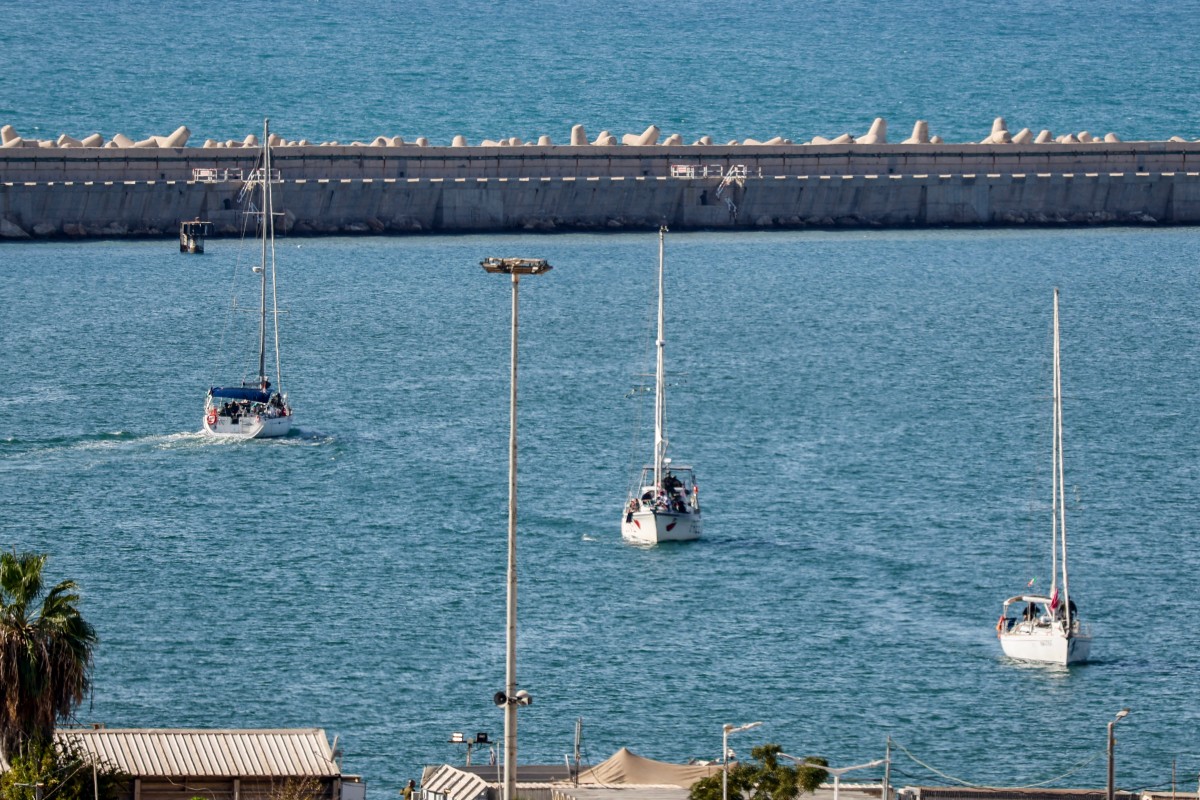
Israel has released 14 journalists and several others after illegally detaining them on Oct. 8. (AFP)
Short Url
Updated 14 October 2025
Follow

Israel releases 14 journalists from Freedom Flotilla vessel

Israel releases 14 journalists from Freedom Flotilla vessel
  • Israeli authorities brutalized them, say reporters illegally held
  • Committee to Protect Journalists slams Tel Aviv’s media ban

DUBAI: Israel has released 14 journalists and several others after illegally detaining them on Oct. 8 aboard a vessel, Wijdan (Conscience), one of several aid convoys of the Freedom Flotilla Coalition, a movement aimed at ending Tel Aviv’s unlawful blockade of Gaza.

The Committee to Protect Journalists’ Middle East and North Africa Regional Director Sara Qudah slammed the regime in a statement on Tuesday.

“Detaining and banning journalists undermines press freedom and obstructs independent reporting at a critical time.

“Journalists must be able to report freely and safely wherever news unfolds, including from conflict and war zones.

“Israeli authorities must allow international journalists immediate access to Gaza now, especially now that a ceasefire is in place.”

Emily Wilder, who was released on Oct. 12, told the CPJ that on the morning of Oct. 8, the Israeli military surrounded and boarded the vessel, and “held us captive for 12 hours on board until we reached the port of Ashdod.”

Wilder said she identified herself as a journalist and was wearing her press card. A soldier took her notebook and although it was returned later, it had “clearly been read,” she added.

Noa Avishag Schnall, reporting for Drop Site News, described the brutality she and others faced during detention by Israeli authorities.

In an Instagram video, she said she was hung by her wrists and ankles with metal shackles and beaten on the stomach, back, face, ear and skull. One of the guards sat on her neck and face, blocking her airways.

She said the men were threatened by guards and attack dogs, and some women were threated by pepper spray and rape.

Another journalist told the CPJ: “They pulled me by my hair across the port to where everybody was forced to kneel for some time. They zip-tied my hands behind my back, and my press card was on me the entire time. Later, they seized it — it was stolen from me.”

Human rights and legal advocacy group Adalah, which is representing the detained journalists and activists, told the CPJ that Israeli authorities “treated the journalists accompanying the flotilla no differently than they treated the activists,” even though the journalists were there to report on the voyage.

Earlier this month, Israel detained more than 400 people, including 32 journalists, who were aboard the Global Sumud Flotilla.

Two of them told Reporters Without Borders they were assaulted.

Jonathan Dagher, head of the RSF’s Middle East Desk, said: “The arrest of the journalists aboard the flotilla was already a blatant violation of the right to reliable information. But the mistreatment — including violence — they were subjected to is unacceptable.”




Israeli prisons treated like another war front after Oct. 7, says freed Palestinian author

Israeli prisons treated like another war front after Oct. 7, says freed Palestinian author
Updated 04 November 2025
Follow

Israeli prisons treated like another war front after Oct. 7, says freed Palestinian author

Israeli prisons treated like another war front after Oct. 7, says freed Palestinian author
  • Brutality rose significantly in last 2 years, says Nasser Abu Srour

DUBAI: Palestinian author Nasser Abu Srour, who was released last month after 32 years in captivity, said torture and brutality inside Israeli prisons had intensified in the past two years, turning detention centers into “another front” of the conflict in Gaza.

Abu Srour was among more than 150 Palestinians serving life sentences who were freed under a US-brokered Gaza ceasefire deal. He was exiled to Egypt, where he was placed in a five-star hotel in Cairo — a jarring contrast, he said, to the conditions he endured during imprisonment.

After Oct. 7, 2023, beatings and deprivation of food and warmth increased in prisons. Even the guards’ uniforms were replaced with ones bearing tags that read “fighters” or “warriors,” he said.

Abu Srour added: “They started acting like they were in a war, and this was another front, and they started beating, torturing, killing like warriors.”

He described how areas without security cameras became “places for brutality,” where guards would tie prisoners’ hands behind their heads, throw them to the ground, and trample on them.

“All cultural life in the prison ended in the last two years,” he said, as all reading and writing materials were confiscated. Daily rations were minimal, and prisoners were only given one set of thin clothes.

He recalled that prisoners were always hungry, and because their bodies were weak they “couldn’t handle even a medium temperature.”

He added: “Whenever someone was leaving prison, everyone would try to become their friends so they would get their T-shirt or underwear, or anything.”

Abu Srour took part in the First Intifada, the Palestinian uprising between 1987 and 1993, when he was charged as an accomplice in the death of an Israeli Shin Bet security officer.

He was sentenced to life in prison without parole in 1993, based on a confession extracted under torture.

In his more than three decades behind bars, Abu Srour completed a bachelor’s and a master’s degree in political science and turned to writing. He began composing poetry and other works that were smuggled out of prison.

His memoir “The Tale of a Wall: Reflections on Hope and Freedom,” dictated to a relative through phone calls over two years, has been translated into seven languages and is a finalist for the Arab Literature Prize.

After years of torture and unheeded appeals, Abu Srour struggled to believe until the final moment that his name was on the list of prisoners to be released after the Oct. 10 ceasefire.

He said: “They were calling out cell numbers, and I was sitting on my bed in room number six feeling like I am not part of it.

“There were so many times when I should have been part of it over all those years. But the whole thing is so huge and so painful, I didn’t want to interact. It was a defense mechanism.”

The 24 hours before his release were particularly painful, as prisoners were subjected to an intense final round of beatings.

During the 48-hour transfer that followed, prisoners were not allowed to open the curtains on the buses until they reached Egypt.

It was only then that Abu Srour saw the sky for the first time outside prison walls.