Madagascar’s military coup leader says he is ‘taking the position of president’

Update Madagascar’s military coup leader says he is ‘taking the position of president’
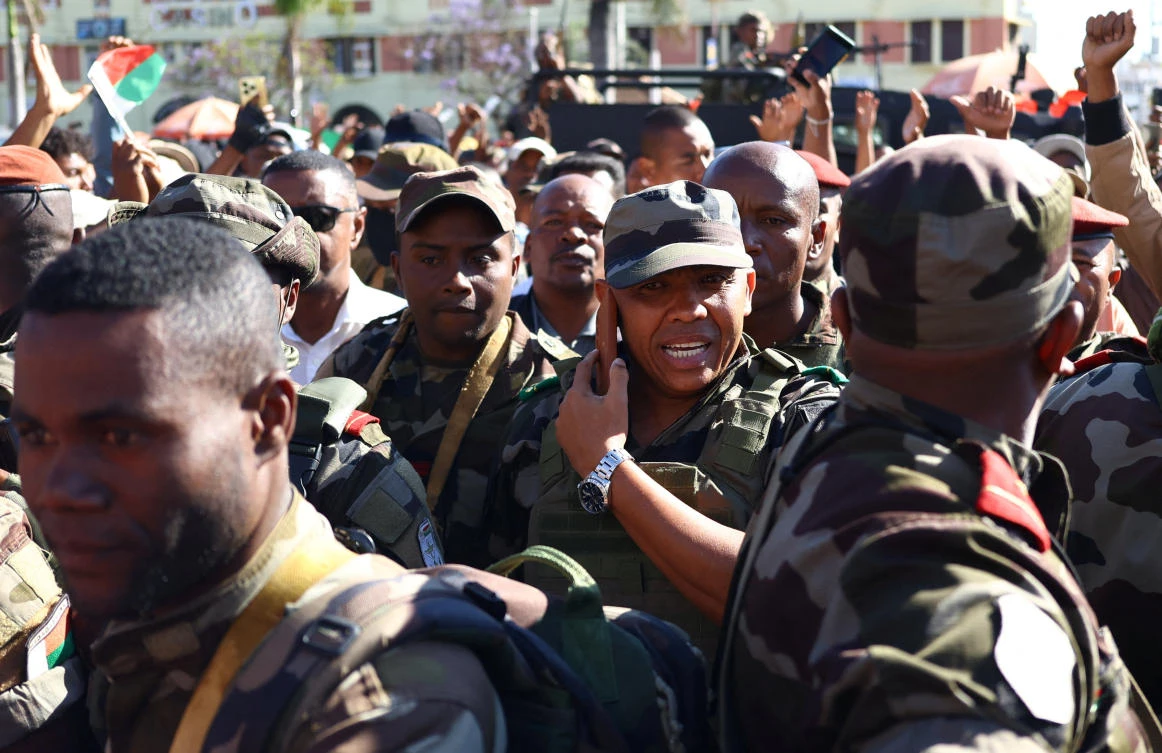
Col. Michael Randrianirina, head of the elite Madagascar military unit, center, arrives with military personnel to join protesters gathered in Antananarivo on Oct. 14, 2025. (Reuters)
Short Url
Updated 15 October 2025
Follow

Madagascar’s military coup leader says he is ‘taking the position of president’

Madagascar’s military coup leader says he is ‘taking the position of president’
  • Col. Michael Randrianirina expects to be sworn in as the Indian Ocean country’s new leader in the next few days
  • He said he is taking the role as head of state after the country’s High Constitutional Court invited him to do so

ANTANANARIVO: Madagascar’s military coup leader said Wednesday that he is “taking the position of president” in an interview at his barracks.

Col. Michael Randrianirina, who led a rebellion by soldiers that ousted President Andry Rajoelina, said he expects to be sworn in as the Indian Ocean country’s new leader in the next few days.

Randrianirina announced Tuesday that the armed forces were taking power in Madagascar, capping weeks of protests against Rajoelina and his government by mainly youth groups.

He said he is taking the role as head of state after the country’s High Constitutional Court invited him to do so in the absence of Rajoelina, who fled Madagascar following the uprising.

“There must be an oath-taking” to make his position official, Randrianirina said.

The protests reached a turning point on Saturday when Randrianirina and soldiers from his elite CAPSAT military unit rebelled against Rajoelina and joined demonstrations calling for the president to step down, forcing Rajoelina to flee.

“We had to take responsibility yesterday because there is nothing left in the country, no president, no president in the senate, no government,” Randrianirina said.

Rajoelina, who has been president since 2018, said he had fled to a safe place in fear for his life after the rebellion by Randrianirina’s soldiers. He has rejected the military takeover as an illegal coup attempt by a rebel faction.

Randrianirina said the new military leadership would quickly appoint a new prime minister who would form a government, but didn’t give an exact time frame for that to happen.

“What I can say is that we are already accelerating it so that the crisis in the country does not last forever,” the colonel said.

Madagascans have seen their country roiled by several coups and attempted coups since gaining independence from France in 1960. The Indian Ocean island has also struggled with high levels of poverty ever since.

A 2009 military-led coup brought Rajoelina to power as a transitional leader, when the president had cast himself as a champion of the youth.

There was no significant immediate reaction to the takeover by the international community or the African Union, which had called an emergency meeting for its security council on Tuesday.

Some analysts have described the weekslong youth uprising in Madagascar as an expression of grievances over government failures and condemned the military takeover.

“Gen-Zers in Madagascar have been on the streets of the country protesting the lack of essential services, especially water and electricity, and the negative impact on their lives for almost a month,” said Olufemi Taiwo, professor of Africana studies at Cornell University. “This is a civil society uprising and its resolution should not involve the military.”

He called for the African Union to condemn another coup that Africa “does not need,” adding that no country should recognize the new military leadership.


World leaders to rally climate fight ahead of Amazon summit

World leaders to rally climate fight ahead of Amazon summit
Updated 5 sec ago
Follow

World leaders to rally climate fight ahead of Amazon summit

World leaders to rally climate fight ahead of Amazon summit
  • About 50 heads of state are expected in the rainforest city of Belem for a summit ahead of next week's COP30 climate negotiations
  • Almost every nation is participating, but the US is sending nobody, with President Donald Trump having branded climate science a “con job”

BELÉM, Brazil: World leaders meet Thursday in the Brazilian Amazon in an effort to show that climate change remains a top global priority despite broken promises and the United States shunning the gathering.
About 50 heads of state and government are expected in the rainforest city of Belem for a summit on Thursday and Friday ahead of the annual UN Conference of Parties (COP) climate negotiations that open next week.
Almost every nation is participating, but Washington is sending nobody, with President Donald Trump having branded climate science a “con job.”
UK Prime Minister Keir Starmer and French President Emmanuel Macron are expected in Belem but other major economies, including China and India, are sending deputies or climate ministers.
The choice of Belem, a city of 1.4 million people, half of whom live in working-class neighborhoods known as favelas, has been controversial due to its limited infrastructure, with sky-high hotel fees complicating the participation of small delegations and NGOs.
Authorities have invested in new buildings and renovations, but with fewer than 24 hours to go to the leaders’ summit opening, media teams and delegation scouts arrived at the COP venue Wednesday to find building works still very much underway.
Nonetheless, Karol Farias, 34, a makeup artist who came to shop at the newly spruced up Ver-o-Peso market told AFP: “The COP is bringing Belem the recognition it deserves.”

Uphill battle 

Brazil is not seeking to land a big deal at COP30, but rather to send a clear signal in an uncertain time that nations still back the climate fight.
The US absence will linger awkwardly during the summit, as will Brazil’s recent approval of oil drilling near the mouth of the Amazon River.
So, too, will the unanswered call for a wave of ambitious new climate pledges ahead of COP30, and the stark acknowledgement from UN chief Antonio Guterres that the target of limiting global warming to 1.5 degrees Celsius from pre-Industrial levels will be missed.
Host Brazil is also still scrambling to find affordable rooms in Belem for cash-strapped countries.

Brazil's President Luiz Inacio Lula da Silva gestures next to James Marape, prime minister of Papua New Guinea, ahead of the COP 30, in Belem, Brazil, on November 5, 2025. (REUTERS)

The COP30 presidency on Tuesday said it had secured outside funding to provide three free cabins aboard cruise ships for delegations from low-income countries.
Brazil has acknowledged the uphill battle it faces rallying climate action at a time of wars and tariff disputes, tight budgets, and a populist backlash against green policies.
In a sobering reminder of the task at hand, a closely watched vote last month to reduce pollution from global shipping was rejected under intense pressure from the United States.
Leaders gathered in Belem “need to deliver a clear mandate to the COP to be ambitious and to close the gap and to address the issues that are burning,” Greenpeace Brazil executive director Carolina Pasquali told AFP from aboard the organization’s Rainbow Warrior flagship, docked at the city’s port.

 ‘Enough talk’ 

Rather than producing a slew of new commitments, Brazil has cast the summit as an opportunity for accountability.
“Enough talking, now we have to implement what we’ve already discussed,” Brazil’s President Luiz Inacio Lula da Silva said this week.
Brazil is putting diplomatic muscle into pitching a global fund that would reward tropical countries for protecting rainforests.
It has also put a particular emphasis on adaptation, a key demand of countries pushing for more help to build defenses against rising seas and climate disasters.
“This is not a charity, but a necessity,” Evans Njewa, a Malawian diplomat and chair of the Least Developed Countries bloc, told AFP.
These countries want concrete detail on how climate finance can be substantially boosted to $1.3 trillion a year by 2035 — the estimated need in the developing world.
The hosts are also under pressure to marshal a response to the collective failure to limit warming to 1.5C as agreed in the landmark Paris accord a decade ago.
Even if all commitments are enacted in full, global warming is still set to reach 2.5C by century’s end.
“For many of our countries, we won’t be able to adapt our way out of something that overshoots over two degrees,” Ilana Seid, a diplomat from Palau and chair of the Alliance of Small Island States, told AFP in October.
They, among others, want to tackle fossil fuels and push for deeper cuts to greenhouse gas emissions.
Lula said Brazil wants to “propose a roadmap for reducing fossil fuels” but conceded it was a difficult conversation.